Explorer Ford Electric Cars ECO Tests SUV
I have tried the new Explorer and this is what I like most and least about the electric SUV from Ford
 Antonio Roncero @roncero_antonio
8 October 2024
8 min.
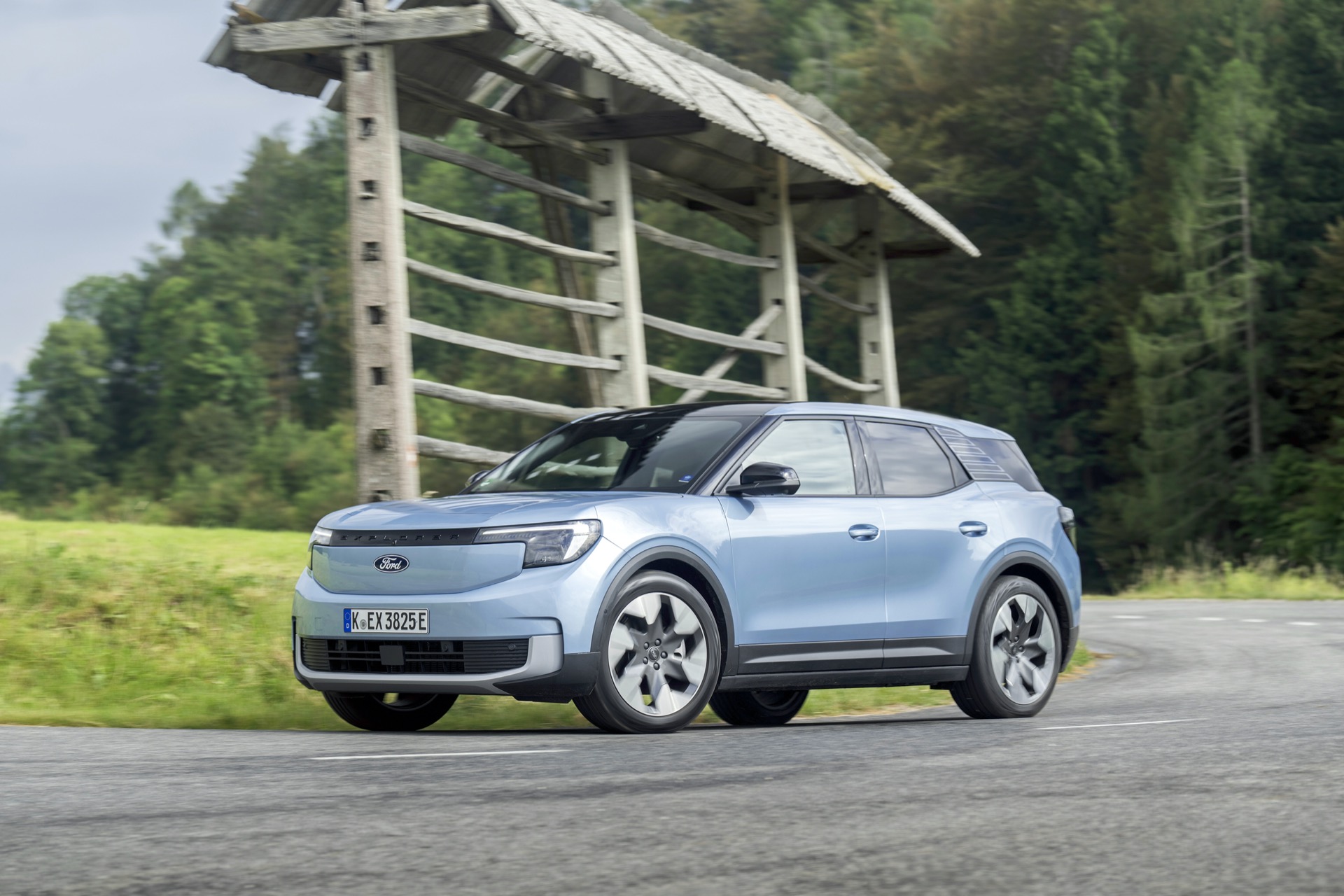
No, I have not completed a 30,000 km trip around the world with the Ford Explorer like Lexie Alford. I haven’t even tested it thoroughly, something I already have a date noted in the calendar for. But a good number of kilometres on motorways and roads of all kinds during the press presentation day has allowed me to get acquainted with the car and note down in my notebook what I like most… and least about the new Ford Explorer, and I am going to share it with you.
To begin with, one of the things I don’t like, and this happens to me more and more with the new electric cars being presented, is precisely that: that they are only electric and there is no option for other propulsion variants. Sure, electrification is here to stay. But that we are still lagging behind, especially in Spain, is not up for debate, it is a fact.
And I am convinced that the Explorer would sell like hot cakes if it had hybrid versions or, at the very least, petrol engines with partial hybridisation. I, at least, would have it on my radar.
A very eye-catching design…
The design is one of the things that attract me to the Explorer. I think it offers originality and freshness, especially in some colours such as blue or red (the darker ones don’t say much to me), and with an appearance that achieves that sought-after adventurous car effect. The large wheels also contribute greatly to the impression the car gives when you see it from outside. They are 19-inch as standard with the basic trim, and 20-inch with the Premium trim, with tyres of different sizes on the front and rear axles.
There are optional 21-inch wheels which, for 1,200 euros on the basic version and 600 euros on the Premium, are quite a temptation, given how spectacular they look. But I would let it pass; the temptation, I mean. Let me explain. The standard tyres with the 19-inch wheel are in size 235/55 on the front axle and 255/50 on the rear, and I think these are the ones with which the Explorer offers the best balance between agility and comfort. On the Premium versions with 20-inch wheels the width is maintained but the profile drops one size; they are acceptable.
But with the 21-inch wheel the profile drops one more size, to fit 235/45 at the front and 255/40 on the rear axle. And you must really like how they look to give up the comfort that is lost. Believe me, you notice it, especially when the asphalt is not completely smooth.
… and a very practical interior
As for the interior, there are several things that caught my attention, most of them positive, with a few details that I think could be improved. The first is how spacious it is for its compact exterior dimensions, as it measures just 4.47 metres in length. Without being among the best in its class, it is also not lacking in boot capacity, with 470 litres and square, very usable shapes. It has a false floor that comes in very handy, for example, for storing the charging cables, as there is no “frunk” or additional space under the front bonnet.
I also like very much the large amount of space for putting things down and emptying your pockets, with a huge compartment between the seats where you can even fit a laptop and several other things, totalling up to 17 litres of capacity, according to Ford, which announces it will sell accessories to customise the way this space is compartmentalised. There is also additional space under the floating console and an “unexpected” recess behind the multimedia screen – Ford calls it “My Private Locker”, which is revealed by manually adjusting its tilt, and which even has its own closure. Furthermore, it is praiseworthy that a series of shortcuts to some of the main functions are kept always visible below the screen, as well as an additional touch surface underneath it to adjust the radio volume. The fact that the multifunction steering wheel controls are also touch-sensitive no longer pleases me so much…
I also find the huge fixed panoramic sunroof spectacular, available as an option on the Premium versions for 1,250 euros. I am one of those who recommend considering this option depending on where you live and how you are going to use the car. As you know, it costs more to lower the temperature the cabin reaches after parking in the sun, or to keep it at a pleasant level while driving when the outside sun is strong. But the air conditioning works very well and it must be acknowledged that it looks spectacular, and the feeling of driving with so much light is appreciated.
Another detail I find original and very cool is the sound bar integrated into the dashboard. It is standard only on the Premium trim, is signed by B&O and together with the 10 speakers and the subwoofer it sounds wonderful.
Some details to improve
Among what I like least about the Explorer’s interior, I have several points noted. One of them, which happens to almost all new electric cars with a dedicated platform and flat floor, is how high the floor sits relative to the seat base in the rear seats, which makes the passengers’ posture in these seats not so comfortable, with their knees too high relative to their hips.
I also don’t like some things that are “inherited” Volkswagen. Indeed, in case you didn’t know, the Explorer shares the platform used by various VW Group models, among them the ID.4, as well as some controls. One of them is that there are no individual buttons to operate the front and rear windows; you first have to press a specific button to switch between them when using the two single up and down window controls.
The other, which I like even less, is the transmission lever on the console. Not because of where it is located, but because, as there are no paddles to change the level of regenerative braking recovery, the only option is to toggle between “D” and “B” modes of the gearbox by turning the lever, a very forced manoeuvre which ends up making you always drive in “D”.
Finally, I also miss an instrument display with a larger screen – it has only 5.3 inches, when it is now almost standard to find screens twice that size – and with greater customisation options.
Range and prices of the Ford Explorer
I have tested the version with a single rear motor, 286 CV and the extended-range battery, with 77 kWh of capacity, which allows a WLTP range of between 572 and up to 602 km, depending on trim and equipment. Its price with discounts – not counting financing or the MOVES Plan – starts from 46,550 euros with the base trim, and 3,000 euros more if you choose the Premium version.
Ford also offers an Explorer with two motors and all-wheel drive delivering 340 CV. In this case the battery has almost the same capacity, 79 kWh, and the range is between 532 and 566 km. But this version has a “problem”. Or rather, two: it costs a staggering almost 9,000 euros more than the rear-wheel drive… and it is not eligible for the MOVES Plan. With all the discounts and MOVES aid you get a rear-wheel drive Explorer with the large battery from 39,550. That is… 15,000 euros less than the Explorer with two motors! Given how well the 286 CV version performs, I can tell you it is not worth making the leap. And on top of that you lose range.
Ford has just added to the range an entry-level version of the Explorer range with rear-wheel drive, a 170 CV motor and a smaller-capacity battery, 52 kWh. The range in this case is between 357 and 378 km, depending on trim. This allows an Explorer to be offered from 41,800 euros, which drops to 34,800 with the maximum MOVES Plan aid. That is 4,750 euros less than the extended-range version. It is also a big step up, but if you choose an Explorer as your only car and want to use it for travelling too, then the investment pays off, not only for the greater range but also for the performance.
In all cases, and this is another thing I like about the Explorer, the maximum charging power it accepts using fast charging is high, between 135 and 185 kW depending on the version. This allows short stops to recover range in a few minutes, or to go from 10 to 80% charge in around half an hour. The route planner is also a great help when travelling, suggesting where to stop to recharge, and preconditions the battery so that charging is faster. However, in the column of what is less good, I would point out that, for the price of the car, the heat pump should be standard (it costs 1,300 euros).
Ford Explorer – Image gallery

 Kia offers an electric range of 10 models, 50 versions and 400 possible combinations
 The seven finalists for the 2027 European Car of the Year (COTY) are exclusively electric
 Peugeot E-208 GTi: a battery-powered toy that revives the spirit of the 1980s sports cars
Deja un comentario