Jaguar Land Rover raises its commitment to sustainability: its luxury interiors will be made from recycled plastic waste
 Mónica Redondo @MonicaRedondoD
29 September 2020
3 min.
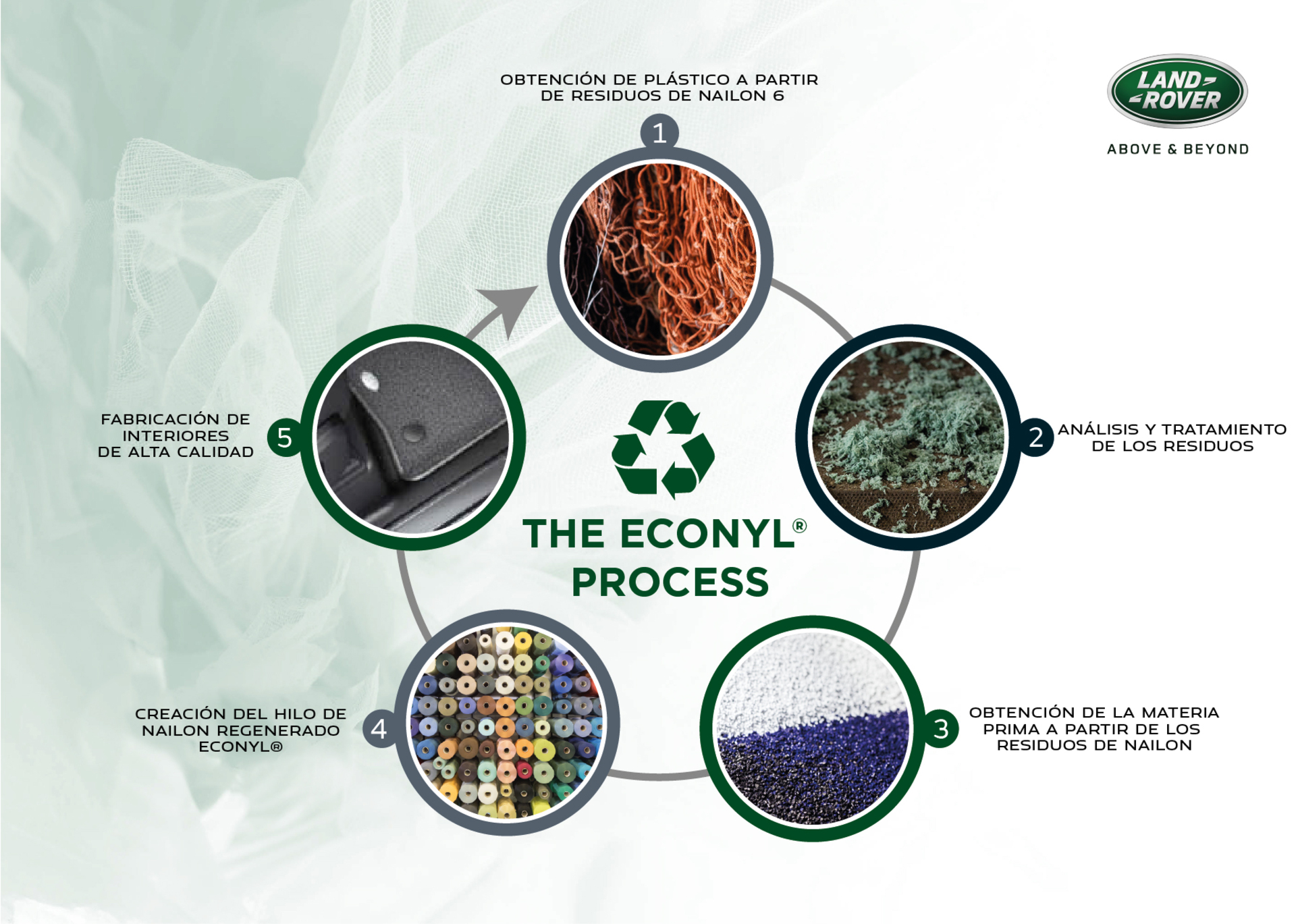
Jaguar Land Rover will produce the luxury interiors of its new models with Econyl, a material created from plastic waste and fishing nets.
Jaguar Land Rover will use plastic waste in the interiors of its next-generation models. The British company aims to introduce into its new models a luxury material made from recycled plastics and fishing nets. In addition, Jaguar Land Rover has committed to using sustainable leather produced from plastic waste in its next-generation vehicles.
Jaguar Land Rover’s future vehicles will feature trims and mats made of Econyl, a regenerated nylon material produced by the Italian synthetic fibre company Aquafil. The material has also been used in the production of clothing, sportswear and watch straps.
Econyl is produced from a combination of recycled industrial plastic, fabric offcuts from clothing companies, and fishing nets recovered from the agricultural industry and abandoned in the ocean. The recovered materials are treated in a chemical plant and broken down into a raw material before being turned into yarn. The waste products from this process, including metal materials and copper sulphate, are sent elsewhere for recycling.
Plastic waste used to create luxury interiors
According to Jaguar Land Rover, the recycling process Aquafil uses in producing the material reduces the nylon’s impact on global warming by 90% compared with material produced from petroleum. That means producing 10,000 tonnes of Econyl saves 70,000 barrels of crude oil and 65,100 tonnes of CO2 equivalent compared with the same amount of non-recycled material.
The introduction of Econyl is part of Jaguar Land Rover’s efforts to offer a range of materials with the “same sense of luxury” as its traditional interiors, but with a reduced environmental impact. Doing so supports the company’s efforts to reduce its carbon emissions to zero. The new Econyl fabric joins other alternative options available in Jaguar Land Rover vehicles. These include a textile made from eucalyptus in the Range Rover Evoque and Kvadrat, a wool/suede fabric partly made from recycled plastic bottles, available in the Evoque, in the Range Rover Sport and in the Jaguar I-Pace.
It is important to highlight that the regenerated nylon polymer has the same chemical and functional characteristics as fossil-based raw material. This type of yarn can be used to manufacture carpets and floor mats.
Adrian Iles, senior engineer on Jaguar Land Rover’s interior systems team, has said that “our designers’ and engineers’ work focuses on developing the new sustainable materials that will form part of future Jaguar and Land Rover models. One of our main objectives is the creation of new sustainable materials using the most innovative and cutting-edge technologies and textiles. The pillars of our Destination Zero strategy are waste and carbon emission reduction and material reuse. This pioneering materials research is key to reaching the goal and is a fundamental part of the design we offer our customers.”


 Peugeot E-208 GTi: a battery-powered toy that revives the spirit of the 1980s sports cars
 New Lexus ES: luxury grows and goes electric
 First contact with the Dacia Sandero Hybrid 155: power and efficiency from €19,890
Deja un comentario