McLaren P1 Range / versions Geneva Motor Show Supercars
McLaren P1, a plug-in hybrid supercar with 916CV
 Chema
20 February 2013
2 min.
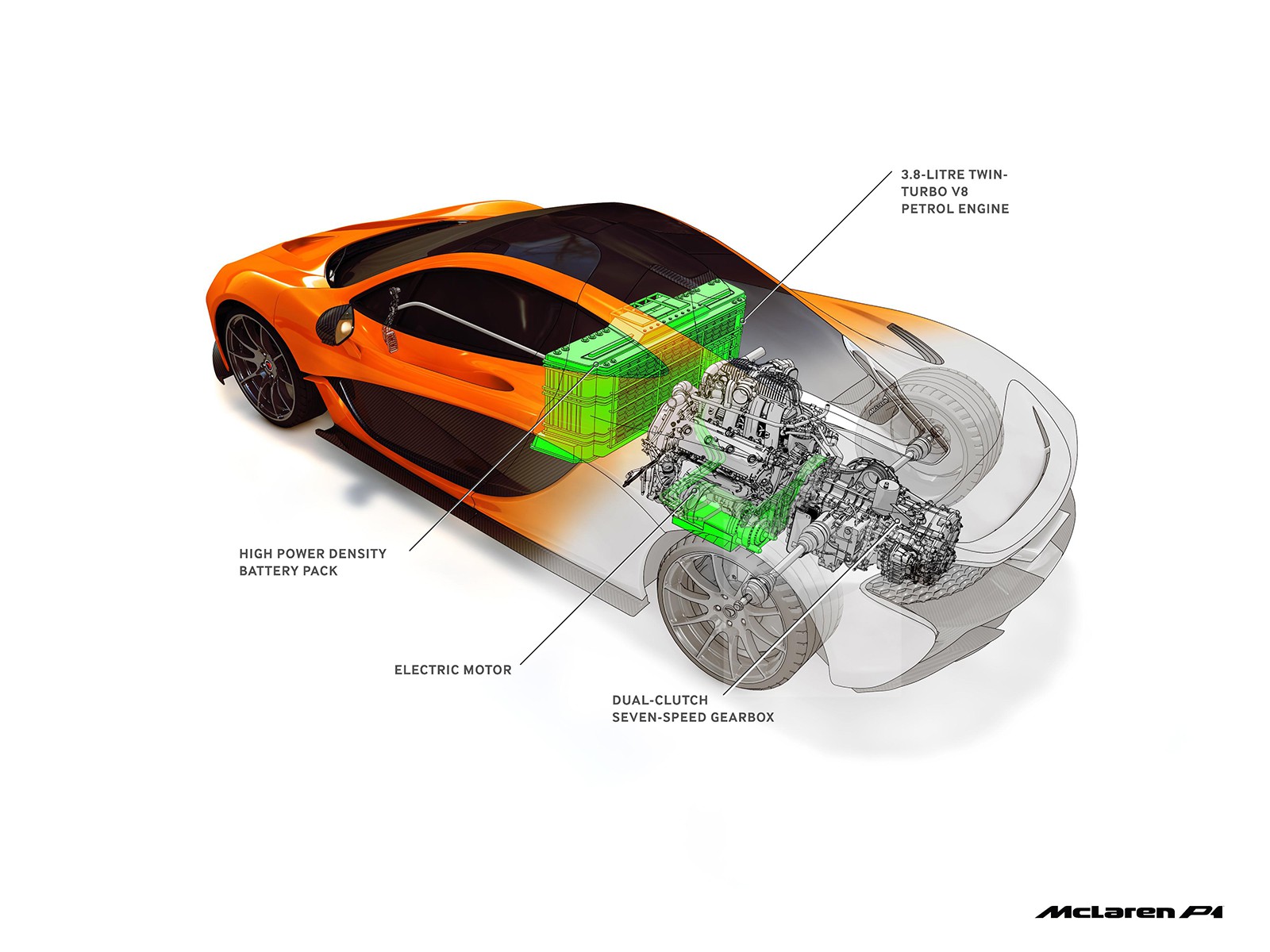
Little by little, McLaren is revealing the design, the inner workings and the novelties surrounding its latest creation, the P1. After getting to know the interior of the supercar from Woking, the mechanics that will power a vehicle have officially been unveiled, which, like the McLaren F1, will revolutionise the automotive world.
A car of these characteristics necessarily needs a complex engine, accompanied by the most advanced technology available at the time it was designed. For this reason, McLaren engineers have not used just one engine, but two. The P1’s main powerplant is based on the MP4-12C. It is a 3.8-litre twin-turbocharged V8 capable of producing 737CV of power at 7,500 rpm and a maximum torque of 720 Nm available at 4,000 rpm.
The petrol V8 will work hand in hand with a 179CV electric motor with instant torque of 260 Nm. With its help, the McLaren P1 homologates 916CV of power and a maximum torque of 900Nm.
The seven-speed dual-clutch automatic gearbox features paddle shifters on the carbon-fibre steering wheel to match the rest of the interior and the monocoque chassis.
The battery that supplies energy to the electric motor has been installed in the lower part of the carbon-fibre chassis and takes two hours to fully recharge. Weighing 96 kg, the battery will allow the McLaren P1 to move in electric mode for a distance of up to 9.6 km.
Besides being able to drive without any noise or pollution, two buttons have been placed on the steering wheel that, in certain circumstances, improve the P1’s performance. On the right is the IPAS (Instant Power Assist System), which, just like a KERS in Formula 1, when pressed allows the full available power of the electric motor to be used.
On the left we find the DRS activation, which minimises drag at the rear. The P1’s rear wing reduces its angle of attack to cut aerodynamic resistance by 23 percent. The DRS is deactivated by releasing the button or by pressing the brake pedal.
Its performance and consumption figures are still unknown.
Source | McLaren


 Kia offers an electric range of 10 models, 50 versions and 400 possible combinations
 The seven finalists for the 2027 European Car of the Year (COTY) are exclusively electric
 Peugeot E-208 GTi: a battery-powered toy that revives the spirit of the 1980s sports cars
Deja un comentario