e-2008 Peugeot Electric Cars ECO Tests
More power, range of up to 406 km, a redesigned look and from 235 euros a month: this is how the new Peugeot E-2008 wants to win you over
 Antonio Roncero @roncero_antonio
11 November 2023
9 min.
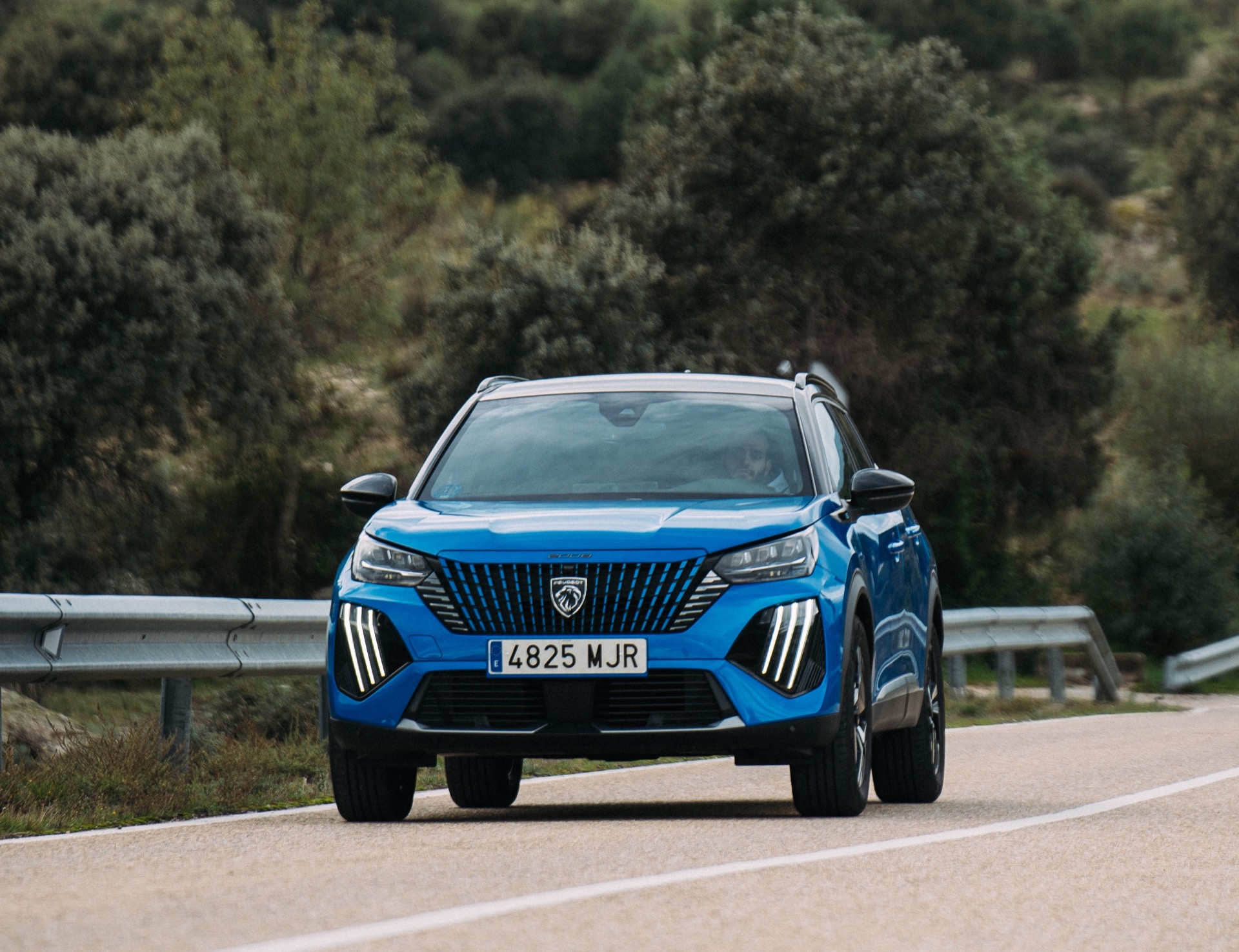
We take the wheel of the new E-2008, the electric version of Peugeot’s small SUV, which receives a more powerful motor, a higher-capacity battery and changes to the design and equipment, with a very interesting result.
The Peugeot 2008, sales leader in 2023 in the “small” SUV segment, undergoes a thorough makeover with aesthetic changes and, in the case of the electric version E-2008, also with important technical innovations. There is also another novelty to note: from December 2023 the Blue HDI 130 CV version will no longer be available, and the 2008 range will only offer petrol or 100% electric engines. Good news for those who do not yet have a 100% electric vehicle on their radar is that the Puretech petrol engines, the 100 CV with manual gearbox and the 130 CV with automatic gearbox, will be joined in February 2024 by a new mild hybrid MHEV variant -and therefore with a ECO environmental label from the DGT– with 136 CV and a dual-clutch gearbox. Incidentally, in its “transformation” to mild hybrid, the three-cylinder petrol engine switches from a timing belt to a chain, which makes this version even more interesting.
But let’s focus on the new E-2008, with which we have had a first hands-on contact, and which remains the second step in the electric range of Peugeot, which now changes its name and uses an “E” for passenger cars, leaving the “e” for commercial vehicles. A range that already includes the E-208, the E-2008 and the E-308, to which the E-3008 and the E-408 will shortly be added, and somewhat later the E-5008.
To set the scene, just a few notes on the market: the B segment continues to grow and accounts for more than 43% of sales, slightly ahead even of the C segment, that of compact cars; between the two they capture 85% of the market. And within the B segment, SUVs account for 60% of sales, compared with 40% for traditional bodies, since estates and MPVs have already disappeared from this segment. As for engines, in the B-segment SUV segment in which the 3008 competes, the best sellers are petrol cars, almost 63%, with 14% full hybrids, 8.6% mild hybrids MHEV and just 7.9% diesel.
However, in this category the share of pure electric sales barely reaches 1.4% in the year-to-October cumulative total. And certainly, that dismal figure is not due to a lack of supply: there are the Opel Mokka e, the Jeep Avenger and the DS 3 E-TENSE, with which the E-2008 shares its electric system; or the MG ZS, Hyundai Kona Electric, Kia e-Niro… We will see how the electric SUV market evolves in this category in the coming months.
Updated design and new i-cockpit driving position
The truth is that the exterior redesign suits the new 2008 wonderfully, which was already an attractive car and has always made the most of this quality. It does not change much, but enough to look fresher, sportier and more modern, especially at the front, with the new grille, full LED headlights, the signature with the vertical “three claws”… There are six colours to choose from, including two shades of grey, one black, one white and the eye-catching red and blue; and three wheel designs, with 16″ for the entry-level Active versions, 17″ for the Allure and GT, and optional 18″ wheels for the latter trim only.
Inside, Peugeot remains faithful to the i-cockpit, with a very small steering wheel and the instrumentation mounted above it. In this case it is an evolution, but one affecting the screens rather than the concept itself. I still think it is a good idea: it is original and very pleasant to handle the tiny steering wheel, or to barely have to take your eyes off the road to check the instruments. But I always recommend trying it first, because depending on the driver’s height, if you want to see the entire instrument cluster you may need to lower the steering wheel a great deal -sometimes not even then-, and in the end this not only conditions your seating position but also makes it harder to get in and out of the car, even with the flat-bottomed wheel. I don’t experience this in larger cars -for example in the 308-, but I do in this 3008; again, the best thing is to try it first at a dealership.
As for the novelties, the digital screen of the multimedia system is now 10 inches across all versions (previously it was 7 inches on the lower trims) and has a new design. The difference is that the Allure and GT feature higher resolution. The instrumentation is also a digital screen for the two top trims, while the Active retains analogue dials. Worth highlighting are the more powerful wireless charger (15 W instead of 5 W), the three USB-C sockets fitted as standard at the front (plus a USB-A at the rear) on the two top trims, the wireless Mirror Screen function to integrate the smartphone screen content into the multimedia system, or the “on street parking” function of the Tomtom navigator, which provides information on the likelihood of finding parking at the destination, as well as wireless map updates.
Also new are the front and rear video cameras for parking assistance, now with higher definition, as well as the front HD camera, which can provide a panoramic view. The remaining novelties inside include new upholstery across all versions, with the addition of an optional Alcantara upholstery for the GT trims. And the MyPeugeot app is updated with new features such as the digital service book, the ability to send routes from the phone to the car’s navigation, and, very important in the case of the electric version, the charging planner to optimise journeys.
More power and more range for the electric 2008
For now, Peugeot keeps the 136 CV version with a 50 kW battery in the range; but as we will see later, the price difference makes it unattractive: the new E-2008 with 156 CV and a 54 kWh battery offers better performance, is more efficient and extends the range to 406 km, compared with 345 km for the less powerful version, which costs only about 1,500 euros less. Both versions come as standard with a 7.4 kW single-phase charger, and an 11 kW three-phase charger can optionally be fitted. Going from 20 to 80% of the battery takes just 30 minutes at a 100 kW charging point, which is the maximum DC charging power. With AC, it takes around 4 hours and 40 minutes on a 7.4 kW Wallbox, and a little over 11 hours from a domestic socket.
At the wheel of the new E-2008, the extra power is the least of it, although the performance is there. If you drive efficiently, which is how these cars are meant to be driven, it goes just as well as the 136 CV version; in fact, both have the same torque figure, so the extra CV only come into play if you want maximum acceleration: the more powerful one needs almost a second less to go from 0 to 100 km/h and reaches top speed sooner, 150 km/h in both cases. But for everyday driving that extra power is not necessary. However, an important plus is the almost 5 kWh more usable battery capacity and the greater efficiency of the new powertrain, which take the homologated range up to 406 km (compared with 345 km for the less powerful one).
In real driving this means you can tackle journeys planning stretches of nearly 300 km between charges without “fear”, something that used to be impossible. In the end you still have to stop with both, but with the new battery you have more peace of mind. During our hands-on drive, moving with the flow of traffic, driving in ECO mode and trying to be gentle with the accelerator, it was not difficult to achieve an average of just under 13 kWh/100 km, without switching off the air conditioning.
Otherwise, the E-2008 still stands out above all for how pleasant it is to drive. Not only in terms of the smoothness and immediacy of the motor’s response, a trait common to all electric cars; also in how the suspension works, the insulation of the cabin and the agility the 2008 shows when manoeuvring or tackling bends. Once you get used to the i-cockpit and the feel of the brake pedal, everything is plain sailing.
Equipment and price of the Peugeot E-3008
Peugeot has simplified the 2008 range, leaving just three versions. The Active trim is the entry level, followed by the Allure, which adds to the Active equipment the front parking sensors, 2D digital instrumentation, a boot floor adjustable in two heights, rear privacy glass, gloss black roof bars, Peugeot i-Connect, a centre armrest with electric parking brake and automatic emergency braking. The GT trim adds 3D instrumentation, reversing camera, sport steering wheel, black roof, Full LED headlights with automatic lights, keyless entry and start, wireless phone charger, ambient interior lighting and aluminium pedals.
Recommended retail prices, without any incentives, start at 39,640 euros for the 136 CV E-2008 in Active trim, and from 41,090 euros for the 156 CV version. The Allure trim costs about 1,600 euros more than the Active, and the GT costs 2,200 euros more than the Allure. At the same trim level, the more powerful version with greater range costs only about 1,500 euros more, and you get a car with better performance and almost 60 km more range. It is worth opting for the more powerful one while both versions are still offered, although everything suggests the 136 CV E-2008 has a limited future.
With Peugeot’s “Electric Renting” formula, which includes the Plan MOVES discount and an EasyWallbox charging point, you can enjoy a 156 CV E-3008 on a renting basis from 235 euros a month over 36 months (10,000 km per year contract) with an upfront payment of 6,654 euros; or from 380 euros a month with no upfront payment.
Peugeot E-2008 – Image gallery
Technical specifications of this car


 Kia offers an electric range of 10 models, 50 versions and 400 possible combinations
 The seven finalists for the 2027 European Car of the Year (COTY) are exclusively electric
 Peugeot E-208 GTi: a battery-powered toy that revives the spirit of the 1980s sports cars
Deja un comentario