Test drive: Audi Q7 50 TDI quattro, an almost perfect SUV
 Antonio Roncero @roncero_antonio
18 August 2020
14 min.
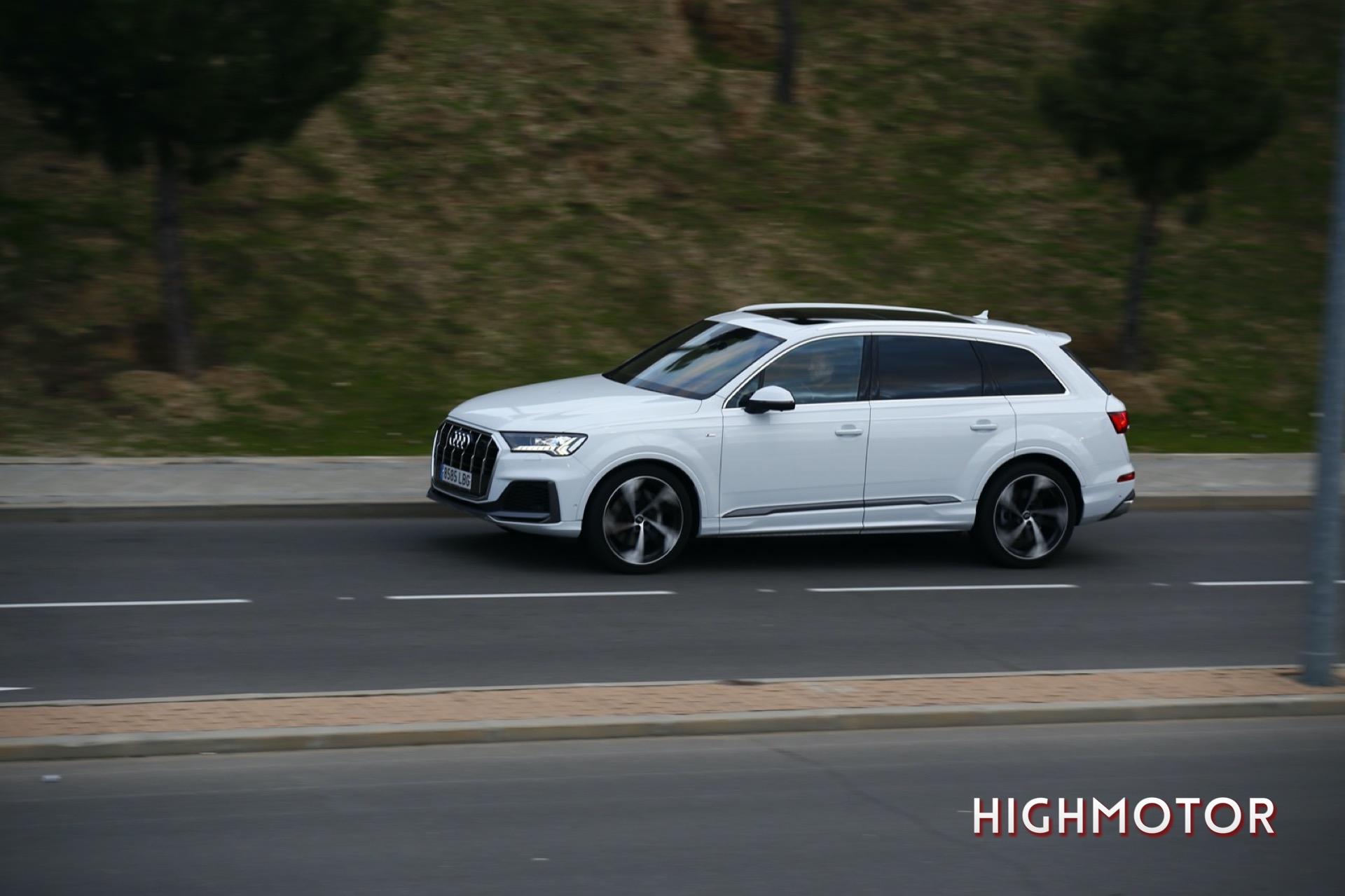
The luxury and comfort level of an A8 with the agility of a Q5, the performance of a sports car and the fuel consumption of a hybrid. And if you want, you can even leave the asphalt behind. That car exists: the Audi Q7 50 TDI quattro.
Choosing a version from the current Audi Q7 range is not easy, even though there are not many options available. But for the first test drive we carried out with the new edition of Audi’s large SUV, we chose the Q7 50 TDI quattro. An absolutely flawless car in every sense, combining first-class luxury and comfort with unexpected agility and off-road capabilities where the first limit will be set by the tyres.
Before telling you how the Audi Q7 50 TDI quattro drives and what it offers, it is worth reviewing how the range looked after the last update of the four-ring SUV at the end of 2019, and the main changes it brought compared with the version on sale since 2015.
Audi Q7 2020 range
The main changes affected the exterior design, with a more “bold” look, recovering some of the features introduced on the brand’s latest SUVs, such as the Audi Q3 Sportback, without altering the dimensions. The bumpers, grille, side skirts and light units were changed, as was the rear diffuser.
But above all, the main changes are found in the cabin, following the digitalisation strategy that Audi started with the A8. We will look at these changes and what they entail in more detail, as well as the new features in terms of equipment.
As for the mechanical range, the two V6 turbodiesel versions are retained: the 45 TDI with 231 CV, and the 50 TDI with 286 CV, both with Mild-Hybrid mild hybrid technology and the ECO environmental label from the DGT.
Until recently a 55 TFSI petrol was offered, but it has disappeared from the price list. At the top in terms of power and price we find the Q7 TFSIe, the plug-in hybrid version, which splits into two variants: 55 TFSIe (381 CV) and 60 TFSIe (455 CV). Both TFSIe versions carry the ZERO emissions label.
These are the starting prices of each version.
- Q7 45 TDI quattro: €69,960
- Q7 50 TDI quattro: €76,960
- Q7 55 TFSIe quattro: €79,060
- Q7 60 TFSIe quattro: €90,010
It should be mentioned here that the difference between the 55 TFSIe quattro and the 60 TFSIe quattro is not due to power alone; the 60 TFSIe is offered with the S line trim, which for the 55 TFSIe would cost €86,210. It should also be taken into account that both TDI versions can be chosen with 7 seats, an option not available on the hybrids. Its price is around €1,800, including the electric folding mechanism.
In addition to mild hybrid technology, other mechanical or technical novelties incorporated into the Q7 2020 range are the electromechanical body stabilisation system and the four-wheel steering.
A first-class cabin
If you were to enter the Audi Q7 blindfolded, whether to sit at the wheel or in the rear seats, and then removed the blindfold, the sensations would be comparable to those conveyed by a Audi Q8. I mean what you perceive in terms of luxury, quality, refinement…
You would know you were in the SUV because it would have been easier to get in and settle into the seat. And because of the higher, more “seated” position. The sense of a well-built car with high technology that the Q7 conveys can be appreciated in every detail, from the moment you press the start button and the screens come to life.
Here there are no fewer than three screens as standard. The two MMI screens, both touch-sensitive and haptic, like the screens of mobile phones or high-end tablets. The upper one, 10.1 inches, for the multimedia system, and the lower one, 8.6 inches, for controlling the climate or entering text.
And behind the steering wheel, 12.3 inches for the Audi virtual cockpit, also standard. I still consider it the best of the digital instrument clusters, by far. For the quality of the graphics, for the customisation possibilities (more so in the optional “plus” mode) and for how well it simulates the analogue instrumentation of classic gauges. Keeping an eye on the car’s key parameters in the background while following directions on the navigation map directly on the screen is a real luxury and hardly forces you to take your eyes off the road.
However, I must say at this point that so much digitalisation does not seem good to me if you don’t change your habits. Unless you use the multifunction steering wheel or voice control, navigating the menus of the touch screens, for example to adjust the climate control, always requires more attention than conventional physical controls. In fact, in some cars such as the new A3, Audi is maintaining its commitment to digitalisation… but bringing back some traditional controls for the main functions.
Otherwise, the driving position is exquisite in terms of comfort, ergonomics, insulation and visibility… And passengers will have no complaints either. With the plus rear bench, they will travel even more comfortably than in an A8, since leg space and backrest recline can be adjusted individually. And for luggage space, even if you opt for the third row of seats you won’t have problems. The boot capacity varies between 865 and 2,050 litres with 5 seats, and between 740 and 1,925 litres in the seven-seater, with the two third-row seats folded.
Fully connected
Another highlight of the new Audi Q7 is the connectivity it offers as standard. The MMI Navigation plus system includes a high-speed LTE connection, with a wifi hotspot.
The possibilities it offers are enormous, from navigation with Google Earth satellite images to cloud-based voice recognition, which means you don’t have to learn set commands and can “talk” to the car to find a restaurant or raise the cabin temperature. Of course, it includes real-time traffic information, hybrid radio, access to Twitter and even integration with Alexa, Amazon’s voice service.
For the Audi Q7 the Audi connect Emergency Call & Service and Audi connect Remote & Control packages are also standard. The first activates the emergency call in case of an accident and sends information about the vehicle, as well as allowing you to arrange service appointments with the workshop. The second connects the vehicle to your phone and allows, through the MyAudi app, remote checking of various car parameters, such as parking location, door locking, oil and fuel levels, or activating the stationary heater, if fitted as an option.
Equipment: is an S line better, or customising à la carte?
Our test unit is an S line, which costs almost €7,000 more than the basic trim. Note what it includes, because almost everything it adds is decorative or customisation you could do without, and use that sum to complete the equipment of a basic Q7 with the endless list of options.
Among other things, the imposing look of the S line comes from the sports seats, the Alcantara and leather upholstery, the specific steering wheel, the aluminium inserts, the floor mats with contrasting stitching, stainless steel pedals, anti-glare exterior mirror, interior ambient lighting, sport air suspension and 20″ wheels in a turbine design.
My suggestion would be to start from a Q7 with the base trim and, of the standard S line elements, keep the adaptive air suspension, which costs €2,400 in its standard version and €2,800 in the sport variant. From there, personalise to taste in terms of upholstery, seats, steering wheels, wheels… I do recommend adding, among the functional options, the comfort key (€1,200) and the plus rear bench with individual seat adjustment (€475).
The list of possible optional items is absolutely overwhelming. For example, you could equip your Q7 50 TDI with Matrix LED headlights for €1,700, or €3,000 if you opt for Matrix LED with laser light, which, incidentally, after testing them, I found absolutely impressive. Not only for their ability to light up the road, but also for how they make driving easier, automatically switching to high beam, or lighting up a bend before you reach it, based on GPS data.
The list of options for driving-related systems does not end here. The advanced running gear package includes four-wheel steering and active roll stabilisation (€5,300), and the 50 TDI can also be fitted with carbon-ceramic brakes, which cost €10,300. The Advanced running gear is worth thinking about; the ceramic brakes, don’t worry, you won’t need them.
As a curiosity that is also worth bearing in mind, the fuel tank, which is 70 litres as standard, can be enlarged to 85 litres on both TDI versions, for an extra €135. The AdBlue tank is always 24 litres.
From here we would move on to the optional assistance systems, grouped into the City (€1,825) and Tour (€2,300) packages. There is also a night vision assistant (€2,600), a head-up display (€1,705), or a Audi Bang & Olufsen system with 3D sound (€1,400 for the “basic”, €7,500 for the “Advanced”).
On the road with the Audi Q5 50 TDI quattro
Equipped with the whole arsenal of technological aids mentioned in the equipment section, this Audi Q7 50 TDI quattro is a surprising car. You get used to it quickly and end up using it without the “laziness” that sometimes comes with driving a large car, especially when parking, moving around the city…
Its five metres in length are not a problem when manoeuvring, thanks to the help of the four-wheel steering. The same can be said of the 2.1 tonnes kerb weight when it comes to moving, whether accelerating… or cornering. The extra agility provided by the steering on the rear axle also plays a big part here. But above all, the operation of the active stabilisers system stands out.
When you sit high in an SUV of this size, you expect that, even if the suspension is firm, the body will lean somewhat in corners. In the Q7 with the active anti-roll system that “somewhat” is really very little. Without going into too much technical detail, what it basically does is apply a torque opposite to that exerted by body roll on the anti-roll bars, using for this an electric motor that acts as a coupling between the two halves into which each bar is divided. These small electric motors can deliver a power of about 3 kW (about 4 CV), and are powered by the main 48-volt electrical system. In a straight line they disconnect the anti-roll bars, to favour comfort.
Electronics at the service of the suspension
At first the sensation is a bit strange. But it lasts for a few corners. Once you accept that the feeling of the car not leaning even when you push the machine is not a feeling but a reality, everything is plain sailing. With the 20-inch wheels of the S line (the Q7 comes with 18-inch wheels as standard, and optionally can be fitted with wheels up to 22 inches), and fully asphalt-oriented, low-profile tyres for an SUV that, let us remember, is not the SQ7, the handling is impeccable, whatever the type of road, if you fit the air suspension, which offers different ride heights and adapts the calibration to driving conditions. The Q7 swallows potholes as if by magic.
You only have to worry about aiming with the steering wheel and the accelerator, as well as choosing the programme you prefer from the Audi drive select, although you can also leave it on automatic. And on the motorway, not even that. Because the adaptive driver assistant works wonderfully. I think even the feel of the steering would improve with less radical tyres. Something that has an easy solution: not choosing the S line trim, and fitting the wheels of your choice as an optional extra.
In this Q7 we tested it with the adaptive assistant: it does what an adaptive cruise control does, maintaining the distance from the car in front even in stop-start traffic or jams. And it helps keep the car in its lane, which allows the driver some “relaxation” when there are many kilometres to cover on long journeys.
But beware, it is by no means a self-driving system. Although it is a relief to be able to take your hands off the wheel for a few seconds or reposition your feet without having to watch the pedals, always keeping your eyes on the road, of course. With the route programmed, the efficiency assistant even anticipates traffic and road conditions, to get the most out of a V6 TDI engine that is also a marvel.
Diesel is still the best option for a large SUV
Because real-world consumption of around 9 l/100 km in a car like this in mixed use can only be described as excellent. It seems incredible that diesel still has detractors, when in certain cases it is the best option. And this is one of them: a large, heavy SUV, which makes most sense on long road journeys.
Here it is hard to admit that the 45 TDI, with its 231 CV and 500 Nm of torque, would be more than sufficient. Especially when the price difference between the two is about €7,000, with equal equipment. That is why I would not overlook the “smaller” engine which, let us remember, is basically the same V6, with identical technology, but different electronics.
The difference in power shows in performance. While the 45 TDI can accelerate from 0 to 100 km/h in 7.1 seconds, the 50 TDI does it in 6.3. Impressive figures. Top speed exceeds 240 km/h, and the thrust is simply overwhelming. Moreover, with a smoothness of operation that brings back to mind an old saying: “it doesn’t feel like a diesel”. The brakes, as we mentioned before, have no problems.
The eternal question “petrol or diesel” is no longer such, from the moment the SUV in the range that uses the least fuel is no longer the TDI, but the plug-in hybrid. The 55 TFSIe quattro, with its 380 CV and the ability to cover 50 km in electric mode on a single charge, is a real temptation for barely €2,000 more than the 50 TDI. But beware, do not be fooled by its less than 4 l/100 km of WLTP consumption. Once the battery runs out, which will be after the first 130-140 km, the TFSIe will consume well over double that figure on the road.
So there you have it. If you do long-distance driving, diesel is still alive, and the Q7 50 TDI quattro is one of the best options among large premium SUVs. Alternatives? The Mercedes GLE 350 d 4MATIC, with 272 CV and a price from €76,550. Or the BMW X5 xDrive30d, with 265 CV and a price from €77,200.
Technical specifications of this car


 Peugeot E-208 GTi: a battery-powered toy that revives the spirit of the 1980s sports cars
 New Lexus ES: luxury grows and goes electric
 First contact with the Dacia Sandero Hybrid 155: power and efficiency from €19,890
Deja un comentario