Test drive: DS 4 BlueHDI 130 EAT8, the best alternative to German premium compacts
 Antonio Roncero @roncero_antonio
4 January 2023
11 min.
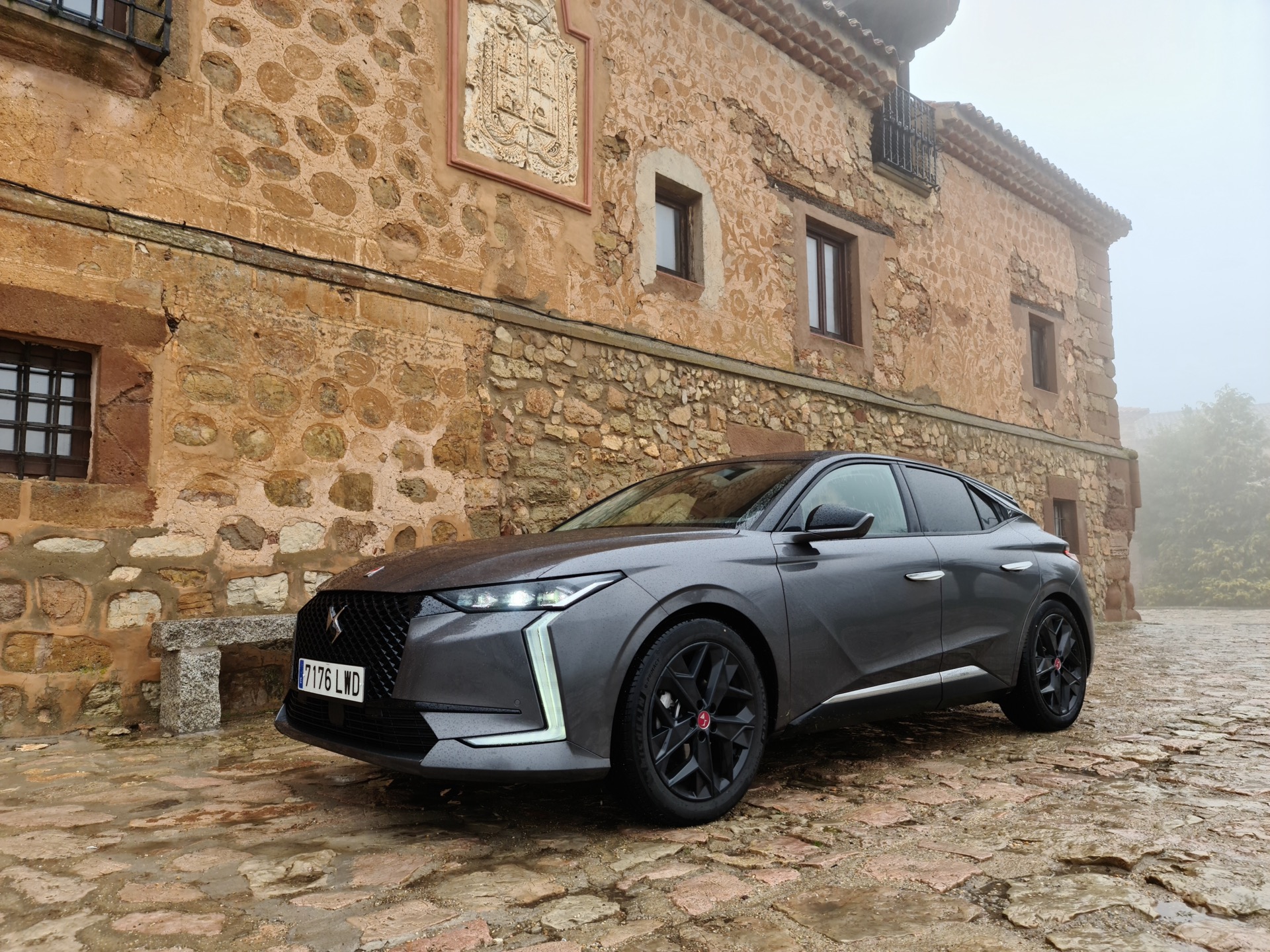
We test the turbodiesel version of the DS 4, a model that, in terms of build quality, comfort and equipment options, is a serious alternative to German premium compacts.
The second generation of the DS 4 was unveiled in early 2021 and went on sale in our market in mid-2021. This compact stands out for its design, exceptionally high build quality and great ride comfort, positioning itself as a very serious alternative to models from premium manufacturers. Here it competes, without complexes, with rivals of the calibre of the BMW 1 Series, the Audi A3 and the Mercedes A-Class.
A bit of history about the first DS 4: the “ugly duckling”
In reality, the first DS 4, which saw the light ten years earlier and received a facelift in 2015, was conceived with this purpose. But the first DS 4 was born “crooked”. I still remember, years before the launch of the first model in the DS range from Citroën, the DS 3, a press presentation in which the executives of the French brand showed us what was to be their premium “offensive”: the DS 3, the DS 4 and the DS 5.
The idea was to hold a kind of “clinic”, in which journalists would give our opinion on Citroën’s strategy of targeting the premium segment with its DS line. And I remember perfectly my conversation with a group of designers and engineers, trying to convince them of something I believe they had already internalised but could not admit: unlike the DS 3 and DS 5, rather than a model with its own identity, the first DS 4 looked like a “tuned” Citroën C4. On the outside… and on the inside, because even the dashboard was the same, with changes only to some materials to justify that supposed premium character and a price much higher than that of its sister brand model.
The fact is that in 2014 the DS line stopped being linked to Citroën and began to be sold as an independent brand. The DS 4 underwent a “facelift”, but until the arrival of this second generation, it never really met expectations.
Second-generation DS 4: what it should have been and wasn’t
With the second generation of the DS 4, however, DS has hit the nail on the head. For me, this new DS 4, or at least the same concept, is what the first one should have been: a car unlike any other, but above all very different from any other compact model from the Stellantis Group brands with which it shares the modular EMP2 platform, such as the Citroën C4, the Peugeot 308 or the Opel Astra. By the way, the DS 4 is manufactured in Rüsselsheim, at the German Opel plant.
And now let’s get down to business and focus on what the DS 4 offers, and more specifically the version we have chosen for our test, equipped with the 130 hp BlueHDI turbodiesel engine and automatic gearbox.
Its body has a standard compact format, measuring 4.40 metres in length, 1.49 metres in height and 1.83 metres in width. And it must be said that the design is very eye-catching from any angle. It has four doors, but the rear ones are very well concealed, and it could almost pass for a three-door body. The flush-fitting, retractable door handles contribute to this.
Currently, the DS 4 range lets you choose between the 130 hp three-cylinder PureTech petrol engine, the 130 hp four-cylinder 1.5 BlueHDI, and the DS 4 E-TENSE, with a 224 hp plug-in hybrid powertrain.
DS 4 equipment and prices
There are no fewer than six trim levels: Bastille, Performance Line, Performance Line +, Trocadero, Rivoli and Opera, although not all are available with every engine.
The prices of the DS 4 BlueHDI start at €32,650 with the Bastille trim, €35,700 for the Performance Line, €37,350 for the Trocadero version, €39,600 for the Rivoli and €44,600 for the Opera trim. As for the engines, the price premium of the turbodiesel over the petrol at equal equipment is around €1,300.
In addition, you can choose the Cross line, which gives the DS 4 a crossover look thanks to details such as the grille, the black window surrounds and the roof bars. These Cross versions, which do not increase ground clearance, also incorporate a traction control system that lets you choose between the arena, mud or snow driving modes, as well as hill descent control. For the DS 4 BlueHDI, the Cross line can be chosen on the Trocadero, Rivoli and Opera trims, for an extra cost of around €800.
The price difference between petrol and diesel at equal equipment is around €1,300, while the DS 4 E-TENSE is in a different league, as the most affordable plug-in hybrid version already exceeds €41,000. All these prices are those currently offered by DS on its website, including the online purchase discount (between €2,000 and €3,000) and financing, which gives you the option to test-drive the car before buying, return it within 14 days and even have it delivered to your door, although it is advisable to read the small print very carefully.
Choosing the equipment version is not easy, given how many are available. Even less so on the brand’s website, which is not very intuitive and where it is even hard to find the versions available. The standard equipment is complete, but to enjoy those details that place the DS 4 on a higher level, you should opt for at least the Trocadero trim. In any case, it is also possible to start from the basic version and customise it to your liking. The possibilities are enormous, not only in terms of safety, multimedia and comfort elements, but also in upholstery, inserts, colours, and so on.
As equipment items that stand out in this segment, the DS 4 can fit matrix LED headlights, a sophisticated head-up display HUD projected onto the windscreen, a night vision system or a Focal sound system with 14 speakers.
The DS 4 interior: form before function
If externally the DS 4 conveys sportiness, the interior is more about sophistication and elegance. This is a car that surprises with its presentation, the quality of its materials, the fit and feel of all its controls. But it should also be borne in mind that design takes precedence in many respects over versatility or practicality.
The latter is especially evident when it comes to the available interior space: the DS 4’s interior accommodation is worse than that of the vast majority of compacts of its size. If you are clear about this, you won’t be in for any surprises. Because although the front seats are fantastic, rear-seat passengers will not enjoy the kilometres very much. The gap the doors leave for getting in and out is not wide, and legroom is rather tight; fortunately, there is enough room to slide your feet under the front seats and there is no lack of headroom. It is by no means a 2+2. The rear seats are usable, but if you are going to travel frequently with adults in the back, the DS 4 is not the best choice.
According to official figures, the boot has a capacity of almost 440 litres. And this is certainly more than its main alternatives. However, when it comes to loading the same luggage, it does not seem that there is more space than in a Mercedes A-Class, which has a seemingly smaller boot. In any case, its shapes are regular and usable.
I really liked the driver’s position, especially for the comfort and support offered by the seats and that sense of sophistication conveyed by the design and materials. The only jarring note is the instrumentation, with a small screen for what is expected today, few configuration options and an information display that seems rather unrefined. On the other hand, if you go to the checkout, you can fit a HUD instrumentation projected onto the windscreen with a large amount of information and high-quality graphics.
DS Iris System multimedia system
The multimedia system could also be improved in this respect, although its 10-inch screen offers great sharpness and navigating through the various menus, while not standing out in this area, is easy and intuitive despite having many functions. For example, the climate control system, which has no separate buttons, is also adjusted from here.
This screen is part of the system that DS calls Iris System, which allows you to manage the multimedia functions in two other ways, in addition to the touchscreen itself. The first is a voice control system that does not entirely convince me. The second is a small additional touchscreen between the front seats, but it is very underused. Basically it serves to activate the main menu where the various icons appear on the large screen and to select one, with no possibility of interacting beyond zooming. Or entering characters by writing with your finger to, for example, search for an address.
Other interesting details of the DS 4 cabin are the way the climate control vents are integrated, so that the central ones are barely distinguishable, and the side ones are located in the doors, as a continuation of the control module for the electric window switches, which are positioned very high and forward, so they are not comfortable to reach. As for the button panel below the multimedia screen, with some direct controls to activate the rear window defroster, for example, they look very nice with a metallic finish, but by day the engraving indicating their function is barely visible; at night, however, they are backlit.
Driving the DS 4 BlueHDI: maximum comfort
The dynamic side is one of the things that surprised me most about the DS 4, with an impressive ride comfort, even better than that of some luxury saloons. This is mainly due to the good work of the suspension in filtering out potholes. But the cabin is also very well insulated. So much so that the 1.5 BlueHDI engine seemed smoother in this car than in any other I have tried it in.
And that is despite our test unit not having the DS Active Scan adaptive damping, which has the particularity of being able to “read” the road thanks to a video camera and adjust the dampers to the best possible setting before reaching an irregularity in the tarmac. But with the standard damping, the DS 4 already shows an extraordinary ability to swallow potholes without resorting to an excessively soft setting, and the steering contributes with a very precise feel. The driver assistance systems also work very well. In particular, the active cruise control measures distances very well and brakes and regains speed very smoothly.
I was struck by the fact that our test unit was fitted with Michelin ePrimacy tyres, designed with the needs of electric cars and plug-in hybrids, such as the DS 4 E-TENSE, in mind. But the truth is that after being able to put them through kilometres of all kinds of conditions, even in the rain, I liked them a lot. Undoubtedly, the tyres themselves and very reasonable dimensions — 205/55-19, without the need for very wide, low-profile tyres — have something to do with the ride comfort thanks to their low rolling noise, and a lot to do with the low consumption of the DS 4 BlueHDI.
As for the engine, I initially thought that a refined car like this might suit the three-cylinder petrol better. But the BlueHDI is very smooth as soon as you set off, and is only noticeable when cold or at low speeds. The combination with the 8-speed torque converter automatic gearbox, which you can operate in sequential mode using the paddles on the steering wheel if at any moment you want to move with more “joy”, is a sure bet.
The start-stop system also works very well. And the consumption figures are even better than expected: in ECO mode (you can also choose the “normal” and “Sport” modes, with a slight difference in the throttle response), it is not at all difficult to travel with averages of around 6.5 l/100 km. It’s a pity that, as with the petrol engine, the BlueHDI also lacks a mild hybrid system that would allow access to the DGT ECO label. But you can’t have everything…
DS 4 BlueHDI 130 EAT8 – Image gallery§h115§


 The seven finalists for the 2027 European Car of the Year (COTY) are exclusively electric
 Peugeot E-208 GTi: a battery-powered toy that revives the spirit of the 1980s sports cars
 New Lexus ES: luxury grows and goes electric
Deja un comentario