Test drive: Opel Astra GSi Line 1.4 Turbo, sportiness is back at Opel
 Yago González Mato
16 March 2018
9 min.

We spent a week living with the Opel Astra in its GSi Line version with a 150 CV 1.4 TSi engine, a sport-focused version that we really enjoyed.
The GSi badge has returned to Opel, although perhaps we should say: sportiness has returned to Opel. The last batch of Opel GSi models was produced in the nineties (we’re talking about legendary cars like the Corsa GSi, Kadett GSi or the Astra GSi), but last year the German brand decided to revive these letters to name its new range of sporty vehicles; a series of cars that will sit between the brand’s standard range and its OPC (the most sporty versions). The Opel Astra will be the third to receive a GSi version (the Corsa and the Insignia have already done so) in mid-2018, but as of today, the German compact already offers the GSi Line trim, a sport-focused configuration that sits halfway between the standard model and the future GSi version. We tested it with the 1.4 Turbo petrol engine with 150 CV and we love it. Here’s why.
Sportiness without giving up comfort
From the moment you get in until you get out of the Opel Astra GSi Line, you feel like you’re driving a compact focused on sportiness, which does not mean the comfort offered by a standard Astra has been lost along the way in this version.
If you’re looking for a car to enjoy on a mountain pass but also don’t suffer over speed bumps, this Astra GSi Line will delight you. Its chassis is really good. The tuning of the suspension is firm, but the ease with which it absorbs road irregularities is surprising. The steering, the pedals, the gearshift lever… everything has a touch of sportiness but also of comfort.
Activate SPORT mode and you’ll bring to life a chassis that has a lot to say on winding roads (its cornering is very good), but drive in ECO mode and you’ll discover the softer and more docile side of a car that performs brilliantly in both settings.
The unit we tested fits 18-inch wheels, a very attractive option visually but which slightly unbalances the good work of the chassis due to the low-profile tyre (225 40 R18). The wheels that come as standard (17”) very possibly contribute to a better functioning of the suspensions.
An optional extra we strongly recommend from a chassis standpoint is the semi-independent rear suspension. Unlike the torsion beam rear axle that comes as standard, this semi-independent suspension allows more precise guidance in demanding conditions. It can be acquired with the “Performance Pack” for 290 euros. It is worth mentioning that Opel has abandoned adaptive damping in this latest version of the Astra, but the suspension offered by this Astra GSi Line is versatile enough that you won’t miss it.
In terms of sportiness, this Opel Astra GSi Line is perhaps a step behind some of its rivals (Renault Megane GT Line, Ford Focus ST Line or Seat Leon FR), which offer a more precise steering feel when linking corners. But that does not necessarily have to be a disadvantage against them. After all, if you’re looking for a bit more spice at the wheel, you only have to wait for the GSi version that will hit the market in a few months. Otherwise, this Astra GSi Line offers you that sporty edge with a versatility very useful for day-to-day driving.
1.4 Turbo engine: the perfect balance between performance and consumption
The Opel Astra GSi Line is offered with two petrol engines (1.4 Turbo with 150 CV and 1.6 with 200 CV) and two diesels (1.6 CDTi with 136 CV and 1.6 CDTi with 160 CV). For the test we chose the 1.4 Turbo petrol unit for its compromise between performance and consumption. After testing it for a week, we have been able to see how much this engine has improved over time.
The Astra GSi Line 1.4 Turbo has an official consumption of 5.1 l/100km. In real conditions we are talking about around 6.5 litres if you drive at constant speed on the road, without many changes of pace; that said, using ECO mode you don’t need to worry too much about the accelerator. If, on the other hand, you unleash the engine’s full potential and activate SPORT mode, consumption can easily climb to 10 litres if you make the most of the available power or do a lot of city driving, which is quite normal for these turbocharged, small-displacement petrol engines. In real use, averaged over the week, with road, city, cold starts and some motorway driving, the average comes to around 8 l/100 km.
But what has caught our attention most about this engine is its low-rev pull and smoothness, two aspects in which this powerplant was lacking in previous versions. It still isn’t an engine with excessive torque (pulling power) at low revs, but it is now easier to drive comfortably at low speeds.
When driving sportily, it is not one of those engines where you chase the rev limiter (located at around 7,000 rpm), and its feel and sound are not especially sporty either. But the car climbs through the revs cheerfully and consistently. The turbo contributes its share but does not determine the character of an engine that likes to stretch through the gears. It delivers its best performance between 4,000 rpm and 5,500 rpm.
Compared with its rivals of similar power, the Opel 1.4 Turbo is slightly less “refined” in feel than the 1.5 Ecoboost of Ford or the 1.5 TFSI of Volkswagen; the latter would be the most refined of the three, and the real benchmark for performance, helped in part by its cylinder deactivation system when it comes to saving fuel. In any case, we are surprised by how much this engine has evolved in its latest versions.
One of the aspects to improve of this engine is the operation of the start/stop system. The system starts the car when you lift your foot off the brake (on other cars it does so directly when you press the clutch) and sometimes there is a delay that makes it harder to pull away from a standstill. It is not a serious problem; once you get used to how the system works you manage to start the car quickly, but it is true that other cars handle this better.
Spacious cabin and good finishes
Once inside, we find a spacious car (average compared with its rivals) with finish quality above the average. The rear seats are comfortable with plenty of legroom; it is one of the longest compacts in its segment and that size advantage is noticeable in the rear seats.

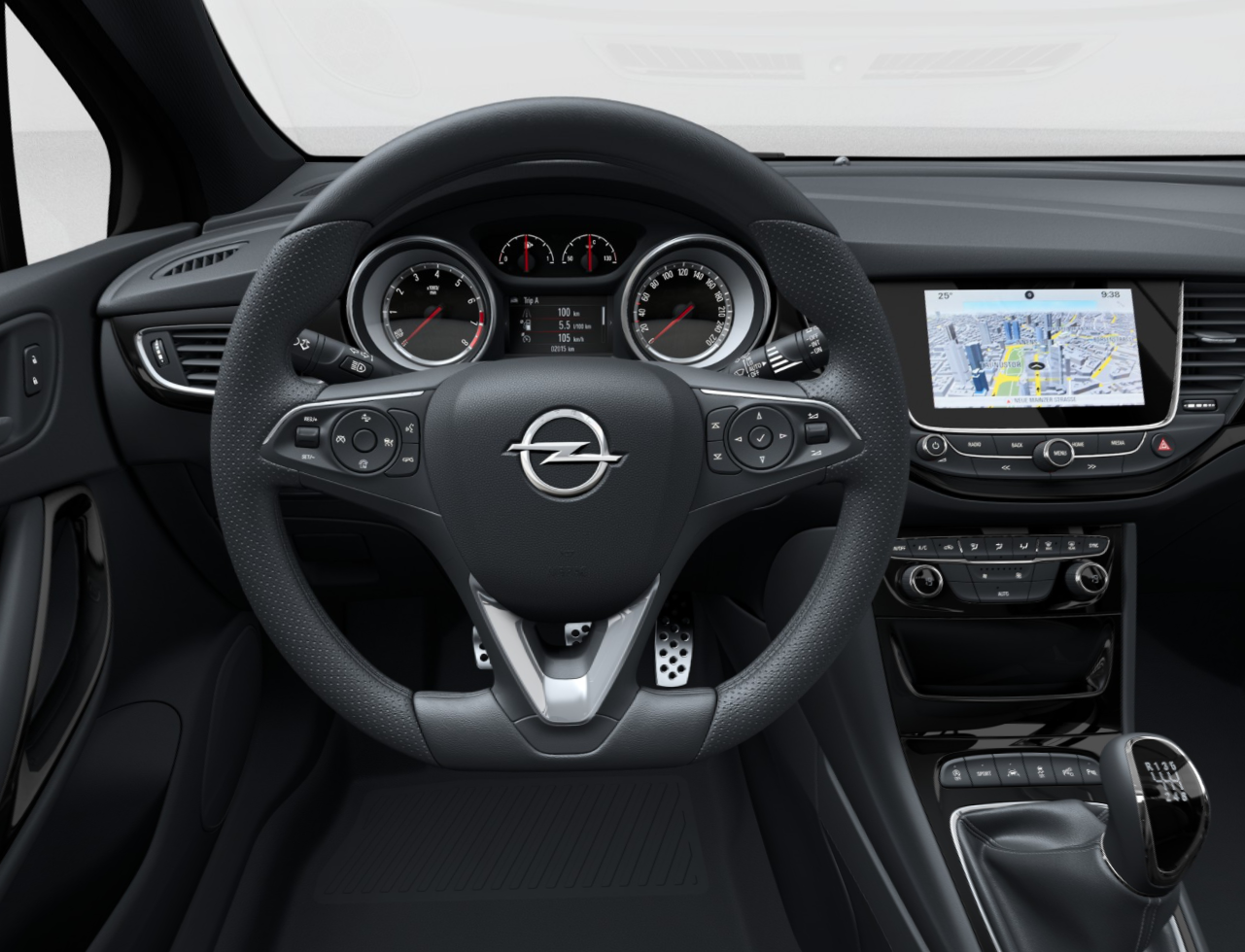

Improved connectivity and infotainment system
The old infotainment technology of Opel was not among the best on the market. Its touchscreens were somewhat outdated and not entirely intuitive. The same was true of the connectivity system: a few days ago we tested a Crossland X (which had the old generation of infotainment) and we had quite a few difficulties pairing our mobile device.
On the contrary, the new infotainment technology of Opel, debuting in this Astra GSi Line, offers many more virtues than its predecessor. The touchscreen is much more modern, ergonomic and intuitive (the menus are very well organised). Accessing information is much faster and simpler, as is connecting your smartphone to the vehicle.
Opel Astra GSi Line: a very well-equipped version
The GSi Line version of the Opel Astra costs around 5,000 euros more than the basic trim (Selective) and 3,000 euros more than the intermediate trim (Dynamic), but with the level of equipment it offers, it is not expensive. Among the many items that come as standard, we highlight the following:
- “OPC Line” sport pack: costs 1,150 euros on other versions.
- GSi sport steering wheel
- Chrome exterior mouldings around the side window surrounds
- 17″ alloy wheels with 5 double spokes (225/45 R17 tyres)
- Sport pedals (aluminium)
- Drive Assist Pack:
- Cruise control
- Front collision prevention system
- Unintended lane change warning
- Traffic sign recognition
- Brake Assist
- Automatic parking system (not included on other versions)
- LED daytime running lights
As an option, the Drive Assist 2 Pack is highly recommended, which includes a very effective collision warning system (with a light signal on the windscreen and an audible alert), adaptive cruise control and a leather-wrapped steering wheel. It costs 800 euros.
How much does the Opel Astra GSi Line cost compared with its rivals?
The Opel Astra GSi Line currently costs 20,245 euros (price with the brand’s promotion and financing), which places it among the cheapest in its category:
- Ford Focus ST Line (1.5 Ecoboost 150 CV): 17,059 euros (configurator price with discount applied). The new generation is just around the corner, but the price is unbeatable, it has a good engine and the chassis is still among the best in its class.
- Renault Megane GT Line (TCe 130 CV): 19,292 euros (configurator price with discount applied). Unlike the rest, this model offers a 130 CV engine (a 20 CV deficit compared with the others).
- Seat Leon FR (1.5 TSI 150 CV): 21,680 euros (configurator price with discount applied). The perfect balance between sportiness, performance, consumption and everyday usability.
- Volkswagen Golf R-Line (1.5 TSI 150 CV): 29,000 euros (configurator price with no discount currently available). Too expensive without discounts. A minimum price to start considering it as an alternative would be around 25,000 euros.


 Kia offers an electric range of 10 models, 50 versions and 400 possible combinations
 The seven finalists for the 2027 European Car of the Year (COTY) are exclusively electric
 Peugeot E-208 GTi: a battery-powered toy that revives the spirit of the 1980s sports cars
Comentarios cerrados