Born Cupra Electric Cars Compact ECO Tests
We test the CUPRA Born e-Boost: an electric sports car with up to 549 km of range
 Antonio Roncero @roncero_antonio
4 October 2022
9 min.
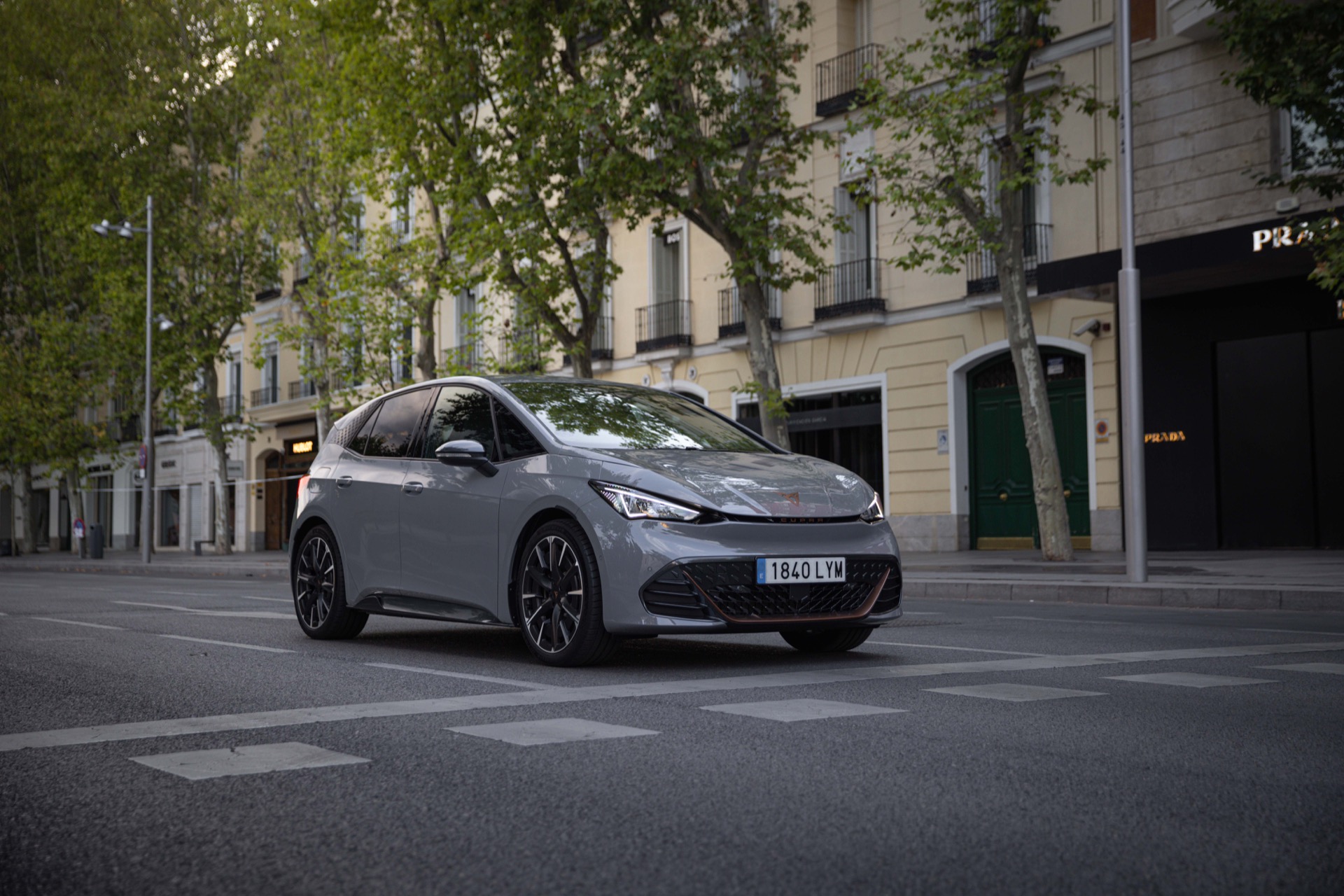
With the new e-Boost package, the CUPRA Born is a highly efficient city car capable of tackling long-distance journeys and behaving like a true GTI on your favourite winding road.
Taking advantage of the presentation of the new features in the CUPRA Born range, we took the opportunity to test one of the most interesting, the version with the greater range: the Born e-Boost Pack & Battery Pack. With 231 CV of power and a 77 kWh battery, this CUPRA is almost like three cars in one: a very efficient city car, a vehicle that already allows tackling fairly long journeys thanks to its great range (549 km according to the WLTP cycle), and even a small GTI for fun on winding roads if you activate the “Cupra” mode.
But first of all, let’s review all the news and how the new CUPRA Born range stands, since in addition to the e-Boost package there are other improvements.
News in the CUPRA Born range
The main news is the arrival of the e-Boost version with the aforementioned 77 kWh battery and 170 kW (231 CV) of power. This means the CUPRA Born range is configured with the following versions and prices, pending a future entry-level version with 150 CV, a 45 kWh battery and a range of 340 km:
- Born 150 kW (204 CV), 58 kWh battery, 425 km range: 40,900 euros
- Born e-Boost 170 kW (231 CV), 58 kWh battery, 420 km range: 41,190 euros
- Born e-Boost 170 kW (231 CV), 77 kWh battery, 546 km range: 45,620 euros
From these prices one would have to deduct the 1,210 euros discount offered by the brand, which leaves the current entry-level version at under 40,000 euros, one of the most affordable electric cars of this size, power and range… except for the MG 4 Electric, which we have not yet tested. One of the main alternatives I would consider over the CUPRA Born if I had to choose an electric car in this category would be the Renault Mégane E-TECH.
Other news in the range is the standard incorporation of Plug & Charge technology, which speeds up the charging process by automatically authenticating the vehicle at the charging point without the need for cards or apps, as well as the increase in maximum charging power from 135 kW to 170 kW in the versions with the higher-capacity battery, which also now offer five homologated seats instead of four.
e-Boost and Battery Pack packages: are they worth it?
At first glance, fitting the e-Boost pack to the CUPRA Born with the 58 kWh battery, to go from 204 to 231 CV, costs just 300 euros. And it is worth it, not only for the almost 30 extra CV and the improvement in performance (7 tenths less in the 0-100 km/h acceleration; stopping the clock at 6.6 seconds is already a respectable figure) without giving up an excellent range (it loses only 5 km). In addition, this pack includes front brakes with larger-diameter discs (340×27 mm, vs 330×23 mm; the rear ones, as on the VW ID.3, are always drum brakes), 19-inch wheels in the Typhoon design, a steering wheel with satellite buttons, and the CUPRA mode is added to the driving profile selector. In addition, the DCC adaptive chassis (870 euros) and 20-inch wheels with Michelin Pilot Sport EV sports tyres in size 235/40 (1,770 euros) can be optionally fitted, compared with the standard 19-inch wheels and 215-50 tyres.
Only in the case of the 231 CV e-Boost versions can one opt for the Battery Pack, the 77 kWh battery instead of 58 kWh, priced at 4,500 euros. The homologated WLTP range rises to 546 km. But the “jump” here really does call for careful thought, since the extra 126 km of range come at a high price. And not only because of the extra price to pay. Due to the greater weight, the CUPRA Born e-Boost with the large battery loses a little in performance compared with the 58 kWh version; specifically, 4 tenths, stopping the clock at 0-100 km/h in 7 seconds.
In summary: a resounding yes to the e-Boost package, and a heavily qualified “it depends” for the Battery Pack, unless you think of the CUPRA Born as a car for travelling fairly often; and even then… Personally I would stick with the intermediate version, with the e-Boost package and the 58 kW battery. It offers the best performance and the most sporty feel, and its 420 km of homologated range is already enough to even consider long journeys, taking advantage of the fact that with fast charging at 135 kW you can gain 100 km of range in about 7 minutes… or go from 5% to 80% charge in half an hour. It’s a matter of stopping more often for less time, which ultimately pays off, and then charging fully at the destination.
The interior of the CUPRA Born
CUPRA’s first 100% electric car does not disappoint in the slightest. Especially if we take as a reference its “first cousin”, the Volkswagen ID.3, with which it shares the platform, motor, batteries and even the concept of the cabin. But here we find many differences, with a much more elaborate presentation that conveys the feeling of being in a sportier and at the same time more “serious” car.
The sports seats fitted as standard hold the body beautifully, the central console has numerous spaces for storing objects, and both the digital instrumentation with a 5.3-inch screen and the multimedia system, which here reaches 12 inches, operate smoothly once you get the hang of the menu system. In the versions with the e-Boost pack the steering wheel adds two satellite controls: one on the left to switch between the different driving modes, and another on the right to directly activate one of them, the so-called CUPRA mode, exclusive to the Borns with this pack.
Interior space is very good relative to the exterior size, with a length of 4.3 metres, a width of 1.81 m and a height of 1.54 m; especially compared with compact cars with combustion engines. The legroom stands out, and it falls slightly below average in boot capacity, with about 385 litres that are quite usable thanks to the regular shapes and the two-level adjustable floor.
https://www.youtube.com/embed/YkdlWbSQWPs
The standard equipment is very complete. All versions have progressive steering, a driving mode selector with four programmes (additional CUPRA mode on the e-Boost), mode 2 and mode 3 charging cables, emergency braking with pedestrian and cyclist detection, lane departure warning, rain and light sensors, 7 airbags, two-zone climate control, parking sensors, the CUPRA Connect Gen 4 connectivity system, wireless connectivity with Android Auto and Apple CarPlay, a wireless phone charger, 18-inch alloy wheels, multicolour ambient lighting and aluminium pedals.
Among the optional extras, the heat pump costs 1,020 euros, assisted parking costs 250 euros, and there are various packs, starting from the simplest and most recommendable, called Advanced, which for 930 euros adds navigation, adaptive and predictive cruise control, light assist, traffic sign recognition, tinted glass and a rear-view camera.
Behind the wheel of the CUPRA Born e-Boost
Probably, the Born is the model in the entire CUPRA range that stands out more for how pleasant it is to drive than for especially dynamic behaviour. Note that this does not mean the Born lacks a sporty feel, especially in the e-Boost version with CUPRA mode activated and the Michelin Pilot Sport EV tyre option, which it does have. And again the comparison with the VW ID.3 is unavoidable here. The CUPRA Born not only has quicker steering, but the suspension setup is firmer, with a lowered ride height. Overall, the sensation is of greater composure and precision than in the Volkswagen model.
On urban routes or on the outskirts of big cities its handling is an absolute delight, thanks to its agility, manoeuvrability (it turns a lot), almost total absence of noise, an immediate throttle response… So far, no surprises, which is typical of any new-generation electric car. But the Born also willingly accepts even spirited driving on winding roads, although the steering feedback when you pick up the pace is not what a CUPRA León conveys, for example, especially on the tighter bends, where if you accelerate hard before the steering is straight the stability control prevents that oversteering character typical of a rear-wheel-drive car from showing itself.
For a car with the bit of “spice” you expect from a CUPRA, the Born would need slightly quicker steering, more appropriate brakes for sporty driving, and a bit more “punch” in power delivery. In CUPRA mode, or when kicking down, maximum power is available for about 30 seconds (provided battery charge and temperature conditions allow), but it arrives in such a way that you feel you don’t have 231 CV under your right foot, although the performance figures then confirm that it does.
On the brakes, a note: careful, I’m not saying more powerful; but those rear drums, which can be fine for any other kind of driving relying on regenerative braking, do take their toll if you’re demanding. And, before I forget, one thing that is very important to me in an electric car, whether or not it has sporty aspirations: selecting between the deceleration levels, even though there are only two as in this case (the “D” and “B” gear positions), should be accessible and easy to use. On the Born, as on the ID.3, it is a control located to the right of the steering wheel as an extension of the instrument display screen, very modern and very attractive, but which does not let you “play” with the energy recovery system the way paddles on the steering wheel or a sequential shifter would.
Pending a more thorough test to take consumption measurements—around 21.5 kWh on average during our first contact, combining little city driving, many bends and some motorway—and to experiment with charging, the Born even seems to me a suitable car for planning long journeys. With the 58 kWh battery you will have to schedule stops to recharge every 250 km, leaving a little margin; with the 77 kWh battery you can calculate almost 100 km more, but you will still have to stop.
CUPRA Born e-Boost – Image gallery
Technical specifications of this car


 Peugeot E-208 GTi: a battery-powered toy that revives the spirit of the 1980s sports cars
 New Lexus ES: luxury grows and goes electric
 First contact with the Dacia Sandero Hybrid 155: power and efficiency from €19,890
Deja un comentario