We test the renewed Volkswagen T-Cross, a "made in Spain" SUV that scores points as an everyday car
 Antonio Roncero @roncero_antonio
29 February 2024
8 min.
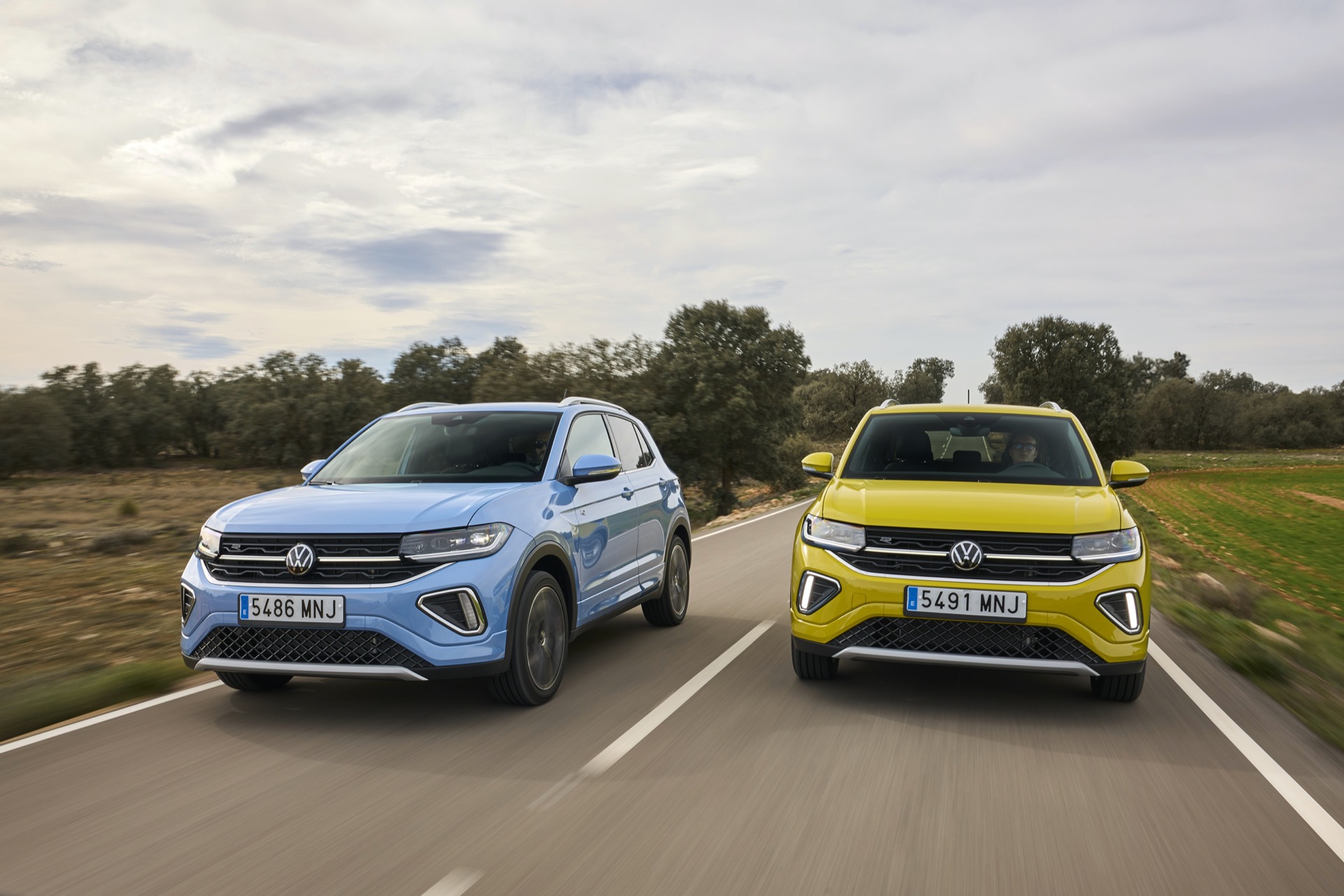
Volkswagen has renewed the T-Cross, the entry-level model in its SUV range, with a styling update, more equipment, higher-quality interior finishes and more technology.
As the times lately dictate, four years after the unveiling of the first Volkswagen T-Cross the German brand is carrying out the first update of one of its most important models. And once again, we have travelled to the brand’s factory in Navarre to visit the plant where the T-Cross is built exclusively for Europe, alongside the Volkswagen Polo and the Taigo; and, of course, to see firsthand how the changes have suited this small SUV.
Now let’s get down to business, but first some figures I think are very interesting, though you can always skip straight to the next paragraph. The SUV segment stopped being a fad some time ago, and in 2023 it reached a 60% share of our market. That is, 6 out of every 10 new cars sold in Spain have an SUV body. And specifically, in the urban SUV segment where the T-Cross competes, which is the second best-selling model from Volkswagen in our country, sales have multiplied by six over the last 10 years. Now you’ll understand why I said the T-Cross is one of the most important models for Volkswagen in our market. But let’s get to the heart of the matter and see what this new T-Cross brings.
What the T-Cross changes on the outside… and the colours are no joke
Basically, the changes are the usual ones in a restyling of this kind: tweaks here and there affecting the grille in pursuit of a closer resemblance to the T-Roc, Tiguan and Touareg, new-design light clusters with LED daytime running lights and the option of Matrix LED headlights, which the brand calls “IQ-LIGHT”, light projection integrated into the exterior mirrors, new wheel designs and new body colours.
And here I want to pause a little, because Volkswagen, in a clever marketing move and showing a good sense of humour, has chosen a naming scheme for the T-Cross colours that is surprising. Goodbye to “Tornado Red”, “Aquamarine Blue”, “Tungsten Silver” or “Pure White”… Steering away from the trend among all brands of giving names to colours -and to wheel designs- that is enough to make you think twice, Volkswagen has decided, at least for now for the T-Cross, to call the red colour Red Red; the blue, Blue Bluish; the white, White and that’s it; the yellow, Yellow Yellooow; and the black, Dark Black. Yes, that’s exactly how you’ll read them in Volkswagen’s commercial catalogues. A friendly touch that fits the model perfectly, aimed mainly at a young audience. And an approach the brand has confirmed it will apply to other models, though with a slightly less carefree twist.
The interior of the new T-Cross: more quality and Digital Cockpit as standard
The interior also has slight changes. The most important one in terms of design is that the central screen of the multimedia system is no longer integrated into the dashboard lines and now sits in an independent, “floating” structure. Tastes differ, but personally I found the previous design more modern, although this solution lets the screen sit a little higher, making it easier to see and operate.
The buttons for operating the climate control have also changed and are now touch-sensitive on models fitted with automatic climate control. More modern, but I still find classic physical controls easier to use. There is a clear improvement in what we criticised most about the T-Cross: the poor look of the materials used in many areas of the interior has disappeared, with softer upholstery, less hard plastic and, overall, everything more pleasant to the touch. It’s not a benchmark in this respect, but it no longer feels out of place.
Another interesting novelty is that every T-Cross now comes with Digital Cockpit instrumentation as standard, with an 8-inch high-resolution screen, which on R-Line models grows to 10.25 inches. As for the multimedia system screen, it is also 8 inches as standard, rising to 9.2 inches on the higher versions.
Otherwise, the T-Cross keeps the qualities that make it one of the most versatile SUVs of its size, thanks not only to good overall space. Details such as the sliding rear bench with 14 cm of adjustment to favour passenger or luggage space, a double-height boot that can vary its capacity between 385 and 466 litres, the possibility of folding down the front passenger seatback to carry objects up to 2.4 metres long, or the new towbar that now raises the maximum towable weight from 55 to 75 kg (you’ll be able to take your new e-bikes) make the small T-Cross into something more than a purely urban SUV.
More complete equipment from the base versions
And we come now to matters that directly affect your wallet, such as equipment. Volkswagen has restructured the range and now the base version, simply called T-Cross, comes as standard with the aforementioned digital instrumentation and LED headlights, multifunction camera, roof bars, rear parking sensors and traffic sign recognition system. This trim is only combined with the entry engine, the 1.0 TSI of 95 CV with 5-speed manual gearbox.
On the next rung, Life models add 16-inch alloy wheels, dual-zone climate control, darkened rear windows, front parking sensors, wireless App Connect and the Travel Assist assistant with adaptive cruise control and assisted longitudinal and lateral guidance. Finally, what used to be the R-Line package is now the top-of-the-range version, which adds to the Life trim 17-inch wheels, Matrix LED headlights with dynamic light assist, R-Line exterior and interior trim, LED rear lights with dynamic indicators, the Digital Cockpit enlarged with a 10.25-inch screen, rear view camera and driving profile selector. For these two trims, Life and R-Line, you can choose any of the three available engines.
A very interesting option is the so-called “Más” package available for the Life trim, which for just 200 euros extra adds items that would cost 2,300 euros if fitted individually. They are: metallic paint, R-Line wheels, tinted windows, rear camera, keyless access, light and visibility packs and the Beats Audio sound system. It’s worth it, considering that an R-Line costs 3,500 euros more than the Life.
And how much does the T-Cross cost? Volkswagen advertises an attractive “from price” of 21,950 euros, including the so-called “VW welcome campaign” and MyWay financing, which lets you get into the T-Cross for a monthly instalment of 125 euros, with a deposit of 5,282 euros and a final payment of 16,980 euros. Without discounts it is not a cheap car, since the 1.0 TSI Life of 115 CV with manual gearbox, which would be the minimum starting point I’d advise considering, has a list price of 26,840 euros.
Which engine to choose in the new T-Cross range?
I’ve practically answered this already in the previous paragraph: at equal equipment, the 1.0 TSI of 115 CV with 6-speed gearbox, which gains 5 CV over the previous T-Cross, costs barely 800 euros more than the 1.0 TSI of 95 CV with 5-speed gearbox. Not only does it offer better performance and a more pleasant drive, but also practically the same consumption… and it even uses less in some conditions of use. And for 1,400 euros I wouldn’t think twice: get it with the DSG dual-clutch gearbox, you’ll get the most out of the investment from day one and you’ll think of it every time you would have had to press the clutch.
With this 115 CV engine the T-Cross offers the best balance of performance, consumption and price across the whole range. It doesn’t fall short in any circumstance unless you’re looking for sporty driving -for that there’s still a more powerful engine above it-, it keeps consumption very tight if you don’t push it, and you’d have to be quite attentive to notice you’re driving a three-cylinder car. The only thing you might miss, not just with this engine but across the T-Cross range, is that there is no possibility of mild hybridisation to get you the ECO label from the DGT.
The 1.5 TSI four-cylinder goes considerably harder and uses only a little more, but it is paired exclusively with the DSG gearbox, costs another 2,100 euros more than the 1.0 115 CV DSG and is only offered in the R-Line trim, which puts the starting price very close to 34,000 euros. Heavy stuff.
Volkswagen T-Cross – Image gallery
Technical specifications of this car


 Kia offers an electric range of 10 models, 50 versions and 400 possible combinations
 The seven finalists for the 2027 European Car of the Year (COTY) are exclusively electric
 Peugeot E-208 GTi: a battery-powered toy that revives the spirit of the 1980s sports cars
Deja un comentario