Behind the wheel of the Geely Monjaro EM-i Ultra: a plug-in hybrid SUV that aims very high
 Antonio Roncero @roncero_antonio
22 November 2026
18 min.
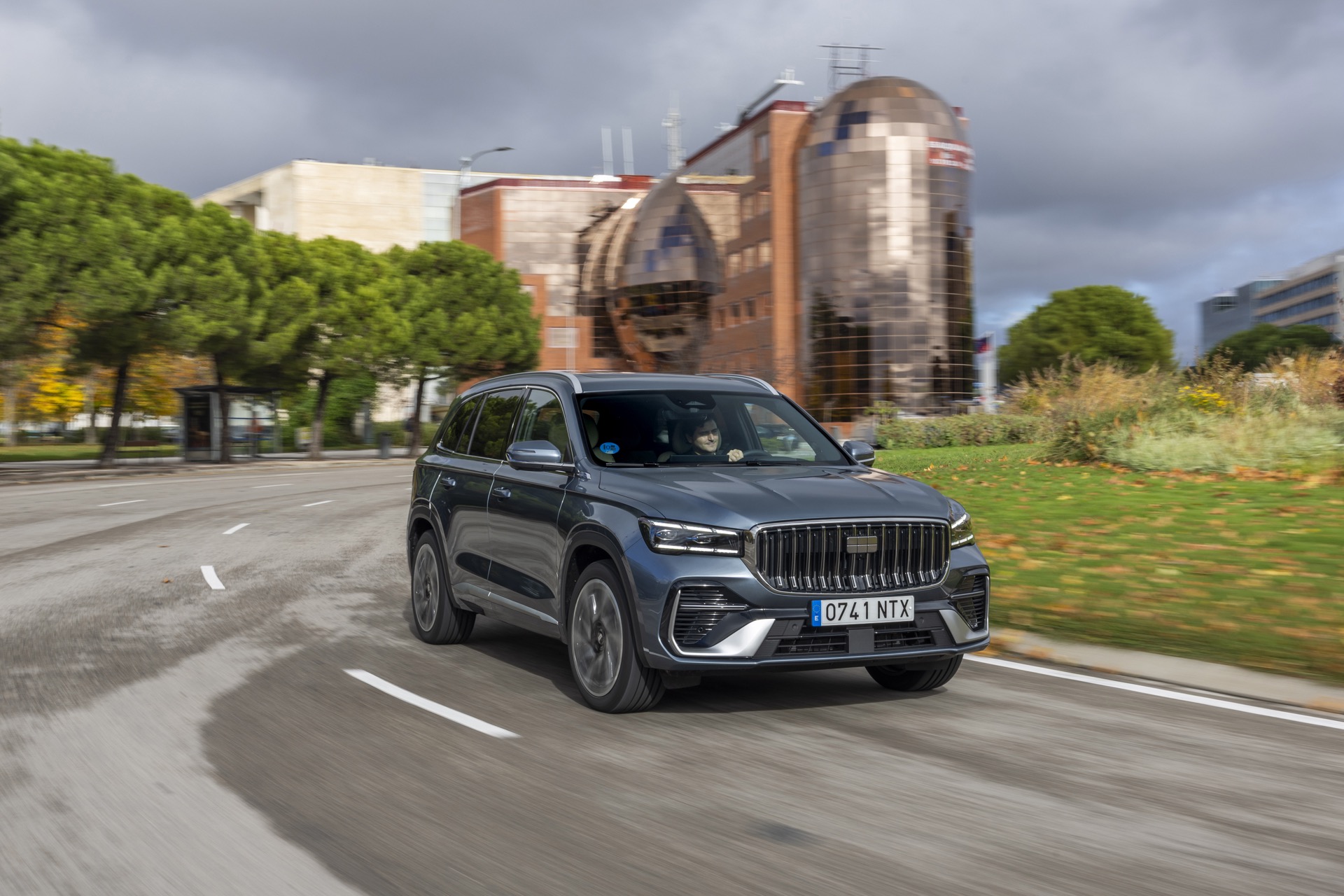
Geely Auto’s new flagship in Spain has 334 CV, all-wheel drive, 116 km of range in electric mode, one of the best driving feels among new Chinese-brand cars and a very competitive price, as long as the discounts apply.
We could go back a little further, but especially over the last three years, Chinese brands have gained ground in the Spanish market with a very recognisable formula: huge screens, lots of standard equipment and prices that European rivals, today, seem to find increasingly hard to match. It is an effective recipe, but it almost always left one subject unfinished: dynamic behaviour, what the car conveys when the road stops being straight and the tarmac is no longer perfectly smooth.
The Monjaro EM-i Ultra, Geely Auto’s fourth model in Spain and the brand’s new flagship, sets out to change that trend. It is a segment D SUV with a plug-in hybrid powertrain producing 334 CV, all-wheel drive and almost 120 km of homologated electric range which, judging by the sensations it conveys behind the wheel, aims higher than its launch price suggests, below 38,000 euros with all the discounts applied.
A large SUV that doesn’t feel like one
The Monjaro EM-i measures 4,800 mm long, 1,895 mm wide and 1,700 mm high, with a wheelbase of 2,845 mm. These are large-SUV dimensions, designed for those who genuinely need space, although behind the wheel the car does not feel massive at all. Ground clearance is 189 mm and the approach and departure angles are 19° and 18°, which gives it a degree of ability on poor roads without pretending to turn it into an off-roader.
The design follows a concept that Geely defines as an interpretation of Scandinavian design based on sobriety, balanced proportions and perceived quality. It is no surprise that many people will be reminded of Volvo… although, depending on the angle from which you look at it, it also bears similarities to other European SUVs, in particular Volkswagen or Skoda. In practice it must be said that it is a car with clean lines and solid presence, without excess. The large grille with vertical slats, the 20-inch wheels aerodynamically optimised, the upward-sweeping daytime running lights, the short front overhang and the LED signature running across the entire rear form a discreet and recognisable whole.
The exterior colours available are five: Imperial White, which is standard; and Volcanic Black, Titan Grey, Amber and Glacier Blue as paint options that the brand calls “premium”, and which are offered at launch with no surcharge. For the interior, as an alternative to the standard Onyx Black, an optional Sand finish in brown can be chosen.
The Monjaro is based on the global GEA Evo platform, and Geely Technology Europe, the unified R&D centre that integrates the brand’s engineering in Sweden and Germany, played a key role in its development. The Gothenburg centre contributes the heritage in architecture and safety, and engineers at the Raunheim centre handled the chassis tuning. Added to this are components from European suppliers such as ZF, for the steering, and Bosch, for the braking system.
According to Geely, the development programme combined virtual tuning with artificial intelligence, with testing equivalent to 720,000 km and 30,000 adjustment iterations on European road profiles, five rounds of real-world trials and 7,200 hours of work across eight facilities in Europe and Asia. These include Arjeplog and Hällered, in Sweden, and IDIADA, in Spain. In other words, part of what you feel behind the wheel was worked on on roads and circuits we know well. And this matters for understanding what comes next and why, on this occasion, we start by talking about dynamic behaviour.
Behind the wheel of the Monjaro EM-i: the most European Chinese SUV
The Monjaro’s dynamic behaviour is among the most European we have found so far in a Chinese car -the GWM Ora 5 also comes to mind– and in many respects it even improves on what some rivals from the continent offer. The difference compared with other rivals of the same origin, some of which took no less than two years from launch to make adjustments to suspension and steering, is that on the Monjaro both are very well tuned from the start.
The DP-EPS electric power steering, signed by ZF has three levels of assistance. I would say it is not yet perfect, but it has a natural and progressive response, without that sensation of extreme softness and lack of feedback still perceived in many cars of Asian origin. Here you clearly understand what the front wheels are doing, and that allows the car to be placed precisely through a tight bend or to avoid feeling excessive floating when driving on the motorway, where stability and the absence of constant corrections are much appreciated.
The suspension is the other half of the equation. The layout is McPherson at the front and multi-link at the rear, with dampers featuring an RS valve system and, standard on this finish, electronic control. It combines three passive operating paths with an electromagnetic control valve and adjusts damping in real time, with a response time of less than 20 milliseconds. There are three selectable modes, Comfort, Standard and Sport. Geely claims it reduces impacts over speed bumps by up to 23%, improves vibration filtering by 19% and increases ride smoothness by 33% compared with a conventional damped suspension.
I wouldn’t dare confirm it, but I would say the result is very good. Even in Comfort mode the damping is not soft at all, which allows body movements to be well controlled, something that is not always easy with a car of this size which, with the weight of the battery, goes above 2 tonnes. But the car absorbs potholes well and offers a convincing balance between comfort and control. Bearing in mind that the standard tyre fitment is around 245/45 R20, that balance is all the more commendable.
The e-AWD electric all-wheel drive completes the picture. The system can send all the torque to the front axle or split it up to 50/50, and its rear electric motor -there is no mechanical connection between the two axles- responds in just 0.01 seconds, according to the brand. There are six drive modes: Pure, Hybrid, Power, Snow, Off-Road and Sand; and in the last three the all-wheel drive stays permanently active. In normal conditions it works so discreetly that you barely notice it, but it is there when it rains -it engages automatically if the indicators are on for more than two minutes-, on slippery surfaces or on a demanding gradient. I briefly drove the Monjaro EM-i on tracks without any difficulty for the traction system beyond a slightly muddy stretch, and what struck me most, once again, was how well the suspension works.
As for brakes, the Monjaro fits the integrated Bosch OneBox system, also with the option of choosing between two modes, Sport and Comfort, which slightly change the feel of the pedal by intervening in the transition from regenerative to hydraulic braking. Geely quotes a braking distance from 100 to 0 km/h of 33 metres -the best in its class according to the brand- and a speed of 79 km/h in the moose test. These are internal homologation figures, but they fit with the sense of security the car conveys under hard braking. As soon as we have the chance we will put the Monjaro EM-i through a longer and more demanding test that allows us to confirm all these good impressions left by this first contact.
Interior: the quality no longer surprises, but it still draws attention
Previous Geely models, each in its segment, already gave us the impression of being at a very good level in terms of quality, from the E5 and the Starray to the E2. The Monjaro raises that perception. The cabin combines a tidy layout with large surfaces covered in soft-touch materials. But what truly makes the difference is the attention to detail: trims with three-dimensional laser engraving and a matt anti-glare finish, and a rotary dial in cut crystal that is a pleasure to use. The upholstery is a synthetic leather very similar to nappa, and the 256-colour ambient lighting completes a very refined atmosphere.
The driving position is completely digital. There is a 15.4-inch central screen, a 12.3-inch instrument cluster and a 25.6-inch Head-Up Display projected onto the windscreen. Everything is managed with Flyme Auto, a smooth proprietary Geely system that supports OTA remote updates and is wirelessly compatible with Apple CarPlay and Android Auto. We must also talk about silence. The front windows are double-layer laminated glass, and when driving you notice the work Geely describes in its dossier regarding insulation, sealing and other measures aimed at reducing the noise reaching the cabin. What I liked least is that there is still a great dependence on the screen for certain functions: even to switch on the lights you have to tap several times. In the end, given the lack of buttons, the best approach is to become “friends” with the voice control system and not get tangled up in menus.
If one strength of the Monjaro as a travel car has to be singled out, it is the seats. They combine 11 layers of material in the front seats and 8 in the rear, with high-density foams, including a 15 mm layer, that adapt to the body and spread the pressure. They are soft without sinking and firm without feeling hard, and the sense of comfort does not fade as the kilometres add up. The front seats have electric adjustment with memory, heating, ventilation and eight-point massage with a novel acupressure function, which stands out in this price range.
The interior space matches the exterior size. It is a very spacious cabin for five occupants, with good legroom thanks to the 2,845 mm wheelbase. The rear backrests can be reclined by 5 degrees and, a practical detail, the front passenger seat can be adjusted from the rear seats, in case the person behind needs more room. The rear seats have their own air vents and USB-C ports.
The boot is another major asset. Its capacity is 633 litres, expandable to 2,183 litres with the rear seats folded, and the tailgate opens and closes electrically. If the front passenger seat is also folded, objects up to 2.8 metres long can be carried, which makes it very flexible for transporting dismantled bicycles, boards or furniture. The cabin adds up to 34 storage compartments, longitudinal roof rails come as standard and the towing capacity is 1,500 kg braked, a very good figure for a plug-in hybrid.
The EM-i hybrid system: smooth and with reserve power
The heart of the Monjaro is the EM-i Super Hybrid system, which consists of a 1.5-litre turbocharged four-cylinder petrol engine developed specifically for hybrid applications, and three electric motors. Two of them drive the wheels, one per axle, and the third acts as a generator. Added to this are a 3DHT automatic transmission and a 29.8 kWh LFP battery. The combustion engine delivers 102 kW (138 CV) and 230 Nm, with a thermal efficiency of 47.3%, thanks to the Miller cycle, high compression ratio and direct injection at 350 bar. The combined system produces 246 kW (334 CV) and 667 Nm of combined torque, which allows it to accelerate from 0 to 100 km/h in 5.8 seconds and reach 190 km/h, with a top speed of 169 km/h in electric mode, above the usual 140 km/h that most plug-in hybrids are limited to.
What is interesting is how the powertrain divides the work. At low speeds and in town, the system prioritises electric propulsion. With light load it can run in series, with the petrol engine driving the generator. In hard acceleration it works in parallel, adding electric and combustion thrust together. And at high speed the petrol engine can drive the wheels directly with electric assistance. In addition, the rear electric motor can be fully disconnected when not in use, which eliminates drag losses, improving range and consumption.
The driver has three modes at their disposal: EV, which prioritises electric propulsion and only brings the petrol engine in under full-throttle acceleration, for thermal needs or when the battery is below 20%; Hybrid, which alternates the different forms of propulsion to balance consumption and performance; and Power, which raises the battery reserve so that more electric power is available. It is also possible to force the battery to charge while driving -you can choose the percentage you want to reach and set it on a dial on the touchscreen-, but as is usually the case, it is not very efficient.
And how does it go? With remarkable smoothness and forceful performance. In electric mode it moves with surprising ease, without the feeling of being restricted that other large plug-ins give when pushed. And when the hybrid system comes into play, the transition happens almost without the driver noticing: no jolts, no vibrations, no abrupt changes of rhythm. The thrust is progressive and there is always reserve for overtaking or joining a fast road, even when driving in the modes that favour efficiency over performance. Here we could say that, both with the battery energy and with the support of the petrol engine, the performance lives up to the 334 CV it claims.
Energy recovery has four levels (Low, Medium, High and Automatic). In Automatic, the system analyses the gradient, speed and distance to the car ahead: it recovers more in stop-start traffic and less on a free-flowing motorway, to prioritise a smoother ride. It is an intelligent solution that improves range and reduces brake wear, but I still miss paddle shifters and being able to “play” with the deceleration levels while driving, as they do, for example, with Audi, Kia or Hyundai in their plug-in hybrids.
Consumption and range: what to expect day to day
The homologated figures are as follows: 116 km of WLTP electric range, 906 km of combined total range, 2.4 l/100 km of weighted combined-cycle consumption, 18.3 kWh/100 km of electric consumption and 54 g/km of CO₂ emissions. As with any plug-in hybrid, weighted consumption depends heavily on how often the battery is recharged. With the battery depleted, the homologated fuel consumption rises to 7.4 l/100 km, a figure worth keeping in mind if you plan to travel a lot without recharging.
From what we have verified in this first contact, over a route of more than 300 km, mostly on the motorway, in real-world use consumption stays controlled and the electric range is, in practice, one of the car’s great attractions. It will not be difficult to do 100 km in electric mode, or come close, which means many users will be able to get around every day, in town and on intercity trips, without using petrol. The combustion engine is left for long journeys, where total range approaches a thousand kilometres.
Charging is another strong point. On DC it accepts up to 78 kW, which allows going from 30 to 80% in about 15 minutes, a rare figure for a plug-in hybrid. On AC it charges at 6.6 kW, with 20-100% in 4.25 hours. Mode 3 and Mode 2 cables are included as standard, and the V2L system of up to 6 kW allows powering external devices, from a camping trip to a job where there is no socket.
Monjaro EM-i price: watch the small print
The Monjaro EM-i arrives on the market initially in this top-of-the-range version, both in terms of engine and equipment. The only finish available, Ultra, leaves no options on the equipment list except metallic paint, with features such as the panoramic sunroof, front seats with massage, ventilation and heating, Head-Up Display, dual-zone climate control with N95 filter, wireless charger, 16-speaker sound system or 540° panoramic view camera with transparent chassis function. The safety equipment is also very complete, with a long list of assistants: automatic emergency braking, evasive manoeuvre assist, adaptive cruise control, motorway driving assistant, lane keeping and lane change, etc.
And now comes the best part… but beware of the small print. The Geely Monjaro EM-i Ultra has a recommended retail price of 46,990 euros, but the brand advertises it at launch from 37,990 euros. It is a “headline” price, but it includes commercial campaigns and the 2,250 euros of aid from the Plan Auto+ scheme which, at the time of writing, is practically exhausted, so the cash price, if the current discounts remain, starts at 40,240 euros, although it is still a very good price compared with what its rivals offer. And if you buy it on finance? Then the starting price rises to 42,240 euros. Geely offers a launch deal for buying the car on finance at 3.99% nominal interest (APR: 4.73%), with a monthly instalment of 265 euros over 47 months, a deposit of 14,376 euros, plus 554 euros for the credit arrangement fee and a final instalment of 19,175 euros. The total price when paying for the car in instalments is 46,560 euros.
As with the rest of the brand’s models, the warranty is eight years or 200,000 kilometres, for both the vehicle and the high-voltage battery, and the Geely Care+ programme includes 24-hour roadside assistance throughout Europe during the first three years.
Alternatives to the Monjaro EM-i Ultra
Competition in this segment is huge. The sales leader is the BYD Seal U DM-i, which has just been updated with improvements to engines and suspension. The version that competes with the Monjaro EM-i Ultra is the Design, also with all-wheel drive, 374 CV and 114 km of electric range. Its list price is higher than the Monjaro’s, at 48,500 euros. But with all the discounts, including the financing one (and not counting Plan Auto+), it drops to 39,240 euros.
If you are looking for a price-based alternative, a very interesting car with the current offer is the
Mitsubishi Outlander PHEV, which has a discounted price of 35,750 euros, but on finance it comes to just over 32,000 euros. It has all-wheel drive, a maximum output of 306 CV, 86 km of electric range and stands out for its high level of comfort and generous space. A sportier option would be the Cupra Tavascan, which in Endurance version with 286 CV starts at 43,500 euros, and in the VZ 4Drive variant is available from 51,070 euros. If you prioritise space and boot capacity and want a SUV from a European brand, you can look at the Skoda Kodiaq, which in PHEV version is available from 38,800 euros with 204 CV, and goes up to 53,800 euros in the most luxurious versions. And if you need seven seats and do not want to give up luxury, comfort and performance, the Ebro S900 PHEV is the ideal option, with its 426 CV, up to 140 km of homologated electric range and a final price of 41,590 euros.
Geely Monjaro EM-i Ultra – Image gallery

 Kia offers an electric range of 10 models, 50 versions and 400 possible combinations
 The seven finalists for the 2027 European Car of the Year (COTY) are exclusively electric
 Peugeot E-208 GTi: a battery-powered toy that revives the spirit of the 1980s sports cars
Deja un comentario