BMW X5 xDrive40d with 306 CV, road test (Engine and performance)
 Diego G. Moreira
15 April 2012
5 min.
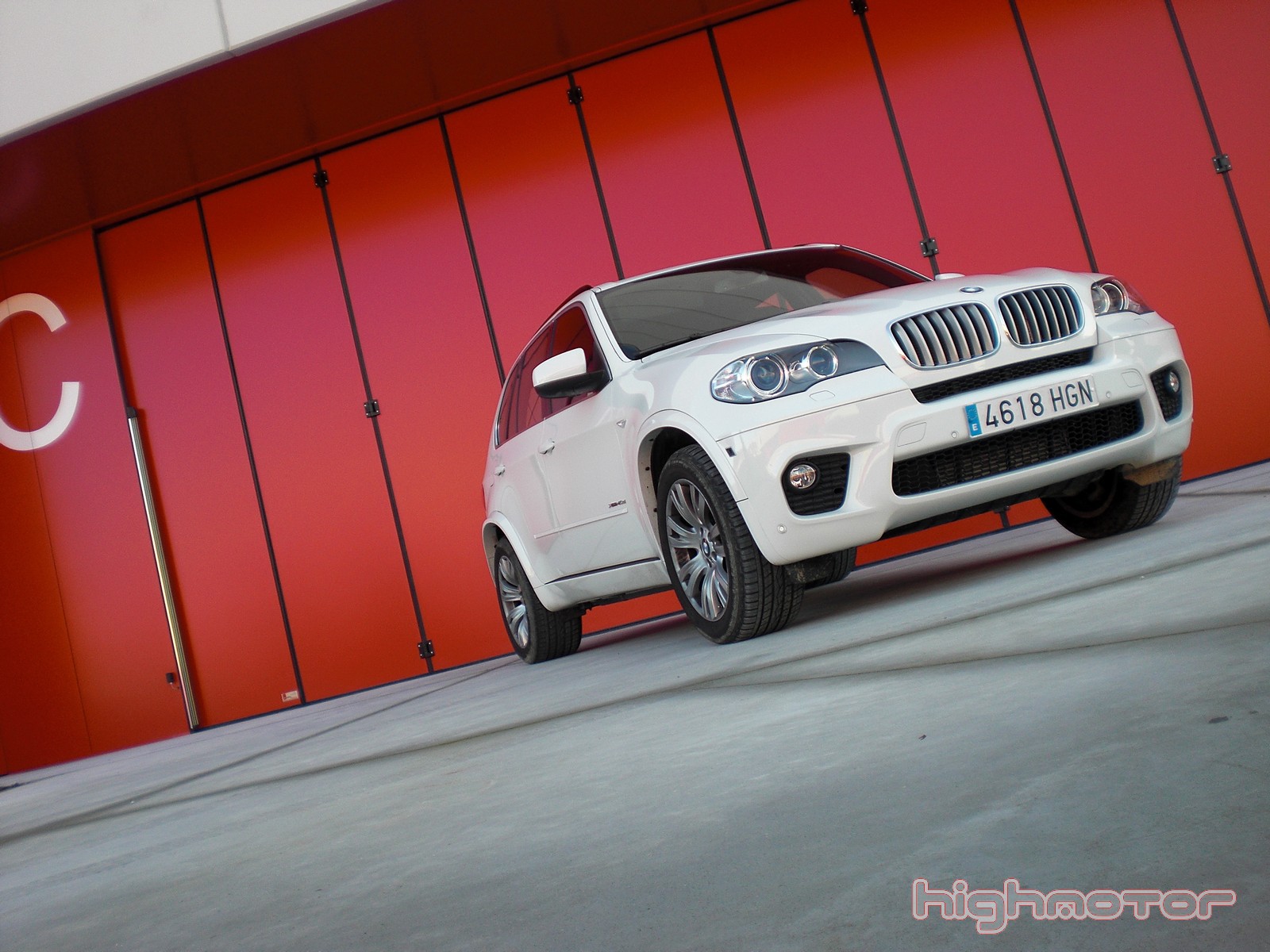
Road test of the BMW X5 xDrive40d with 306 CV. In this section we analyse the performance, the engine, consumption, handling and off-road capabilities of the X5.
A few days ago we announced this test with a photo that was a bit tricky to guess as being about a BMW X5. The photo was of the side, with the front-view camera as the protagonist. Rarely do we get behind the wheel of a vehicle as exclusive as this BMW X5 xDrive40d with 306 CV and the M Sport package.
Behind that name lies a three-litre, six-cylinder in-line diesel engine that produces 306 CV, and the X5’s sporty looks live up to its on-road behaviour. Stick with us through this test and you’ll see how this SUV with a sportscar soul surprises you.
Engine and performance
It’s called the 40d, but in reality we’re not talking about a four-litre engine; in fact it isn’t very different from the 30d. In essence it is a three-litre, six-cylinder in-line block that reaches 306 CV, compared with the 245 CV of the 30d.
It is a twin-turbocharged engine (a smaller turbo for low revs and a larger one complementing it at high revs). One figure that stands out is its over 100 CV per litre of displacement, something unusual in diesel engines.
The best part is not the power figure but the torque, which gives us an idea of this crossover’s pushing capacity. Torque peaks at 600 Nm from just 1,500 rpm, meaning we get a response from very low revs, strong and consistent all the way up to 5,000 rpm (this is where the twin-turbo nature shows, both in the low-rev response and as revs climb, always progressively).
When you press the accelerator the X5 literally pins you to the seat, but where we felt the force most was between 3,500 and 4,000 rpm; at that point all the horses are available under your right foot, propelling this crossover magnificently despite its considerable dimensions and a weight exceeding two tonnes.
Accompanying all this is a lovely orchestra that resonates outside the car when we press the accelerator, marking its sporty character and showing that under the bonnet there is a good herd of horses.
Matched to the engine is an eight-speed automatic gearbox, a well-known ZF unit. The most distinctive feature is the gear selector, with a characteristic design that takes some getting used to, but once you do it is very quick and easy to use.
The gearbox has a Sport mode which sharpens the car and keeps it at higher revs for a more immediate response. In normal mode it shifts up around 2,000–2,500 rpm. That said, paddle shifters are not standard on the steering wheel; they are an extra.
Handling
We already know the engine is powerful, that it has strength and that its 306 CV are felt. But some of you are surely thinking that the BMW X5 isn’t a car that stands out for agility, or that it might be clumsy through corners. Well, no.
What is surprising is precisely its stability and handling, which is closer to a saloon than to a true 4×4. Several luxury SUVs have passed through our hands and I can categorically say that the X5 is one of the most agile when you drive it in a somewhat sportier way.
While on the road it is comfortable, stable and enjoys the advantages of a crossover in terms of comfort and height, without the notorious body roll that many off-roaders show on country roads or motorways. It has no fear of a winding road; simply select the Sport mode on the car, which firms up the suspension and steering, reducing body roll and turning it into a very agile vehicle on bends.
The steering as always stands out for its precision; it is one of the strong points of all BMW models, and in this case it fully meets expectations for the X5. Likewise, the braking system does its job properly and stops the more than two tonnes of this BMW without any problem.
Consumption
In this section we have to start from its size, that is, a large SUV with seven seats, and also from its weight and power. With these starting conditions it is normal that consumption is not particularly frugal, but it remains within normal figures.
On the motorway, over the 1,200 km of our standard test, it settled at 9.5 litres per 100 km. On country roads the figure hovered around 10 litres per 100 km. Finally, in town consumption rose to 13 litres per 100 km.
The fuel tank had a capacity of 85 litres with 8 litres of reserve, enough to ensure you can reach the nearest petrol station.
Off-Road Capabilities
The BMW X5 has permanent all-wheel drive; it normally runs with a bias towards the rear axle and, when it detects loss of traction, redistributes power to the front. We tested the drive system on sandy and dirt surfaces, and it responded correctly.
However, it was not fitted with the right tyres to properly test its off-road abilities, and in addition the M Sport exterior pack reduced the approach angles and ground clearance, so our test unit was not the best example for off-road driving.
The traction tests we were able to run (despite having road tyres) were passed satisfactorily, with a good response. But we could not check much more under these two constraints, nor do I think this is the typical terrain for the BMW X5 or what its potential customers are looking for.
Photos | David Taboada, Test team
Thanks to the collaborators in the photo session and off-road tests of the model


 Peugeot E-208 GTi: a battery-powered toy that revives the spirit of the 1980s sports cars
 New Lexus ES: luxury grows and goes electric
 First contact with the Dacia Sandero Hybrid 155: power and efficiency from €19,890
Deja un comentario