911 Porsche Sports Cars Range / versions Historia
Do you know all the standout versions of the iconic Porsche 911?
 Óscar Sanz
27 October 2023
5 min.
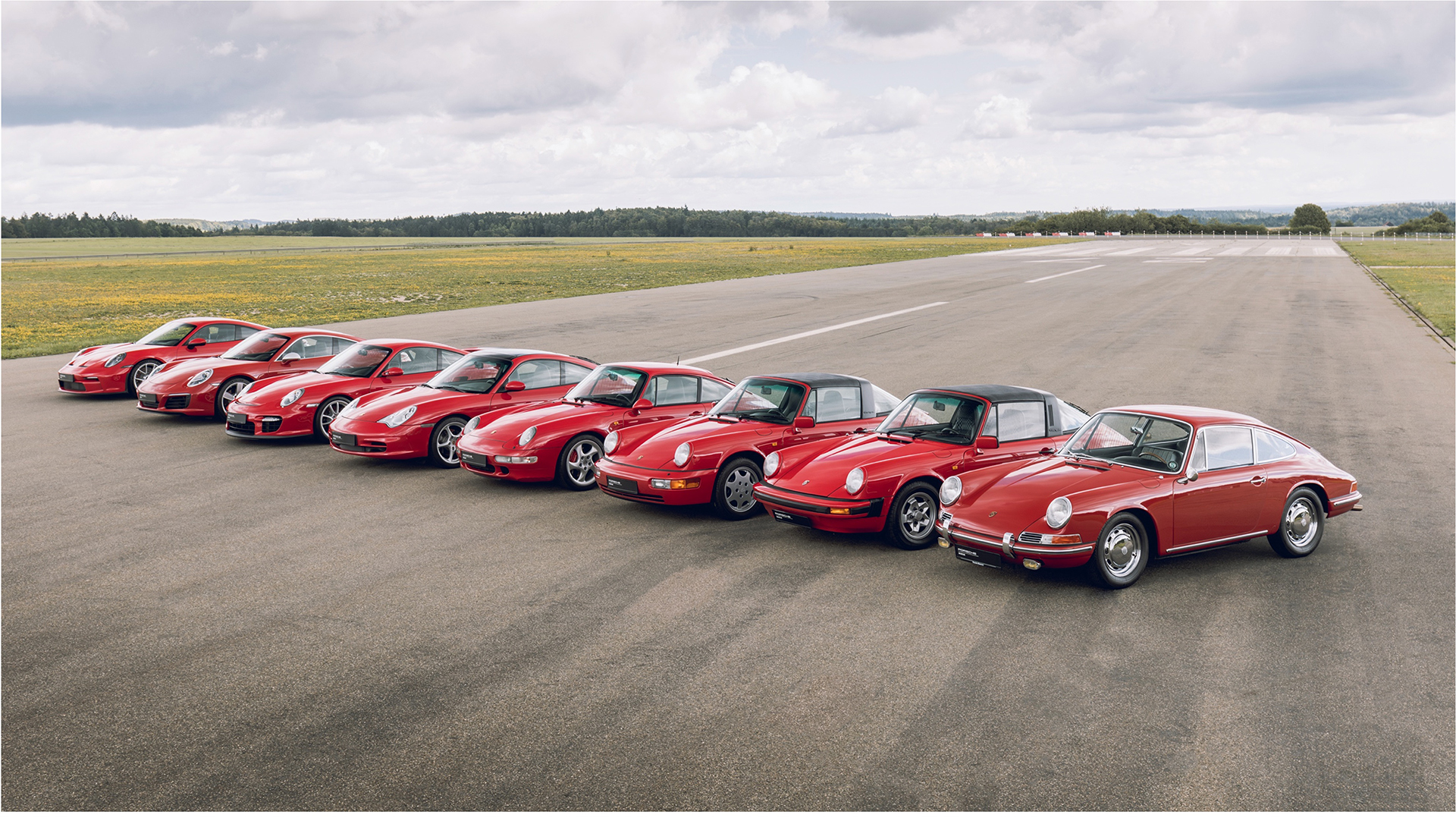
We take a look at the eight generations of this iconic sports car, which has been captivating enthusiasts since 1963, when its first version was unveiled.
The Porsche 911, an icon of the automotive world, has travelled a long and exciting road across its eight generations. From its humble beginnings as the Porsche 901 in 1963 to the most recent commemorative version, presented in 2023, the 911 has captivated sports car lovers around the world. Join us on a journey through the decades as we explore some of the most outstanding moments of this German engineering legend.
The birth of an icon
It was at the IAA International Motor Show in Frankfurt in 1963 that Porsche unveiled a completely new car, initially known as the Porsche 901. The 911 quickly earned a place in the hearts of sports car enthusiasts. Two years later, in 1965, the Targa arrived, a convertible with a safety roll bar that complied with US safety regulations. The reception was spectacular. But it was in 1972 that the 911 Carrera RS 2.7 made its triumphant entrance, a limited-edition model that weighed just 960 kilograms and was distinguished by its iconic “ducktail” spoiler. Equipped with a six-cylinder flat engine producing 210 CV (154 kW), this vehicle reached speeds of up to 245 km/h.
The dawn of the Turbo era
The year 1974 marked a milestone in the history of the 911, as Porsche introduced a turbocharged engine in a production car for the first time. The Porsche 911 Turbo, with its 3-litre engine and 260 CV, caused a sensation worldwide and paved the way for future Turbo generations. At the 1982 Geneva Motor Show, Porsche surprised the public with the presentation of the 911 SC Cabriolet, a convertible with a fabric roof that complemented the Targa. Seven years later, in 1989, the Speedster arrived, with a design reminiscent of the Porsche 356 Speedster of the 1950s and powered by a 231 CV (170 kW) engine from the Carrera 3.2, offering a narrow-body option for export to certain markets.
Classic modernity
In 1989, to mark the 25th anniversary of the 911, Porsche launched the fourth generation, known as the 964, with the Carrera 4 version introducing all-wheel drive, a technical innovation that proved its worth in rally competition. With features such as ABS, power steering and, from 1991, airbags as standard, the rear-engined sports car reached new levels of sophistication. In 1992, the RS designation returned with the Carrera RS, a model focused on lightness. In 1993, roughly 100 units of the 911 Carrera RS 3.8 were built for GT racing, with its unmistakable adjustable rear wing.
The last air-cooled model
At the 1993 IAA Frankfurt Motor Show, the fifth generation of the 911, known as the 993, was unveiled. In 1995, the Porsche 911 Turbo debuted, equipped with a 3.6-litre twin-turbo engine, all-wheel drive and a six-speed manual gearbox. That same year, the turbocharged 911 GT2 and the new Targa were also presented, which abandoned its characteristic curved roll bar in favour of a retractable glass roof.
A historic turn
A historic moment came in 1997 when Porsche presented a new generation of the 911, known as the 996, the first with a water-cooled engine. The 996 was offered in Coupé and Cabrio versions. In 1999, at the Geneva Motor Show, the 911 GT3 was presented as the successor to the 911 Carrera RS. In 2001, the new GT2 became the most powerful 911 to date, with a 462 CV twin-turbo engine and rear-wheel drive instead of all-wheel drive. Admittedly, this model was stripped of several comforts such as air conditioning and the radio which, together with lightweight sports seats, made it ideal for track use.
The return of the GTS
The sixth generation, known as the 997, was presented in 2004. In 2009, the 911 Sport Classic made its debut, becoming one of the most sought-after special models in history, limited to 250 units. In 2010, the Carrera GTS joined the 911 family, offering Coupé and Cabrio versions with a 408 CV engine. The GTS versions have become an essential part of the Porsche model line-up. In 2011, the 911 GT3 RS 4.0 closed out the 997 era with 500 CV, becoming the most powerful naturally aspirated 911 up to that time.
Performance and efficiency
The seventh generation (991) arrived in 2011 and, in 2013, Porsche launched a special edition to commemorate the 50th anniversary of the 911. This commemorative model featured design elements that recalled the original Porsche 911. In 2014, Porsche presented the new 911 Targa at the Detroit Motor Show, with an innovative roof that evoked the classic roll bar. In 2015, the 911 Carrera and 911 Carrera S were offered with turbo engines for the first time, improving power and efficiency. In 2017, Porsche reintroduced the purist Carrera T variant, reducing weight and increasing sportiness.
Greater versatility in a car
In 2018, Porsche unveiled the eighth generation at the Los Angeles Auto Show, the 992, which became more versatile than ever, with Coupé, Cabrio and Targa versions in its different variants. In 2020, Porsche presented the 911 Targa 4S Heritage Design Edition, the first of four planned collector’s pieces. Based on the 911 Targa 4S with a 450 CV twin-turbo engine, this model featured a classic design. In 2022, Porsche surprised the world with the 911 Dakar, a limited series that combined the characteristics of a high-performance sports car with the off-road capabilities of an SUV. And in 2023, to celebrate its 60th anniversary, Porsche presented the 911 S/T, a purist, lightweight model equipped with the GT3 RS engine.
Image gallery: The legacy of Porsche§h167§
Technical specifications of this car


 Kia offers an electric range of 10 models, 50 versions and 400 possible combinations
 The seven finalists for the 2027 European Car of the Year (COTY) are exclusively electric
 Peugeot E-208 GTi: a battery-powered toy that revives the spirit of the 1980s sports cars
Deja un comentario