BYD Electric Cars ECO Tests Urban
I've already driven the new BYD everyone is talking about, and I'll tell you why the Dolphin Surf seems to me the best city car of the moment
 Antonio Roncero @roncero_antonio
29 May 2025
7 min.
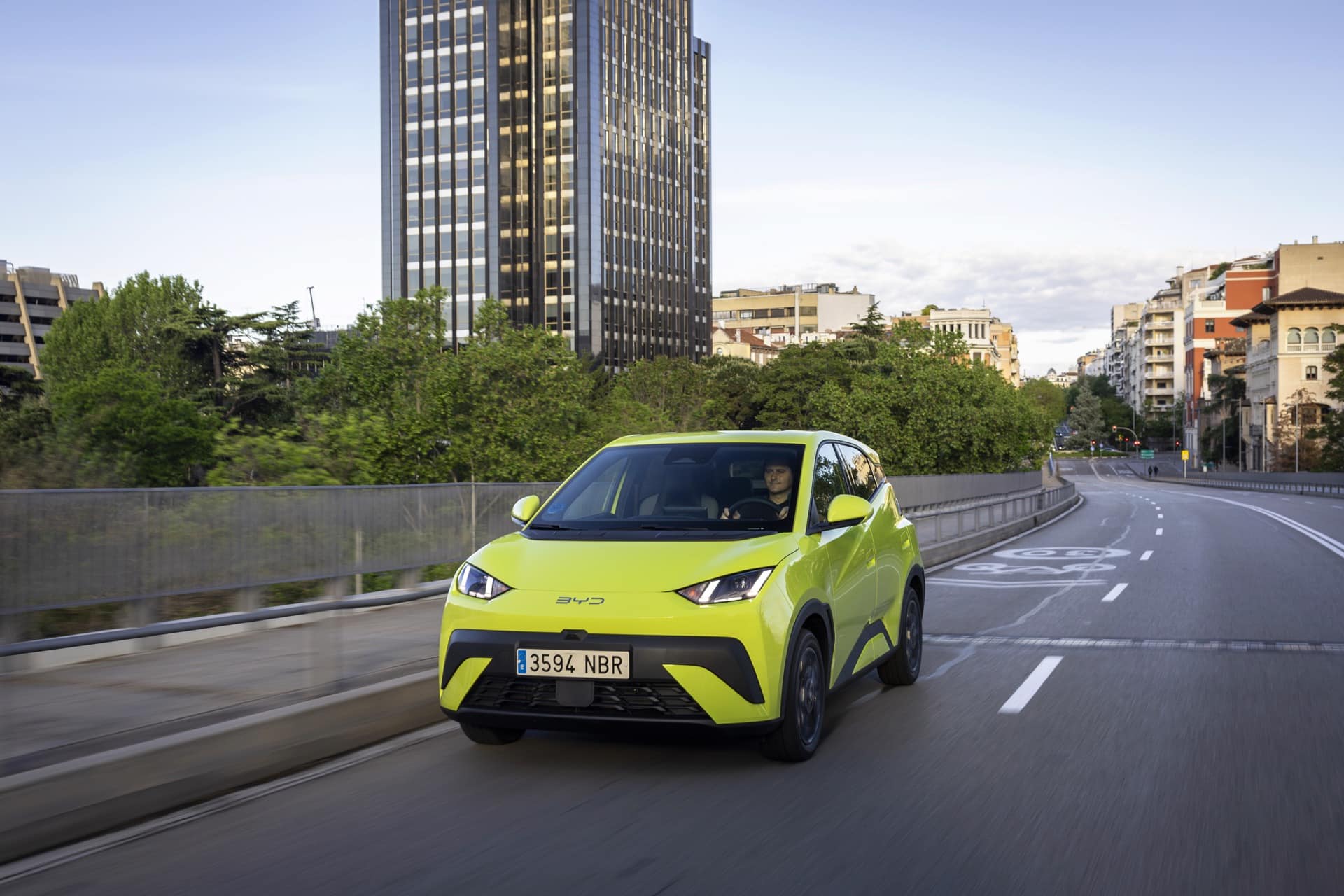
Much is being said about the new car with which BYD wants to conquer the city. And no wonder. If lately every move by the Chinese brand has drawn attention, the new Dolphin Surf draws it even more. Not only is it the most affordable BYD, it is also one of the cheapest electric cars on the Spanish market, right between the Dacia Spring and the Leapmotor T03. But in terms of equipment, quality and driving feel, it is closer to much more sophisticated electric cars… and clearly more expensive ones.
My favourites so far in this category of electric cars for mainly urban use were the Renault 5 E-TECH for the extra emotion provided by a design that wins you over, and the Hyundai Inster, for a driving feel that never makes you think you’re in a small car. But now the new BYD Dolphin Surf enters the picture, and I admit it has surprised me. It has a lot of the Inster’s character behind the wheel, with the feel of a bigger car. And like the Renault 5, it doesn’t go unnoticed either. Especially in the eye-catching lime green colour that comes as standard. That said, think it over carefully because I believe that, in the long run, this colour can become tiresome. It is also available in black, “cream” white and blue, although as an optional extra at 650 euros more.
By the way, since we’re cross-referencing some of its alternatives, it’s worth placing the Dolphin Surf by size before getting into the details. It measures 3.99 metres long, 1.72 metres wide (1.97 metres with mirrors) and 1.59 metres high, with a wheelbase of 2.5 metres. It has a charming five-door body that gives access to a very well-used interior, and a boot with 308 litres of capacity, which is not bad at all. A Dacia Spring is shorter, narrower and has less space for passengers and in the boot, while the Hyundai Inster is shorter but has a cabin as roomy or more so than the Dolphin Surf, with the added advantage that its rear bench slides, whereas on the BYD it is fixed.
BYD Dolphin Surf range: two batteries and two power levels
Two engines are available, with 65 kW (88 CV) and 115 kW (156 CV), and two battery sizes, with 30 kWh or 43.2 kWh. The less powerful engine is offered with both batteries, while the more powerful one is combined only with the larger-capacity battery. The result is a range that looks like this:
- Dolphin Surf Active: 65 kW motor, 30 kWh battery, WLTP range of up to 220 km
- Dolphin Surf Boost: 65 kW motor, 43.2 kWh battery, WLTP range of up to 322 km
- Dolphin Surf Comfort: 115 kW motor, 43.2 kWh battery, WLTP range of up to 310 km
All versions accept AC charging at a maximum power of 11 kW, while with DC the small-battery versions charge up to 65 kW, and up to 85 kW for the larger one. In both cases this means around 25 minutes to go from 30 to 80% capacity. All Dolphin Surfs also come standard with V2L functionality to power external devices using the car’s battery.
Prices with promotional campaign start at 18,780 euros for the Active, 22,780 euros for the Boost and 25,280 euros for the Comfort. This means that, if you take advantage of the MOVES III Plan, with the 4,000 euros in aid you get a Dolphin Surf Active from 13,780 euros, which drops to 11,780 euros, the price the brand advertises, but beware, only if you hand in a car for scrapping. In addition, for the first 500 orders, BYD gives away a wallbox with 11 kW of power (charger only, without installation).
The Active version includes a multimedia system with a 10.1-inch rotating touchscreen, parking sensors, rear camera, V2L functionality, adaptive cruise control, air conditioning, synthetic leather upholstery and electric mirrors. For the 4,000 euros extra, the Boost adds the extra 100 km of range from the larger-capacity battery, 16-inch alloy wheels, electric front seats, rain sensor and electrically folding mirrors. The top-of-the-range Comfort adds a 360-degree camera, LED headlights, tinted glass, heated front seats and wireless smartphone charging.
Behind the wheel of the Dolphin Surf: a city car that doesn’t feel like one
There will be time for a more in-depth test. But for now, a first contact with the Dolphin Surf Comfort allows us to draw many conclusions. The first is that the car maintains the good form we’ve come to expect from BYD in terms of interior presentation, finishes and attention to detail. Without a doubt, well above the cars it competes with on price… and even better than some more expensive ones. And the second is that the driving feel, the pedal response and the handling… it’s as if you were driving a larger car in a higher price bracket.
With the more powerful engine the Dolphin Surf accelerates from 0 to 100 km/h in 9.1 seconds, compared with 11.1 seconds for the 65 kW small-battery variant, and the 12.1 seconds the Boost needs, with the small engine and large battery. Top speed is 150 km/h in all versions. Although I haven’t yet driven the 65 kW versions, I dare to recommend the less powerful engine for anyone looking for a city car, because the 115 kW one has more than enough power for this type of use, and in some situations, such as accelerating while leaning into a tight bend or on a roundabout, it even loses some traction even on dry tarmac. That said, it’s a delight to zip around town with it, to pull away first from traffic lights or even to see how well it holds its own on motorways and dual carriageways.
Choosing between the Active and Boost versions seems harder to me, since 4,000 euros of difference for the bigger battery and some equipment details is a lot of money. My recommendation is as follows: for mainly urban use, if you can charge the car at home, even from a domestic socket, go for the Active. Bear in mind that the 220 km of range on the mixed cycle turns into more than 350 km in urban use, so you’ll only need to plug it in now and then overnight. However, if you don’t have that option, opting for the Boost may be worthwhile, because in this case urban range goes beyond 500 km.
Otherwise, the Dolphin Surf’s suspension seems very well tuned to me, the car soaks up potholes well and the steering has good feel, although in some situations, such as changing lanes on the motorway, it can feel very direct. There are three driving modes, Eco, Normal and Sport, and the difference between them is clearly noticeable, especially in throttle response. And I still miss, as with all BYD models, the ability to “play” with energy recovery without having to go through the screen, for example with paddles on the steering wheel. By the way, on this point I’d also like the letters and numbers of the information shown on both the instrument cluster and the multimedia screen to be bigger.
BYD Dolphin Surf – Image gallery

 Kia offers an electric range of 10 models, 50 versions and 400 possible combinations
 The seven finalists for the 2027 European Car of the Year (COTY) are exclusively electric
 Peugeot E-208 GTi: a battery-powered toy that revives the spirit of the 1980s sports cars
Deja un comentario