Kia Niro Hybrid vs. Hyundai Kona Hybrid: Korean siblings stuck in the daily traffic jam
 Iván Navarro
17 May 2026
4 min.
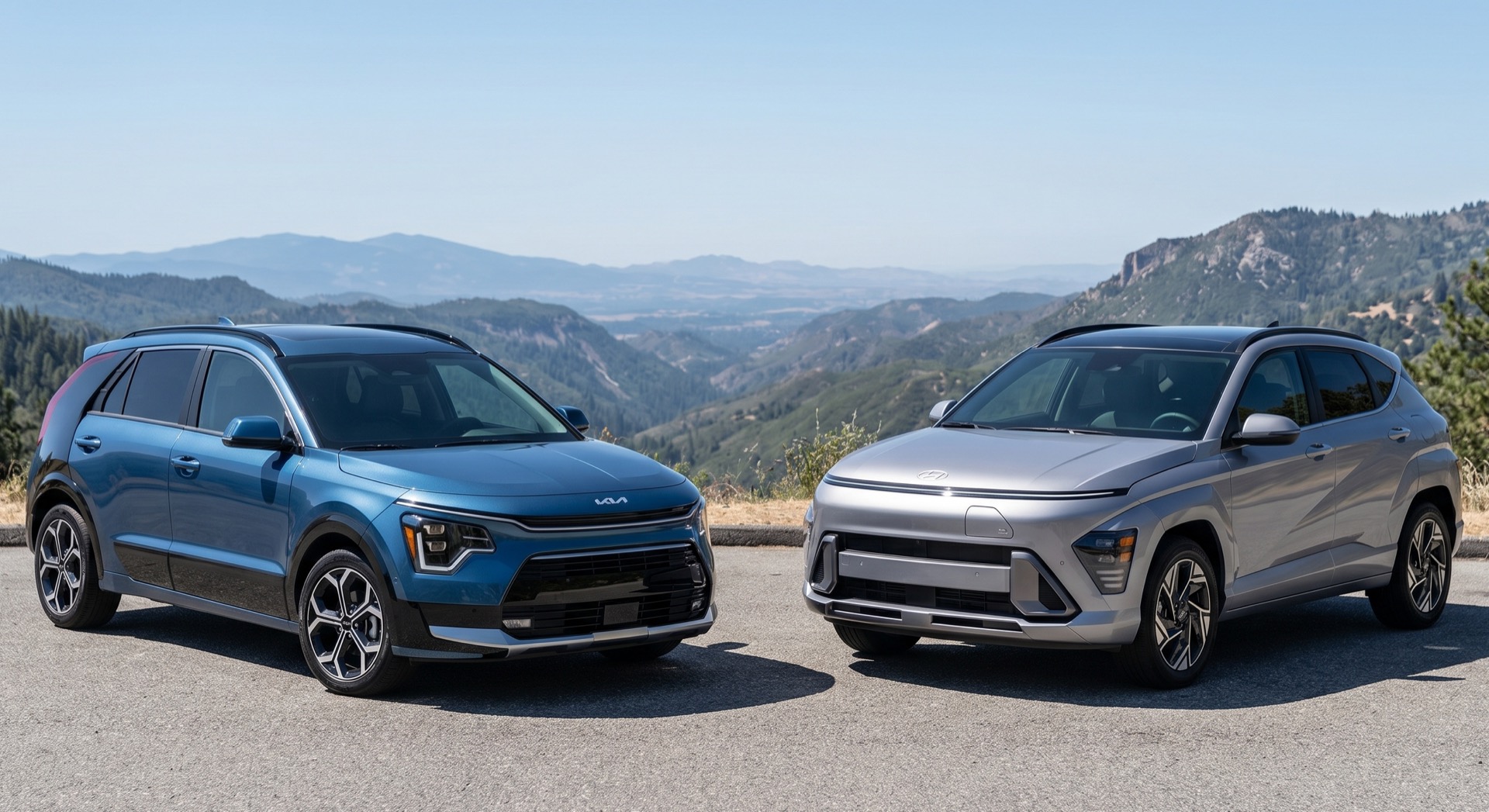
Head-to-head comparison between the Kia Niro Hybrid and the Hyundai Kona Hybrid, two hybrid B-SUVs from the Hyundai Motor group that share mechanics but embody opposite philosophies in everyday urban driving.
They share a platform, engine and Korean DNA, but at the traffic light each one eyes the other sideways. The Kia Niro Hybrid and the Hyundai Kona Hybrid are, on paper, close cousins: 141 CV combined, an ECO label from the DGT and a homologated consumption that lets them rack up almost laughably low monthly fuel bills. But one sit behind the wheel of each and you understand that the Hyundai Motor group has managed to set apart its two hybrid B-SUVs with very different personalities. This is the comparison you need if your day starts and ends in a traffic jam.
Two philosophies, one mechanical heart
Both cars use the well-known 1.6 GDi naturally aspirated petrol engine paired with an electric motor powered by a 1.32 kWh lithium-polymer battery, with a combined output of 141 CV and a six-speed dual-clutch automatic gearbox. So far, twins. The difference lies in how the chassis, the bodywork and the steering calibration interpret that same heart.
The Niro was designed from the first sketch as a hybrid. The Kona, by contrast, was born as a conventional SUV, and the hybrid system is just one more variant within a range that also offers petrol and electric versions. This shapes the character of each one.
Kia Niro Hybrid from €29,500: the efficiency specialist
The second-generation Niro has refined what it already did well: covering plenty of distance in electric mode around town. Its design, with the striking contrasting C-pillar, gives it the air of a designer car without tipping into the flashy. It measures 4.42 metres, offers 451 litres of boot space and features a cabin where rear legroom surprises for its segment.
In urban consumption, the Niro Hybrid moves with ease between 4.3 and 4.8 l/100 km in real-world city use, thanks to a hybrid system that disengages the combustion engine very quickly when the battery has charge.
| Power kW | Power CV | Top speed | Range | WLTP consumption | Label | Fuel |
|---|---|---|---|---|---|---|
| 104 kW | 141 CV | 165 km/h | ~900 km | 4.4 l/100 km | ECO | Hybrid |
Hyundai Kona Hybrid from €28,900: striking design and a more mischievous feel
The second-generation Kona has grown to 4.35 metres and features a front end with a horizontal light bar that looks lifted from a concept car. Inside, two integrated 12.3-inch screens give a sense of modernity superior to the Niro’s. Boot capacity stands at 466 litres, slightly above the Kia thanks to the new platform.
Dynamically, the Kona Hybrid is a little more playful: heavier steering, a suspension one notch firmer and a livelier front-end response when turning in. In town, this translates into a car that feels more agile when dodging potholes and changing lanes on a congested avenue.
| Power kW | Power CV | Top speed | Range | WLTP consumption | Label | Fuel |
|---|---|---|---|---|---|---|
| 104 kW | 141 CV | 165 km/h | ~850 km | 4.6 l/100 km | ECO | Hybrid |
In the real traffic jam: who wins?
This is where the comparison is decided by nuances. The Niro recovers energy under braking with a slightly more progressive feel and keeps the electric motor active for more seconds during start-stop. When traffic turns into an endless accordion, this shows in the consumption gauge and in the sense of calm on board.
The Kona makes up for it with a lower driving seat, a sportier driving position and driving modes that clearly change the car’s character. It is, quite simply, more entertaining when a 200-metre gap opens up between cars.
Summary table: score 1-10
| Model | Price from | Urban consumption | Interior space | Design | Dynamics | Technology | Overall score |
|---|---|---|---|---|---|---|---|
| Kia Niro Hybrid | €29,500 | 9 | 9 | 7.5 | 7 | 8 | 8.1 |
| Hyundai Kona Hybrid | €28,900 | 8 | 8 | 9 | 8 | 9 | 8.4 |
Final verdict
If the priority is minimising petrol spending and enjoying a spacious, quiet cabin, the Niro Hybrid is the most sensible answer. If what you want is a car with presence in the car park, one that makes you forget you’re driving a hybrid when you hit a main road, the Kona Hybrid is hard to argue with. Siblings, yes, but with parallel lives.
Frequently asked questions
Which is better for pure city driving, Niro or Kona Hybrid?
The Kia Niro Hybrid is slightly more efficient in town thanks to its greater use of electric mode when pulling away and a more progressive regenerative braking system.
Do both have the DGT ECO label?
Yes, both models carry the ECO environmental label, which allows unrestricted access to the low-emission zones (ZBE) of Madrid and Barcelona.
Which has the bigger boot?
The Hyundai Kona Hybrid offers 466 litres versus the Kia Niro Hybrid’s 451, although the Niro makes better use of space for rear passengers.
Which is the best urban hybrid SUV for 2024 within the Hyundai Motor group?
It depends on your profile: the Niro Hybrid for maximum efficiency and space, the Kona Hybrid for design and more dynamic driving. Both compete at the top of the hybrid B-SUV segment in Spain.


 Peugeot E-208 GTi: a battery-powered toy that revives the spirit of the 1980s sports cars
 New Lexus ES: luxury grows and goes electric
 First contact with the Dacia Sandero Hybrid 155: power and efficiency from €19,890
Deja un comentario