Lamborghini Temerario Hybrid Cars Sports Cars
Lamborghini Temerario: the Huracán's successor is intimidating, and not just because of its name.
 Antonio Roncero @roncero_antonio
19 August 2024
5 min.
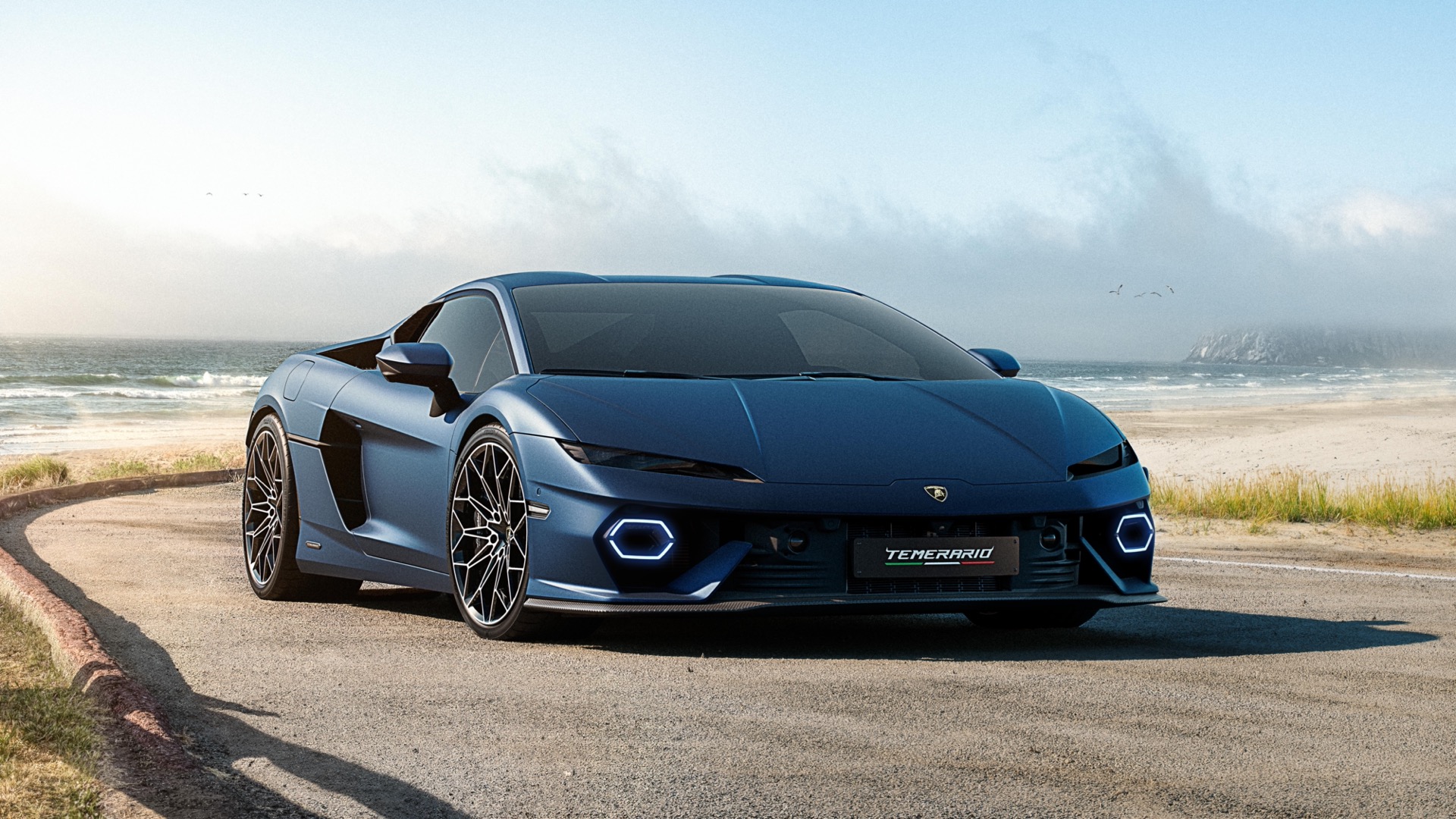
Lamborghini could not have chosen a better name for its new supercar, Temerario, which, with its 920 CV plug-in hybrid powertrain and innovations such as the Vision Unit system, is designed to intimidate its rivals.
Here comes the Lamborghini Temerario, the brand’s second plug-in hybrid model after the Revuelto, replacing the legendary Huracan in the range of the manufacturer from Sant’Agata Bolognese. A supercar that aims to intimidate its rivals not only with its name. Here are some of its most notable features.
An out-of-this-world powertrain
It took Lamborghini five years to develop the Temerario’s plug-in hybrid powertrain. The main goals included achieving the highest possible specific power and torque, with a response as close as possible to that of a classic naturally aspirated engine. And you can imagine what this means: a “high-revving” engine.
The final configuration includes a 4-litre twin-turbo V8 engine with a specific output of 200 CV per litre, capable of reaching 10,000 rpm. The brand takes pride in this: it is the first and only series-production engine in a supercar capable of revving so high. Specifically, the combustion engine delivers 800 CV between 9,000 and 9,750 rpm, with a maximum torque of 730 Nm between 4,000 and 7,000 rpm. The two turbochargers, located inside the V formed by the two cylinder banks, blow at a maximum pressure of 2.5 bar, controlled by electric wastegate valves. The block material is the same the brand uses in its competition engines, and titanium connecting rods and DLC-coated rocker arms (extremely hard carbon layers) are key to reaching such high engine speeds.
Supporting the combustion engine, the Temerario’s plug-in hybrid powertrain features up to three 110 kW electric motors, each delivering 150 CV: one coupled to the engine at the rear axle, which also acts as the starter motor and generator, and two at the front axle, providing all-wheel drive and allowing the Temerario to move on electric power alone in certain phases. The system’s total output reaches 676 kW (920 CV), enabling the Temerario to accelerate from 0 to 100 km/h in 2.7 seconds from a standstill and reach a top speed of over 340 km/h… and nobody will remember the Huracán’s V10.
The newly developed transmission features a dual-clutch 8-speed gearbox, very compact and light, and quicker than the Huracán’s 6-speed unit. The battery, with a 3.8 kWh capacity, sits in the central tunnel and can be recharged in under half an hour with a 7 kW charger, using regenerative braking or even via the combustion engine. Another special feature of the Temerario is the exhaust sound, which is enhanced in the cabin through an additional synthesizer, recreating distinct experiences for each of the four driving modes: city, highway, sport and track. There are also three levels of “drift” in the dedicated mode for controlled sliding, in addition to the hybrid system’s specific modes.
Design and aerodynamics
Externally, the Temerario is recognisable from a mile away as a Lamborghini, although the new hybrid powertrain forced the designers to work overtime. The objectives here were threefold: high stability at high speeds, improved cooling system performance and maximum braking efficiency. And one figure speaks for itself about what has been achieved: an increase of more than 100% in rear-axle load compared with the Huracán EVO, rising to nearly 160% with the Alleggerita Pack. It is the first time the brand offers this package, designed for customers who want to drive their car on track, and which can reduce weight by up to 37 kg through additional carbon-fibre elements, polycarbonate windows instead of glass, titanium exhaust and even carbon wheels.
The radiator has been repositioned to meet the higher cooling demand of the hybrid system, improving by up to 30% in this area. The cooling performance of the carbon-ceramic brakes is also improved, by as much as 20% for the discs and 50% for the calipers. The underbody is a masterpiece, with vortex generators and fins helping to increase aerodynamic downforce, where the diffuser also plays a major role, with a surface area up to 70% larger than that of the Huracán EVO.
For the chassis, Lamborghini uses a spaceframe-type chassis made of aluminium that increases torsional rigidity by 20%, using up to 80% less total length of welding seams, compared with the Huracán it replaces.
A command post to make you feel like a pilot
Inside, beyond the design, Lamborghini has pulled out all the stops on the multimedia side, offering not only comfort for travelling but everything a driver needs to feel like a racing pilot on a circuit.
There are up to three screens, a 12.3-inch one for the instrumentation, the central 8.4-inch multimedia display, and a third 9.1-inch screen for the passenger. New features debut, such as gesture control to move content from one screen to another, as well as the so-called Lamborghini Vision Unit, which, thanks to a dedicated control unit and three video cameras, enables three new services.
One of them is Lamborghini Telemetry 2.0, an on-board app designed for track driving, which displays the layout of more than 150 circuits, monitors track sessions and shares information via the Lamborghini Unica app. Memories Recorder, meanwhile, allows up to two minutes of driving to be recorded.
Lamborghini Temerario – Image gallery
Technical specifications of this car


 Kia offers an electric range of 10 models, 50 versions and 400 possible combinations
 The seven finalists for the 2027 European Car of the Year (COTY) are exclusively electric
 Peugeot E-208 GTi: a battery-powered toy that revives the spirit of the 1980s sports cars
Deja un comentario