Lancia Sedans Sports Cars Photos Tests
Lancia Delta 1.8 Di Turbo Jet 200 CV, test drive (I)
 Diego G. Moreira
29 October 2011
5 min.
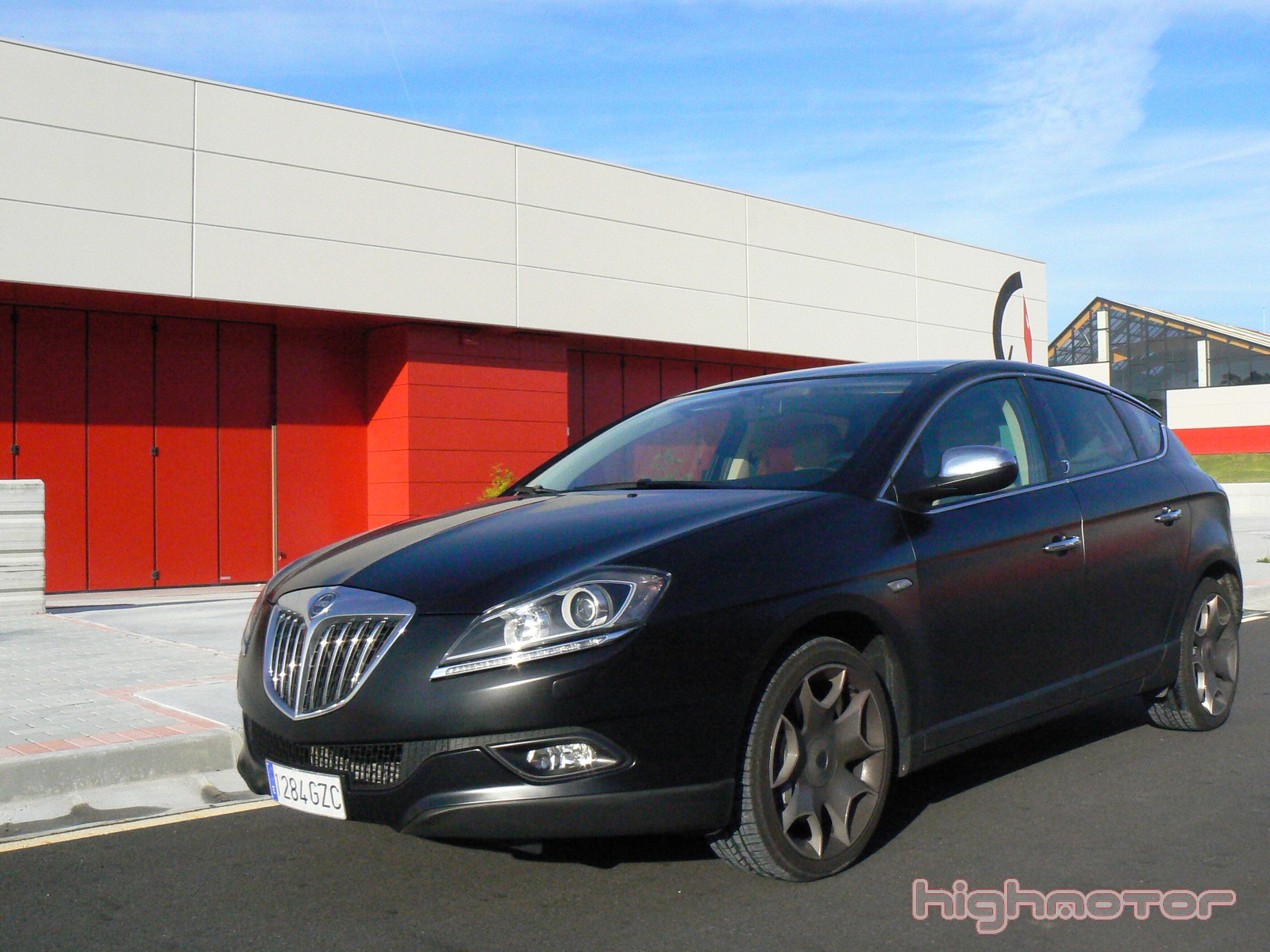
Today we take the wheel of a peculiar Italian: the Lancia Delta, which for two years has been offered in the range with a powerful petrol engine built by FPT that delivers 200 CV. But when we add that our test unit sports a matt black exterior colour, it is clearly not a typical Delta.
It is not the first time we have driven a Lancia Delta, since we already tested the Italian with the 190 CV 1.9 diesel engine, one of the best diesel powertrains in terms of performance and consumption. This time, however, we wanted to try something more radical and less rational, paired with the matt black colour it flaunts, under the name Hard Black.
Engine and performance
Nowadays, when engines are judged more by emissions and consumption figures, this performance-oriented 1.8 Di Turbo Jet of 200 CV turns those expectations upside down, thanks to a forceful dose of power and sportiness. We are talking about a direct-injection petrol engine, turbocharged, with continuously variable dual-phase timing on both intake and exhaust, and a maximum torque of 320 Nm at just 1,400 rpm.
This engine is paired with a six-speed Sportronic automatic gearbox with sequential manual mode and paddle shifters on the steering wheel. Returning to performance, thanks to Scavenging technology we get strong torque from very low revs, which explains the Delta’s punchy response.
We start the car, set off, and press the accelerator with some determination. We see that from around 1,500 rpm the engine begins to wake up, pushing forcefully up to nearly 4,000 rpm, where a even more emphatic surge arrives (between 3,500 and 4,500 rpm), which does not run out until past 5,500 rpm.
In short, we have an elastic engine, with strong pull from low revs that does not fade at high revs and keeps pushing fiercely. Perhaps this is the best word to describe the engine, because, both in its sound and in its delivery of power, we cannot say it is a smooth unit, but it is effective and moves the Delta’s nearly 1,500 kg without trouble.
The gearbox is reasonably quick when using sequential mode, but when we press the accelerator the response could be improved; a bit more speed when downshifting would round out the package. That said, even in sequential mode, if we keep accelerating past 5,000–5,500 rpm, the gearbox upshifts on our behalf, just as it downshifts if we do not do so ourselves when coming to a stop or in a significant reduction.
Handling
Although it may seem we are behind the wheel of a sports car, the Delta is still a saloon, which in this particular case we tested with a very performance-oriented engine. Its dimensions and weight, as well as its suspension layout, must always be kept in mind.
The first time we set out to check how the Delta handles through corners, we faced a very rainy day, where its low-profile tyres (40 series) and 18-inch wheels did not make the task easy and it was not very effective in this area.
Back on dry roads, we again put the Italian’s dynamic qualities to the test, and this time we were surprised by the firmness through corners. While guiding it along a rural road, with constant changes of direction, the Delta showed no sign of the inertia or drift typical of a car of this size. This is partly thanks to a suspension set-up firmer than the model’s usual one, which nonetheless delivers good behaviour overall.
That said, if we are talking about agility, there are clearly more agile models, but it holds its own well enough without sacrificing comfort. Road stability stands out, with comfortable, rather firm suspension.
Completing the sporty package is the steering which, to our taste, could be improved, since it is not as direct as it should be and does not inspire much confidence when driving more sportingly. The standout, however, is the braking system, four Brembo units, which offer surprising efficiency, bringing the Delta to a smooth and rapid stop in any situation.
That said, the front discs should be ventilated to offer better resistance to fade, something we noticed on a winding route after pushing the brakes hard: they did not offer the same effectiveness as when cold.
Consumption
This is the most negative aspect of the engine, because today there are units of similar power that improve on the Lancia Delta’s consumption figures, which in some cases we find excessive. Starting with the motorway figure, motorway we hover around 8.5 l/100 km (a BMW X3 35i of 306 CV has similar consumption).
On country roads it is almost impossible to get below 8 litres per 100 km, while the real-world figure at a normal pace is around 10 litres per 100 km. In town, however, the figure rises considerably to 15–16 litres per 100 km.
It is a performance engine, but fuel consumption suffers because of the performance, and there are currently engines of similar power with somewhat tighter consumption figures.
Photos | David Taboada


 Peugeot E-208 GTi: a battery-powered toy that revives the spirit of the 1980s sports cars
 New Lexus ES: luxury grows and goes electric
 First contact with the Dacia Sandero Hybrid 155: power and efficiency from €19,890
Deja un comentario