Lexus celebrates 30 years of a history full of achievements
 Alvaro Avilés
7 October 2019
7 min.
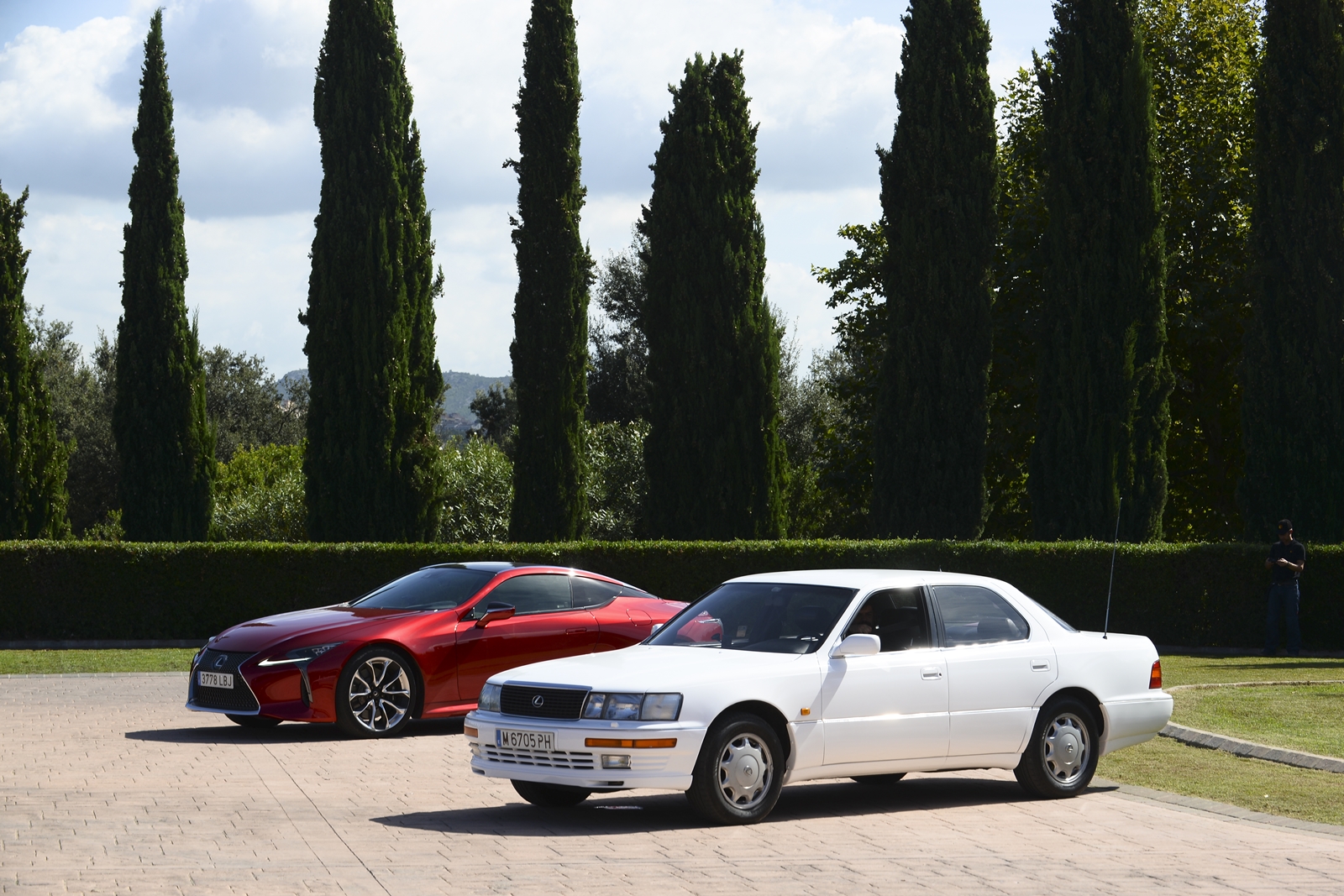
Lexus turns 30 years old, proving itself to be an innovative brand and a pioneer in electrification, so we are going to put together a summary of its main achievements.
Lexus is celebrating its anniversary, and it is that 30 years have already passed since it launched its first vehicle. However, the story goes back much further: it was in 1983 when Eiji Toyoda, president of Toyota, set himself a clear goal: to create the best car in the world which, in addition, would offer the best value for money on the market.
It was an ambitious project, because during the 1980s, the German brands held supremacy in the luxury car segment, and practically no one dared to challenge them.
When the industry first learned of the goal of Lexus, the word most often heard was: “impossible”. In reality, no one believed that a brand that had not yet borne fruit could make a car capable of rivalling the heavyweights of the segment.
During the six years of development, Lexus used no fewer than 13 design mock-ups and more than 400 test mules, which accumulated a staggering 4,000,000 kilometres. The goal was ambitious, and it was necessary to ensure that the final product would be flawless.
The first Lexus reached the market in 1989
Thus, in 1989 the Lexus LS 400 arrived at the Detroit Motor Show, a true unknown that its most direct rivals eyed with suspicion. Moreover, the brand was eager to show the world what it was capable of, since it promised high standards of quality and reliability capable of standing face to face with the Mercedes-Benz S-Class, BMW 7 Series or Jaguar XJ.
This was made clear in its launch commercial, in which one could see how the Lexus LS 400 exceeded 200 kilometres per hour on rollers and, best of all, was so refined that it could keep a pyramid of champagne glasses on its bonnet without spilling any. We leave you the advert in case you want to see it for yourselves.
https://www.youtube.com/watch?v=Do-b4m3m_qg
The occupant beneath its bonnet was a 4.0-litre, 32-valve V8 engine with 250 horsepower supplied by Toyota and refined by Lexus’s engineers to achieve a sound unprecedented by the standards of the era. Moreover, it was an ideal flagship car for cruising at high speeds: it accelerated from 0 to 100 km/h in 8.5 seconds and reached 250 km/h.
“Omotenashi”, a new concept
Thus, the Lexus LS 400 was the beginning of an entire lineage. However, the brand not only wanted to present a benchmark in the large luxury saloon segment, but also wanted to present to society one of the basic pillars of its first 30 years. This is “Omotenashi” in Japanese, or translated into our language, hospitality. At this point, Lexus promised to meet its customers’ needs even before they arose and to take care of the details.
In this way, Lexus was the first brand to include the first two services in the initial price of the car. Moreover, they made sure that when the car was delivered, it was in perfect cleaning condition.
It took only 2 years to achieve success
All these arguments were enough for Lexus to become the leading importer of luxury cars to the US market. Thus, the manufacturer’s presence in North American territory was normalised and the first dealerships began to open. All of this led it to win the award for best brand in this demanding market in 1991.
However, the story of Lexus had only just begun, and the philosophy of Lexus remained the same: blending craftsmanship and innovation. Proof of this is the presence of the “Takumi” in its factories: these are specialists who are responsible for passing quality control on each unit, checking all the settings and finishes by hand.
At the plant that Lexus has in Miyata there are only 19 “Takumi”, and in order to be part of this elite workforce, they must pass tests such as making an origami figure with one hand in 90 seconds, and not before having 25 years of experience in various areas of the factory.
Lexus presented the first luxury SUV in 1997
With this blend of technology and craftsmanship, Lexus continued to be a pioneer in many respects. Not least, it pioneered one of the segments with the most representatives today. It was in 1997 that it launched what we now know as the luxury SUV, the Lexus RX 300. Thus, it reached the market 1 year before the first generation of the Mercedes-Benz M-Class and 2 years before the BMW X5.
This first launch was followed by the achievement of launching the first hybrid SUV on the market, the Lexus RX 400h. This was launched in 2005 and had a powertrain consisting of a 3.3-litre V6 petrol engine and an electric motor on each axle, so the total power was 272 horsepower. Thanks to this combination, it achieved good performance and very reasonable consumption for a car weighing 2,000 kilos: it accelerated from 0 to 100 km/h in 7.6 seconds and consumed 8.1 litres per 100 kilometres.
In 2005 they ventured into the world of supercars
However, Lexus did not only focus on making luxury cars and electrifying its range, but also wanted to demonstrate that it was capable of building a true supercar. For this reason, it surprised everyone with the brutal Lexus LFA, a flat-shaped racer fitted with a naturally aspirated 4.8-litre, 10-cylinder V engine capable of delivering 560 horsepower. Moreover, the manufacturer teamed up with Yamaha to develop an exhaust system, thanks to which this car almost sounded better than a Formula 1 car. Only 500 units were sold, and its price was €415,000.
As Lexus has shown throughout its history, it is a manufacturer expert at making a statement, and if there was one criticism levelled at the brand, it was that its designs were boring and very similar to those offered by the German brands. Thus, in 2011 the fourth generation of the Lexus GS debuted the brand’s new design language with the now characteristic double spindle grille at the front.
Also, in 2011 Lexus took a step that many considered reckless but that some brands had copied years earlier: stopping the manufacture of diesel engines across its model range in favour of hybridising its petrol engines.
However, in 2012 Lexus put all its cards on the table and presented the Lexus LF-LC, a grand tourer whose design left all motoring enthusiasts speechless. Such was the success of the prototype that the brand decided to put it into production three years later (2015) with hardly any changes from what the concept showed. The result was the Lexus LC500h, a car that still does not lose an ounce of spectacle.
The Lexus UX is its latest launch
Its latest launch was the Lexus UX, which we tested a few months ago, a mid-size SUV that the brand describes as “the representation of the brand’s evolution in its three years of history”. This new model already features the brand’s fourth generation of hybrid systems.
Finally, it seems that the brand’s sales figures in our market support its good work, since in 2019, Lexus has already increased its market share by 4.1% (0.8% more than in 2018) and will certify its seventh consecutive year of growth.
Thus, it seems that the 30th anniversary of Lexus is only the beginning of a book with many pages still to be written and, if it continues doing things as it has so far, there is no doubt that its path will remain positive.


 Peugeot E-208 GTi: a battery-powered toy that revives the spirit of the 1980s sports cars
 New Lexus ES: luxury grows and goes electric
 First contact with the Dacia Sandero Hybrid 155: power and efficiency from €19,890
Comentarios cerrados