Mazda CX-7 2.2 CRTD 173 CV, road test (Part II)
 Diego G. Moreira
23 May 2010
5 min.
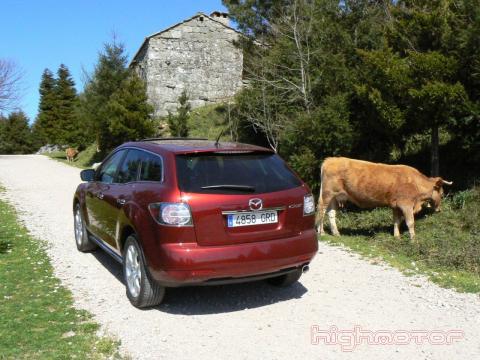
We continue with the road test of the Mazda CX-7 that has just debuted a new diesel engine, the 2.2 CRTD with 173 CV. As usual, you can see the first part to get up to speed on everything related to the engine and the behaviour of this SUV. Its behaviour has practically no drawbacks, making the CX-7 a very easy vehicle to drive, close to driving a passenger car.
Now, in this second part we will focus on the design of the Mazda, which is very different from other SUVs. We also need to talk about the interior space, as well as the quality of the materials we found inside the Mazda CX-7.
Exterior design
The exterior appearance of the CX-7 features quite muscular shapes and design lines. With its 4.7 metres in length, it has sporty touches, like almost all the designs from the Japanese brand. It is interesting how even an SUV of this size and characteristics, with that fluid-lined design and sporty touches gives it a different flavour, far removed from the more familiar models on the market that fill our cities.
Seen from the front it gives the impression of being a bulky or large vehicle, but in practice it is easier to manoeuvre around town than, for example, a Citroën C-Crosser.
With the arrival of the diesel engine at the end of 2009 a small restyling also arrived on the exterior, with changes affecting the grille, more chrome and a new design for the fog lights.
Our Mazda CX-7 was equipped with the highest trim level, the Luxury, and therefore came with 19-inch alloy wheels and 235/55 R19 tyres. As we already explained in the previous part, these wheels were not ideal for off-road use; even the 18″ wheels fitted to the lower trim levels would be more recommendable for taking it off the tarmac, but then that is not really what this SUV is about.
Interior design and roominess
When we sit inside, the first thing we like is the driving position, elevated, with good forward visibility and the pedals set more horizontally than on other models, and very comfortable too. As for visibility, although forward visibility is very good, the car’s various design angles do not help much when parking or in achieving sufficient visibility, but that is what technology is for, such as the rear-view camera or a system that warns us of the blind spot in the mirror so we can change lanes with complete safety.
The seats hold the body very well, and in our version they were leather and of quite good quality. On the other hand, the dashboard does not have shapes that win you over, but the equipment is very simple to use, with large, easy-to-handle buttons. The plastics covering everything feel good, and according to Mazda they are designed to last without losing quality.
The biggest drawback is perhaps the concentration of controls on the steering wheel; on the one hand the driver has everything to hand, but the navigation system can unfortunately only be configured from the steering wheel controls, so the front passenger could change something without distracting the driver, and the navigation screen is quite small.
I don’t know why, but Mazda have always had rather small screens loaded with information, and this one is no exception, since the navigation could be a bit larger, while the other screen showing audio and climate information is also quite small.
But we cannot overlook the instrumentation, which lights up in a violet tone that once again makes the sporty spirit of this SUV clear and is a nice design detail. Our unit also featured keyless entry and start, so in place of the key there was a rotary dial that acted as the key (I definitely prefer it to a button).
The interior of the CX-7 is quite spacious, although it is true that there are smaller SUVs with similar space, you can still travel in it comfortably and roomily. The rear seats have enough space for both legs and head, and two adults will travel very comfortably, while as usual the middle seat is less comfortable.
Overall, the interior ambience, in terms of material quality (although there is quite a lot of plastic), is very good and sits above most mainstream SUVs, differing very little in finish quality from some that are classed as premium.
Boot and storage
Moving on to storage, the centre console still has places to leave things, but the door pockets are rather small. As for the boot, it offers a capacity of 455 litres, a figure that is within the norm for the segment, but we must remember that it carries a full-size spare wheel. The CX-7 can become a true estate-style van if you fold down the rear seats, since the loading area increases considerably.
So we have an SUV with a different exterior design, a spacious interior with plenty of plastic but a sense of quality in the various controls, and simple-to-use equipment. In the third part of the test, we will look at this Mazda’s equipment and prices, as well as our overall assessment of the model.
Photos | David Taboada
Thanks to Borja for his help with the test


 Peugeot E-208 GTi: a battery-powered toy that revives the spirit of the 1980s sports cars
 New Lexus ES: luxury grows and goes electric
 First contact with the Dacia Sandero Hybrid 155: power and efficiency from €19,890
Deja un comentario