Opel SsangYong Photos Tests SUV
Opel Antara 2.0 CDTI 150 CV vs Ssangyong Korando D20T 175 CV, comparison (Part I)
 Diego G. Moreira
3 February 2011
8 min.
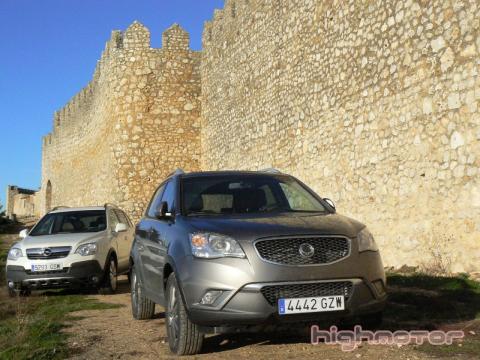
In Highmotor we temporarily leave the German models and head to a segment I personally really like: SUVs, since today we bring you an interesting novelty in the segment, which we have put to the test against a veteran. The Ssangyong Korando has just arrived at dealerships, but it has little in common with what the South Korean brand had accustomed us to, since the Korando is designed in Europe and for European tastes, with plenty of arguments to claim a slice of the urban SUV sales pie.
To test the Korando we have chosen an old acquaintance of this editorial team, the Opel Antara equipped with the 150 CV diesel engine and all-wheel drive, while the Korando also has a diesel engine, this time of 175 CV, in addition to all-wheel drive. The small difference between the two lies in the gearbox, since the German has a five-speed automatic gearbox and the Korean a six-speed manual.
The vast majority of the engine, handling and consumption aspects of the Antara are also applicable to the Chevrolet Captiva, since they share the same engine, chassis, gearbox, among other elements, changing only the design, equipment and interior space. During the comparison we had fairly favorable weather to test these SUVs, since right after leaving Madrid with them we were able to test their ability to make progress on snowy roads.
Engine and performance
In the case of the Korando it is a new engine unrelated to the previous engines supplied by Daimler. It comes from the Australian manufacturer AVL, with a displacement of two liters and 175 CV, more than enough to move the Korando. It is an engine that responds with strength to move the more than two tonnes the Korean weighs, and above 2,000 rpm it pushes decisively, although we are forced to work the gearbox since its response at low revs is not very good.
In the case of the Antara, the engine is an old acquaintance made by VM Motori with 150 CV, and it is an engine on its way out, since its replacement by another 2.2-litre unit of 163 and 184 CV has already been announced. Being paired with the automatic gearbox its performance was quite marred, since it has enough power to move the Antara, but the gearbox tended to rev the car quite high (it normally did not go past 3,000 rpm) without this translating into greater thrust. Even so, with a manual gearbox (always preferable to this automatic) it is an engine sufficient for most journeys.
In terms of gearboxes, the Korean had a six-speed manual with a fairly short first gear, which favoured off-road use, while the Antara had a five-speed automatic gearbox that is already quite dated and whose operation is rather improvable. The good part of the automatic gearbox is that in off-road use we did not abuse the clutch as much. The Korando also offers a six-speed automatic gearbox as an option.
Handling
In this section there are two notable differences between them: on one hand the Korando is taller and has a suspension calibrated more firmly than the Antara, which tends to favour comfort. Therefore we liked the stability offered by the Korean because, despite being quite tall, it does not sway and holds its composure well; the problem appears on more uneven surfaces where its firmer suspension becomes noticeable. On the other hand, the Antara is somewhat lower but its suspension is softer, so we encounter the typical body roll that off-roaders tend to have, although in exchange we gain a suspension that prioritises comfort.
In agility we give the win to the Korando, which has two advantages: the first is its dimensions (it is shorter than the Antara) and the second is its firmer suspension, so we have a crossover that is quite agile in town. The Antara , on the other hand, suffers from its size and its suspension, which reduce the model’s agility.
As for ride comfort, both perform without problems in this area. The Antara has good engine soundproofing, although it is not exactly noted for its quietness, and on board the occupants enjoy a good ride comfort. In the case of the Korando we again find a noisy engine, especially when the car is cold, but the interior soundproofing mitigates the problem quite well, and for travelling we have a comfortable car in which to cover many kilometres.
To finish with handling, there are some details that could be improved on the Korando, since the steering seemed quite soft to me: it is adequate, but a bit more firmness would be appreciated, and finally the brakes. In this section we must also mention that our Korando had barely 500 km on the odometer when we began the test, so the lack of braking efficiency we noticed may be more a matter of insufficient running-in than a flaw in the car itself. Even so, we did notice a lack of braking efficiency, the brakes only working properly when pressed hard. It was rather a shortcoming due to the low mileage of our test unit.
In the case of the Antara , the brakes worked better, but we also encountered a drawback: at the slightest sign of braking hard the ABS kicked in, being unnecessary in some cases. The Antara’s steering is also soft, which is positive for town or manoeuvring, but on the road it needs a bit more firmness.
Consumption
On the motorway the Antara averaged 7.5 l/100 km, while the Korando came in at 6.8 l/100 km, although this figure should be qualified: the Antara had a five-speed automatic gearbox and the model’s manual does not have a sixth gear either (something necessary to reduce consumption), whereas the Korando did have a sixth gear, which directly affected its consumption.
On B-roads the Antara hovered around 8.5 l/100 km and the Korando around 7.5 litres per 100 km. In town is where the consumption of these two SUVs shot up considerably: the Opel averaged around 12-13 litres per 100 km, and the Korando also exceeded ten litres with an average urban consumption of 11 litres per 100 km.
Off-road capability
Before starting this section we must clarify that our two models are SUVs and are therefore not built for intensive use in the countryside or for driving on complex terrain. Even so, we noticed considerable differences between the two. The Korando , thanks to its height, has better angles and, although it has no low-range gearbox, its 50:50 traction can be locked with a button. The Antara automatically configures the traction without allowing you to choose the mode, and its only aid is hill descent control, which is welcome given its size.
As for underbody protection, both had a small protection plate underneath, but in many cases it could prove insufficient. This is a further sign that they are SUVs and not true 4x4s, but for everyday use it was enough.
During the tests we carried out on snowy ground, the Antara’s automatic gearbox again took its toll, taking longer to get traction (even with the gearbox’s snow mode activated), but it completed the test without problems. In the case of the Korando we locked the traction split and had no trouble pulling away on snowy tracks either.
We also tested them on a section mixing mud and damp earth, where our two SUVs could easily have sunk under their weight and failed to get out, but again they showed considerable resilience, working correctly. The positive point of the Antara’s automatic gearbox in off-road use is that you do not make intensive use of the clutch, as you do with the Korean.
Lastly, we noticed that in the case of the Antara , being automatic, the traction split cannot be chosen manually, and in some cases it takes longer to respond and the traction works worse when it is harder to get the car out of where it is. For that reason we opted for the Korando’s system, as it proved more effective during the tests we carried out. But I must insist that this is not the typical use of these vehicles, since they have an urban and road-going nature. On dirt tracks and trails both perform correctly.
Photos | David Taboada


 Peugeot E-208 GTi: a battery-powered toy that revives the spirit of the 1980s sports cars
 New Lexus ES: luxury grows and goes electric
 First contact with the Dacia Sandero Hybrid 155: power and efficiency from €19,890
5 comentarios
Deja un comentario
Creo que la comparativa llega demasiado tarde, ya que el Krando es un modelo actualizado recientemente y el Antara no es el 2011 que seria el que deberia compararse para estar a la altura, en fin, veo una vez más unos intereses a nivel publicitario muy claros y no comprendo esta comparativa.
Hola Álvaro,
Se ha elegido el Antara porque así también podemos extender al Captiva parte de los detalles del coche, segundo porque es un modelo veterano en el segmento y bastante equilibrado, con una buena calidad de terminación y bastante actual.
En motor nos hubiera gustado comparar con uno de 163 o 184 CV, pero lo único que puedo hacer el nombrar que llegarán pero no será hasta dentro de unos meses, dicho esto, el motor de 150 CV es más que suficiente, solamente el cambio consideramos que no está a la altura del modelo.
Por cierto además el Antara es un viejo conocido de nuestra redacción porque hace un año tuvimos una unidad manual, por lo tanto conocemos muy bien al coche lo que no ha facilitado enormemente la comparativa. Los intereses publicitarios no se donde los ves, porque somos nosotros quienes libremente decidimos que pruebas realizar y tampoco cobramos por ellas de los fabricantes.
Por último te recomiendo que leas las tres partes cuando se publiquen, porque hay aspectos donde el Antara es claramente superior, pero claro para eso hay que valorar la prueba entera y no sólo el apartado de motor.
Un saludo
Hola de nuevo, mi comentario ha sido hecho después de leer el articulo completo, la verdad que poco se ha dicho bueno sobre el anterior Antara el cual me sigue gustando, aunque como espero poseer el nuevo, estoy ansioso de leer comentarios sobre el más satisfactorios que la versión que aqui comparais , el articulo es bueno pero en mi opinión un poco raro, cambio manual, cambio automatico, 175CV contra 150CV etc.,por cierto obserbo que el Antara de la comparativa lleba el flex-fix, me gustaria algún comentario al respecto pues tambien lo he pedido. Un saludo y perdona si molesto con mis comentarios.
hola, me gusta el korando y quisiera preguntar si podeir realizar una comparacion entre el korando y el qashqai, el for kuga o el hyundai ix 35. gracias un saludo
El Korando y el Qashqai es una comparativa que estamos barajando, seguro que dentro de poco la podremos realizar, pero si que la tenemos en mente.
Un saludo