Opel Meriva 1.4 Turbo 120 CV, road test (part I)
 Diego G. Moreira
25 October 2010
4 min.
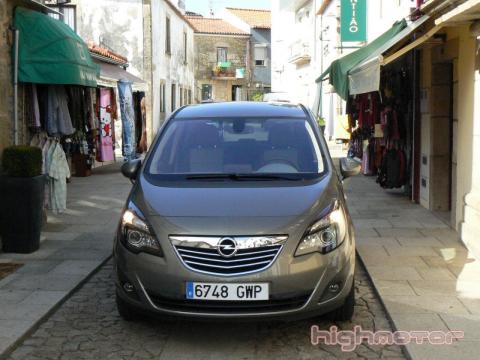
The Opel Meriva was one of the models we were eager to try, mainly because of its innovative rear-door opening system, since few models have a similar one (such as the Rolls Royce Phantom), and we wanted to find out firsthand whether it was a practical system for everyday use.
Our Meriva was fitted with the 1.4 Turbo petrol engine producing 120 CV, paired with a five-speed manual gearbox, more than enough for this type of engine. Initially the Meriva range offered few engine options, but now we can choose, in addition to the 100 and 140 CV petrol versions, four new diesel engines ranging from 95 to 130 CV.
If you are looking for low consumption, it is certainly advisable to head towards the diesel engines, and even the 1.3 CDTI with 95 CV could be a good candidate for the Opel Meriva, thanks to its modest consumption with an average of just 4.5 l/100 km. But returning to our test unit, let’s see how the 1.4 Turbo 120 CV engine behaved.
Engine and performance
This 120 CV turbo engine replaces the previous 1.6 with 105 CV, and it is available in three variants of the same displacement but tuned to 100, 120 and 140 CV. To get the most out of the engine you have to keep it above 2,000 rpm, and at around 4,500 rpm it starts to run out of steam, so it is not very flexible and forces you to work the gearbox quite a lot. The five-speed manual gearbox is more than sufficient for this engine, and it has a rather long 5th gear that keeps consumption down on the motorway.
Above 2,000 rpm it pulls with considerable force, but even so it seems to have fewer horsepower than advertised, and we also found the throttle response somewhat abrupt. That said, if you kept it high in the rev range the engine moved the Meriva without problems, but in terms of responsiveness it lacked flexibility and some smoothness.
Handling
The previous Opel Meriva already boasted good composure and ride comfort, and the current generation certainly improves on it, because it is surprising to see the vehicle’s dimensions, such as its height, and at the same time to find that it doesn’t lose its composure through corners and maintains its stability without problems, always respecting interior comfort.
Even when we took it onto the motorway, it offered a good response, it is quite well soundproofed, and we barely noticed any noise inside, while stability was again very good, similar to a saloon car. The steering stands out for its firmness, it is quite precise, and on the open road its feel is appreciated; only in town, when manoeuvring, do we miss a little more assistance.
As mentioned earlier, the ride comfort has no drawbacks, since the suspension is well calibrated, keeping a balance between composure and interior comfort, and in addition there is no wind or engine noise, making it a good and quite comfortable vehicle for long journeys.
Consumption
Because this engine has such a narrow useful rev range, we are often forced to keep it quite high in the rev range, which is totally counterproductive for achieving good consumption figures. This is precisely where I recommend the diesel engines , especially if we are going to move around urban environments, where the consumption of our petrol Opel Meriva climbs easily.
On the motorway, below 120 km/h we achieved a consumption of around 7 l/100 km, but the average during the test, through urban areas and especially on country roads (30-70%), was 7.5 litres per 100 km, undoubtedly rather high figures when compared with the 1.4 TSI 122 CV engine (which also enjoys more flexible responsiveness).
In the second part we will focus on the interior and exterior design of the new Opel Meriva, undoubtedly one of the points where this Meriva stands out most positively, since its interior practicality is beyond doubt and it offers plenty of interior space.
Photos | David Taboada


 Peugeot E-208 GTi: a battery-powered toy that revives the spirit of the 1980s sports cars
 New Lexus ES: luxury grows and goes electric
 First contact with the Dacia Sandero Hybrid 155: power and efficiency from €19,890
Deja un comentario