BYD SEAL Sedans Electric Cars ECO Tests
Review: BYD Seal, an electric saloon that puts the Tesla Model 3 on the back foot
 Antonio Roncero @roncero_antonio
6 August 2024
10 min.
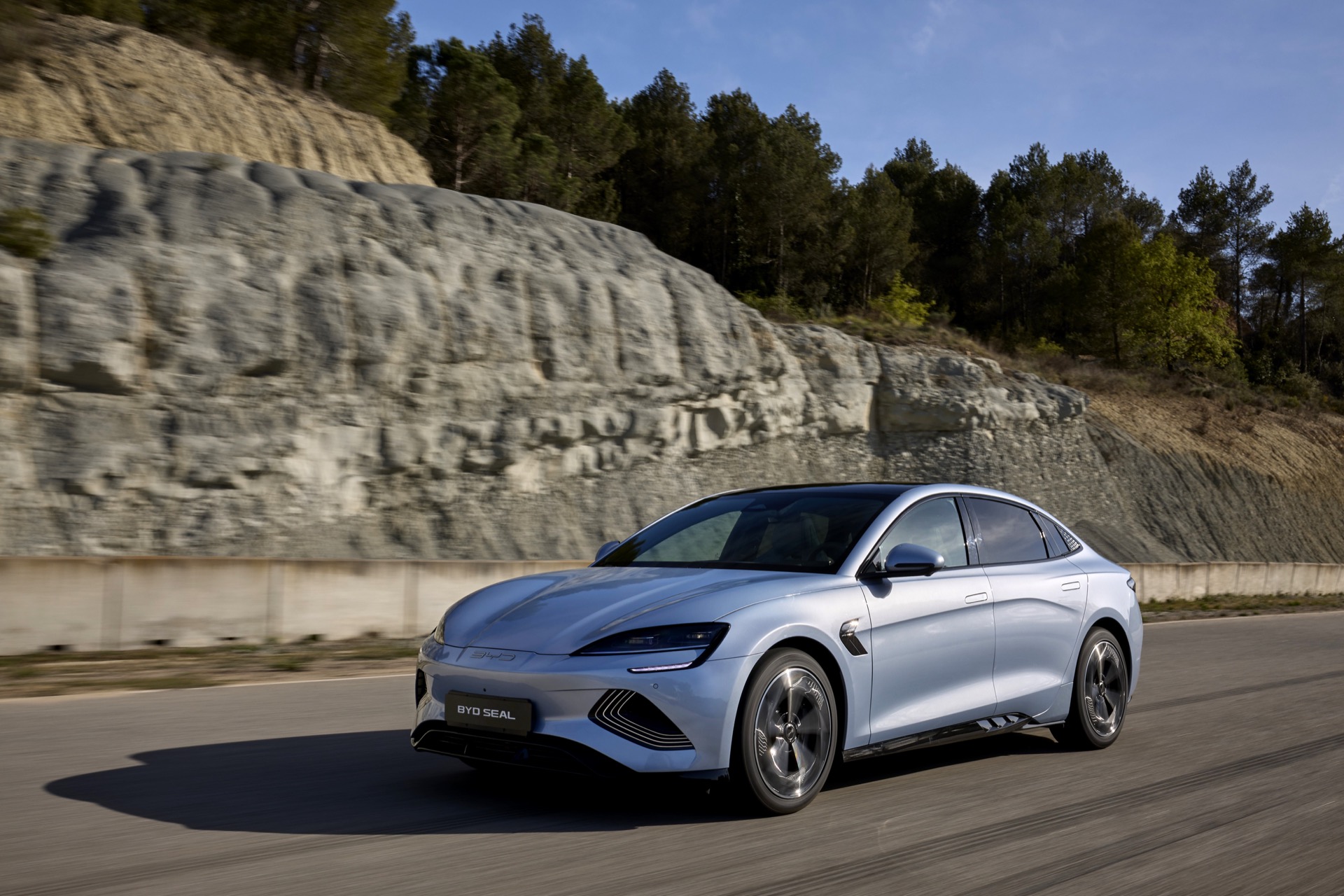
The BYD Seal, in either of its two versions, is one of the best electric saloons in its class, with an almost unbeatable value-for-money ratio, considering its dynamic behaviour, performance, build quality and standard equipment.
In a very short time, BYD, the world’s leading maker of plug-in vehicles, has brought to our market a wide range of electric cars that stand out for their excellent value for money.
Today there are already six electric models in the BYD range: the compact and affordable Dolphin; the SUVs Atto 3, Seal U and Tang, covering practically every segment by size and price; and the saloons Seal and Han. And to all of these we must add the newcomer BYD Seal U DM-i, the brand’s first plug-in hybrid to go on sale in our market, which shares a common denominator with the electric models: nobody in its category offers so much for so little.
However, among the 10 best-selling electric cars in our market during the first half of 2024, you have to go down to ninth place to find the Atto 3, the only BYD in this top 10, led by Tesla with its Model 3 and Model Y. What does BYD need to climb the rankings and place more models in this list? Well, the hardest thing: greater brand recognition. BYD knows this, and is taking it step by step, expanding its dealer network and running marketing campaigns to gain visibility, such as sponsoring the recent UEFA Euro 2024.
Because it won’t be the product that holds it back: BYD has cars capable of putting practically any of the best-selling electric models in Spain on the back foot, including the sales leader, the Model 3. Let’s look at it in more detail.
Two versions with 313 and 530 CV, range of up to 570 km
With a length of 4.8 metres and a sleek body -a drag coefficient of just 0.22- that even has a certain five-door coupé look, though it actually has a conventional boot lid, the BYD Seal is available in two versions.
The Seal Design has a rear-axle motor with 230 kW (313 CV) and 360 Nm of torque, while the Excellence 4WD adds a second 160 kW (218 CV) motor on the front axle for all-wheel drive and a total system output of 390 kW (530 CV). In both cases the battery has a capacity of 82.5 kWh, allowing the Seal to homologate up to 570 km of range, which drops to 520 km in the 4WD.
Using the category’s sales leader as a reference, the rear-wheel-drive Tesla Model 3 has 283 CV and up to 513 km of range, while the Long Range 4WD version reaches 498 CV and exceeds 600 km of range. Admittedly, the Model 3 uses smaller batteries: 60 kWh for the rear-wheel-drive version and 75 kWh for the 4WD. Credit where it’s due to Tesla: the Model 3 is almost unbeatable in efficiency and range, one of its main selling points.
Other possible rivals to the BYD Seal would be the Hyundai Ioniq 6, the §5Audih77§ or the BMW i4.
BYD Seal equipment and price
Value for money is one of the BYD Seal’s best assets, built on a product that scores well in every area and stands out for its equipment. Standard specification is extremely complete: heated and ventilated electric seats, electric tailgate, heated steering wheel, heat pump, multimedia system with a 15.6-inch screen, Dynaudio sound system with 12 speakers, panoramic sunroof, double-glazed windows, dual wireless phone chargers, leather upholstery, ambient interior lighting… It even has an air ioniser and a particle filter to control the quality of the air breathed inside the cabin.
Nor is anything missing when it comes to driver assistance systems, with all the usual ones and some that are less common, including traffic jam assist, intelligent adaptive cruise control, automatic braking for crossing rear traffic, predictive collision avoidance assist and even hill descent control. In fact, there are no options beyond metallic paint. Being nitpicky, the equipment list lacks matrix LED headlights, but you won’t miss them when driving at night: the standard LED headlights with automatic high beam work very well. For long journeys, however, a route planner like the one in the Tesla itself or the one offered by Audi in its e-tron models, which takes charging points into account and suggests routes and stops, would be welcome.
Apart from the powertrain differences, the difference between the Design and Excellence versions is that the more powerful one includes a head-up display and has electronically controlled adaptive dampers. They even share the same wheels, with 19-inch rims and 235/45 tyres.
As for the BYD Seal’s price, the list price of €46,990 for the Design version drops to €35,720 according to the brand’s online configurator, including a promotional discount of over €3,700 and the maximum €7,000 subsidy from the Plan Moves scheme. The list price of the Excellence 4WD is €48,990, just €2,000 more than the 2WD, but this version gets a smaller discount, so the “real” difference ends up at €4,500, quite a temptation.
Either way, it is a very good price for what the Seal offers and competitive against its rivals, all of which are more expensive than the Seal, except the Ioniq 6… and the Model 3. The Tesla saloon is priced at €41,490 according to the brand’s configurator, but discounts of around €3,000 bring it down to roughly €38,000 without Moves, about €5,000 less than the Seal.
The BYD Seal’s interior: lots of quality
The BYD Seal is not the most efficient, nor does it stand out against its rivals for charging performance or boot capacity. Even so, I think it is one of the best saloons in its category even for long trips. And it is, mainly, because the Seal offers an excellent driving position with superb seats, the cabin is very well insulated, and the chassis tuning is well oriented towards comfort, with suspension that filters very well what happens between the wheels and the road surface.
Furthermore, as is usual for the brand, the interior presentation is impeccable, almost that of a luxury car without quite reaching it. The impression it gives is, in any case, a step above what is typical of mainstream brands, touching in many respects on what we could call “premium”. This is where the BYD Seal sets itself apart and gains the upper hand over the Model 3, with better presence and materials that, at least in appearance, seem to be of higher quality.
The front seats strike me as excellent, and two adults can travel comfortably in the rear seats, with the only drawback that there is not much space under the front seats for your feet, so you cannot adopt a position without bending your legs much and raising your knees. The boot, with 400 litres of capacity in both the 2WD and the 4WD, is not very large for the size of the car, but it will be sufficient in most cases. An additional compartment of about 50 litres under the front bonnet is a handy extra for a small bag or for carrying charging cables.
The multimedia system is another of the BYD Seal’s strong points. The 10.2-inch digital instrument cluster is nothing extraordinary. But the multimedia system with the rotating 15.6-inch screen, which can be placed in landscape or portrait orientation, has fantastic quality. At the bottom there are shortcuts that take you directly to main functions such as climate control, although there are also some physical buttons on the centre console, next to the gear selector, such as the drive mode selector or, again, a shortcut to climate control, which is operated from the screen itself.
And while we’re on the subject, at least on our test car, the operation of the climate control seemed improvable. Not because it fails to cool or heat the cabin properly, but because it often runs the fans at high speed, with the resulting airflow and noise inside the cabin.
Behind the wheel of the BYD Seal: a long-distance saloon
Based on the official figures, the difference in power and performance between the Seal Design and the Excellence 4WD might lead you to think that the former is more oriented towards comfort and range, and the latter the choice for those seeking extra sportiness, so the choice should be easy. But driving them clears up many doubts.
Yes, the Design has more than enough power, offers more range and is cheaper. But even in the least favourable case -depending on the discounts in force- the gap with the Excellence 4WD is not large, and that version is not far behind in range and improves handling and the driving experience in every situation, thanks to its electronically controlled variable-damping suspension.
To get to the point: as I have already mentioned above, in either version the BYD Seal seems to me one of the best options for anyone looking for an electric saloon for long trips, due to the composure, security and comfort it conveys from behind the wheel, even when the road surface is not in the best condition. But the greater agility and precision offered by the more powerful version’s electronic suspension alone -although the fact that it has all-wheel drive and better weight distribution also plays a part- makes it worth taking the step up and giving up those 50 km of homologated range of the 2WD.
Consider the Seal Excellence 4WD’s greater acceleration a bonus that is there, even if only to boast that your car can occasionally dip below 4 seconds from 0 to 100 km/h -mind you, the 2WD doesn’t accelerate badly either, 5.9 seconds from 0 to 100 km/h- provided the battery charge allows it. Because in both versions the regeneration capacity is outstanding, and the real-world range makes it possible to tackle 350 km runs at motorway pace with some margin. In daily use on a ring road with some city driving, I found it no trouble at all to exceed 400 km, again leaving a safety margin before stopping to recharge.
This is where the Seal once again cedes ground to the Model 3. The Tesla accepts up to 170 kW on DC charging, compared with the Seal’s 150 kW; but the Model 3 is able to reach that peak sooner and sustain high charging power for longer. In any case, you will rarely need more than half an hour for the battery to climb back to around 80%, and to be on your way again. As standard, the maximum AC charging power is 11 kW.
BYD Seal – Image gallery
Technical specifications of this car
 Peugeot E-208 GTi: a battery-powered toy that revives the spirit of the 1980s sports cars
 New Lexus ES: luxury grows and goes electric
 First contact with the Dacia Sandero Hybrid 155: power and efficiency from €19,890
Deja un comentario