Rolls Royce Wraith Sedans Sports Cars Limousines
Rolls-Royce Black Badge Wraith Black Arrow, the brand's farewell tribute to its V12
 David Lopez @espacionblanco
22 March 2023
3 min.
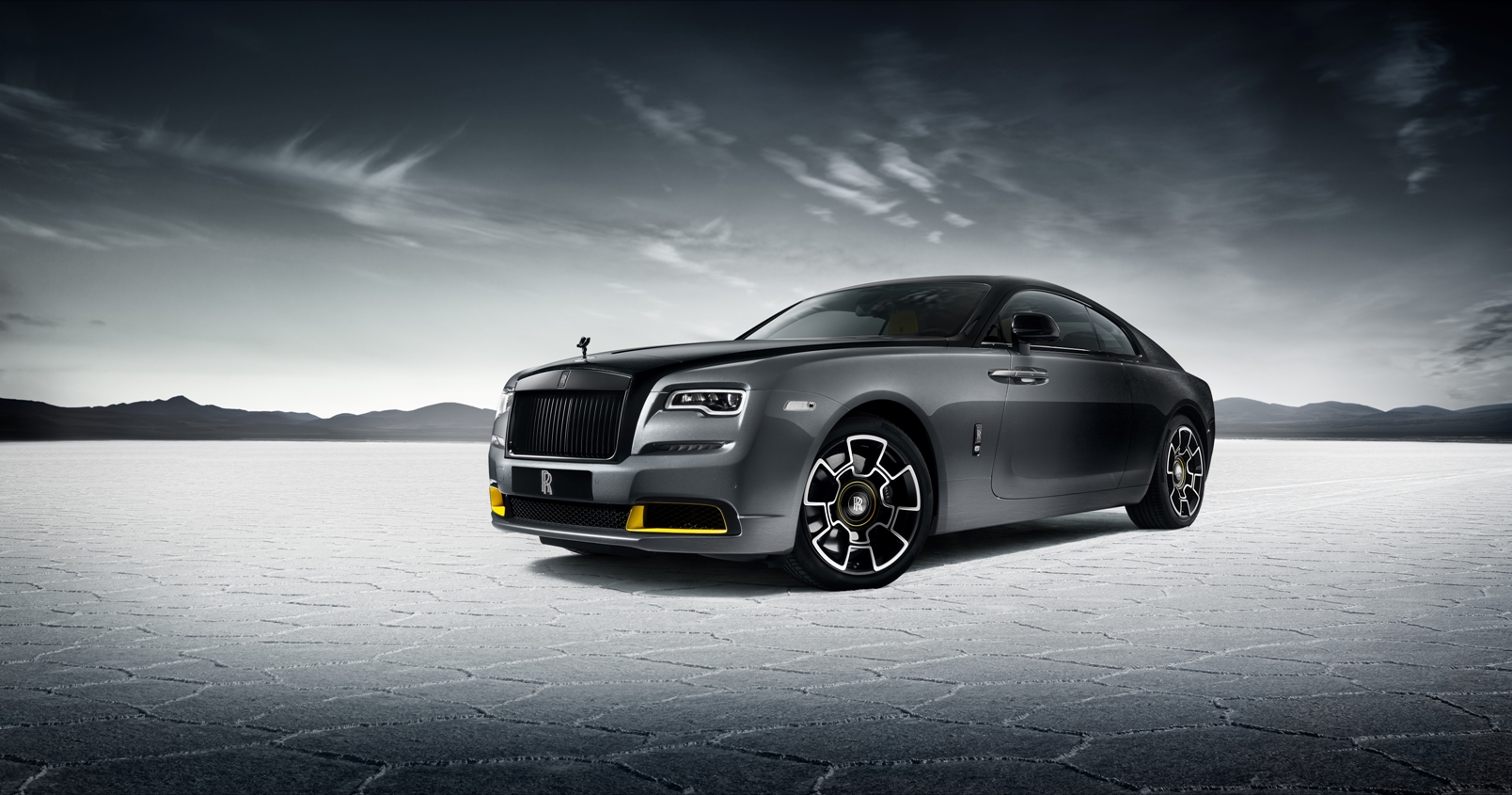
Rolls-Royce will stop using its legendary V12 engine in the Wraith, but first it will pay tribute to it with the spectacular limited edition Black Badge Wraith Black Arrow
Like all brands, Rolls-Royce is also succumbing to the era of electric powertrains, which means that engines such as its iconic V12 no longer have a place in its lineup and, consequently, models such as the spectacular Wraith. That is why, before its final disappearance, the English brand wants to pay a fitting tribute, which translates into exclusivity available to very few.
More than eighty years ago, Rolls-Royce developed the Thunderbolt, a seven-tonne prototype with three axles and eight wheels built to compete at the Bonneville Salt Flats, a place where numerous speed records have been set. There, in 1938, with George Eyston at the controls, the Thunderbolt set the speed record for a car with a V12 engine at 357.457 mph, which also laid the foundations that would later give birth to the Spitfire.
Precisely, the Thunderbolt serves once again as the starting point for paying homage to this limited edition called Black Badge Wraith Black Arrow, which also once again demonstrates Rolls-Royce’s personalisation capabilities. The Thunderbolt had a polished aluminium body whose reflection on the Bonneville Salt Flats made it difficult for the judges to detect when it crossed the finish line, so George Eyston came up with the idea of painting a black line along with a yellow circle on the body to make it easier to see.
This yellow colour appears on the Rolls-Royce Black Badge Wraith Black Arrow in certain exterior elements, such as the bumper and the detail line on the wheels. Undoubtedly, this colour combines perfectly with the Celebration Silver and Black Diamond colours chosen for its bodywork, to which a surface layer of “Crystal” paint with glass infusion has been applied. This creates a blurring effect and a sense of speed, while also adding a crust-like texture, which occurs more abruptly when driving at Bonneville.
Inside, the yellow colour also combines perfectly with black upholstery, appearing in areas such as the dashboard, certain stitching, the steering wheel, to a greater extent on the front seats, and as a detail on the rear seats or door panels. But the interior of the Rolls-Royce Black Badge Wraith Black Arrow will certainly draw attention for its other two exclusive details: the first being the engraved exploded view of a V12 engine on the dashboard and, alongside it, the clock face showing the speed achieved by George Eyston at Bonneville.
For the second exclusive detail of the Rolls-Royce Black Badge Wraith Black Arrow, we’ll have to look up at the always striking Starlight headliner of Rolls-Royce. For this occasion, 2,117 fibre-optic “stars” have been fitted entirely by hand, never before has a Rolls-Royce headliner featured so many, and it represents the Milky Way and the constellations visible on 16 September 1938 from the Bonneville Salt Flats, the exact date of George Eyston’s record.
Mechanically, as expected, there are no novelties, and under the bonnet the Rolls-Royce Black Badge Wraith Black Arrow houses, for the last time, the twin-turbo V12 engine of 6,600 cc delivering 563 CV, which allows the Wraith to reach 100 km/h in 4.9 seconds despite its considerable weight and then reach a limited top speed of 250 km/h.
Only 12 units will be built worldwide of the Rolls-Royce Black Badge Wraith Black Arrow, at a price the brand has not disclosed, although the truth is that it no longer matters, even if we could afford it, since the brand has already allocated all the units to their future owners.


 The seven finalists for the 2027 European Car of the Year (COTY) are exclusively electric
 Peugeot E-208 GTi: a battery-powered toy that revives the spirit of the 1980s sports cars
 New Lexus ES: luxury grows and goes electric
Deja un comentario