Test drive Alfa Romeo Tonale Edizione Speciale: 'mixed' feelings
 Rodrigo Fersainz
20 May 2023
9 min.
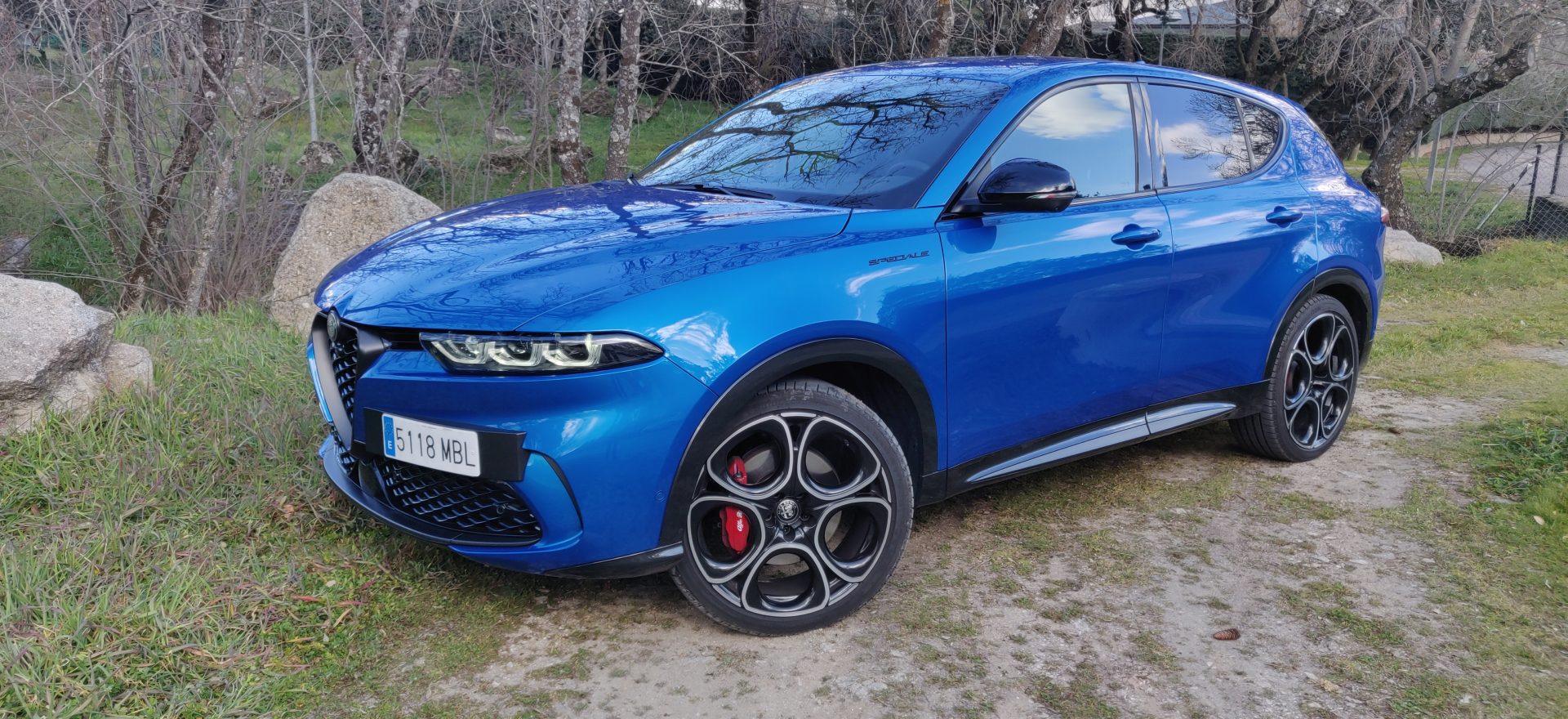
We ‘tune in’ with the test of this very eye-catching vehicle, the Alfa Romeo Tonale Edizione Speciale, with a 1.5 engine producing 160 CV. Is it something more than a pretty ‘face’?
We tested one of the most talked-about compact SUVs of the moment, for its looks, its pedigree, and because it is the forerunner of other models from the brand that will come under the baton of its star signing at the head of the Design department, Spaniard Alejandro Mesonero-Romanos: the Alfa Romeo Tonale. Specifically, in its Edizione Speciale version, with a 1.5 engine producing 160 CV. But is this attractive Italian crossover ‘in tune’?
I was lucky enough to see it as a pre-series unit in Turin, while I was in northern Italy testing other Stellantis models. There, in a group car park, with provisional plates and still some camouflage, the first impression was less rewarding than expected: a smaller and less striking SUV than the Alfa Romeo Stelvio, in a dark matt colour probably neither final nor intended for any catalogue in any country… But with a very promising ‘look’.
Now, it’s time to test this Alfa Romeo Tonale Edizione Speciale, which, dressed in this attractive Misano blue in which it greets me, already looks more refined (and sophisticated) than we expected. At first glance, this version also stands out for its flattering sporty touches, such as the gloss black grille surround, the mesh inserts, the door frames, the wheel-arch mouldings and side skirts, the mirrors (with the Italian flag included)… And, of course, alloy wheels with five polylobed spokes and grey finishing specific to this trim, which reveal the red Brembo brake calipers and which aim to make an impact across the whole car by housing 20″ low-profile tyres and riding on a supposedly lowered suspension.
And this is a compact crossover, one of the many fashionable ones on the market, that’s true. But how does it intend to seduce such a broad potential audience? By staying true to the values of the brand that wears the ‘scudetto’: with more and more sensations in every centimetre of the car.
A very ‘Alfa’ driving position
That is why, on board, it’s worth noticing how well everything is laid out, as well as elements that shouldn’t be missing today or tomorrow in any Alfa Romeo worth its salt, and which appear here after a formidable design effort to combine the manufacturer’s more than 100 years of tradition with the latest technologies in connectivity, safety, comfort and, why not, aesthetics.
Thus, one settles in quickly into its beautiful, carefully finished leather seats (with the logo on the headrests) and soon appreciates a functional and elegant yet ergonomic design wherever you look, with good-quality, well-fitted materials, concessions to visual pleasure (such as the LED-lit strip that runs across the dashboard from side to side, in colours matching the bodywork), the typical round side ventilation grilles with metallic touches – as on the pedals – and the two ‘cannons’ that surround the dials.
These are fully digital, yet they simulate dials, needles… and even a ‘rotating’ odometer like analogue ones! More details to delight the senses: multifunction leather steering wheel with engine start/stop button – which you have to get used to the first few times you leave home in a hurry – and aluminium paddle shifters.
Dynamic behaviour… though not quite
Time to start this powertrain, the first hybrid the brand has ever offered, which, after such a festival of sensations, justifies the ECO label on the windscreen and which connects a little with reality and with the target audience: someone looking for an SUV with a certain height, attractive and somewhat different, from a brand with character, tradition and pedigree, without skimping on indulgent features… but of modest dimensions, reasonable interior space, moderate consumption and the ability to enter the city centre without worrying about traffic restrictions, and geared more to everyday use than long journeys.
This is a hybrid self-charging powertrain (HEV), which is not among the mild hybrids of the Mild Hybrid Electric Vehicle (MHEV) type because its four cylinders, of 1,469 cc capacity and 160 CV of power, rely on a 0.8 kWh battery – with only 20 extra CV – whose electrification system allows the wheels to be driven directly (even if only for a few kilometres, under very specific conditions and quickly ‘calling on’ the petrol engine).
Thus, with a smile on my face from the garage and ‘turning many necks’ even before setting off, I face an ordinary Monday in a different way. The driving position, good visibility and a length of 4.5 m help you get around very well in everyday traffic.
It is true that the limited tyre ‘rubber’ and the stiffness of the suspensions we mentioned earlier penalise comfort here – and the integrity of the materials – when going over potholes, speed bumps, ramps… Nor is it a car to venture into parking on the typical wasteland next to a hospital, for example, or to drive too casually along an unpaved track, even on an estate, due to its lower ground clearance than the standard Tonale and the characteristics of its ‘footwear’.
However, its sportier configuration is appreciated when gaining speed on secondary roads, as body roll is much less than in what this type of crossover usually offers. That said, you soon have to switch with the rotary dial on the centre console to the D driving mode Dynamic (it also has Normal and A for All-Weather) for the response to improve fully.
This is a good thing, because it is noticeable immediately… and ‘not so good’, because, as has been happening to the vehicles of the Group Fiat (now Stellantis) since they introduced this selector more than a decade ago, the behaviour in the other two modes, once you’ve grown used to D, feels somewhat ‘lacking’ when driving in any other.
Above all, in a test unit that does not boast too much power: the 160 CV the powertrain delivers, with 240 Nm of peak torque, fall a little short when you demand moderately dynamic behaviour. Indeed, it goes noticeably better than the 130 CV petrol version and offers – very important today for use in the city – an ECO label instead of a C, although we expected a bit more push.
But that agility in corners – which it has – ends up being diluted in a concept geared more towards comfort on calm, pleasant journeys than towards sporting experiences. In fact, the seven-speed dual-clutch gearbox doesn’t show off as it should either because of that limited push, and it doesn’t let you ‘play’ too much with the gears (it quickly shifts up if it ‘senses’ you are pushing the revs). It’s a pity, since the designers went to the trouble of fitting fixed paddle shifters, large, attractive and with a very pleasant metallic feel… which, however, do not provide a direct response nor, by any means, the sensation of genuinely controlling gear selection.
Life on board
Over the kilometres, in all kinds of situations and with different types of passengers, it’s worth taking another look at the cabin. In the front row, things are very comfortable and, definitively, the ergonomics are really good. The drawback is that, in keeping with the idea that “the Alfa Romeo stand out from the rest by being tablets on wheels” (a mantra they keep repeating to us from Italy), the multimedia screen does its job and is not small (12.3 inches) but it carries reduced information, as does the physical button array below the air vents, which is a little hard to identify and doesn’t make good use of the free space available.
Otherwise, the infotainment experience improves with the digital display – which we mentioned earlier – behind the complete and sporty multifunction steering wheel (which also controls important, well-executed assistants such as lane-departure correction), the USB ports in two sizes at the front and rear… and everything one expects in connectivity from a car today, with compatibility for Apple CarPlay and Android Auto.
In the rear row, however, the padding of the seats is comfortable but the interior space is considerably more limited for three people, especially in headroom, so adults of some stature will feel it. It is clear that the design team has preferred to give as much space as possible to the boot (500 l), which makes it stand out in its segment, provided the goal is to travel with two or three children (or short people) on the rear seats.
So, the Alfa Romeo Tonale is a crossover that catches the eye and represents a plus over what is expected of this type of vehicle: it is a car of restrained dimensions that aims to be practical, comfortable and functional… but that does not want to give up its DNA nor the beauty and sportiness this implies, with more ‘sport’ sparkle – in keeping with the refinement, high-quality finishes and good taste – than genuinely ‘racing’ behaviour.
And for that reason, it is not exactly a low-cost SUV either: the price of the basic Alfa Romeo Tonale starts at €37,032, while this Edizione Speciale started at around €41,000. Now, you can access the HEV powertrain of this test (TI version, HEV, 160 CV) from €44,000, but associated with the special edition it can only be ordered in the Spanish market with the PHEV plug-in hybrid powertrain (from €51,000). One more reason why, throughout the time we tested this so eye-catching and appealing Alfa Romeo, we experienced “mixed feelings”… but which in the final tally have undoubtedly been far more positive than negative.
Technical specifications of this car


 Kia offers an electric range of 10 models, 50 versions and 400 possible combinations
 The seven finalists for the 2027 European Car of the Year (COTY) are exclusively electric
 Peugeot E-208 GTi: a battery-powered toy that revives the spirit of the 1980s sports cars
Deja un comentario