Test drive, review and buying guide: the new Kia Sorento range, one of the best 7-seat SUVs on the market right now
 Antonio Roncero @roncero_antonio
1 July 2024
13 min.
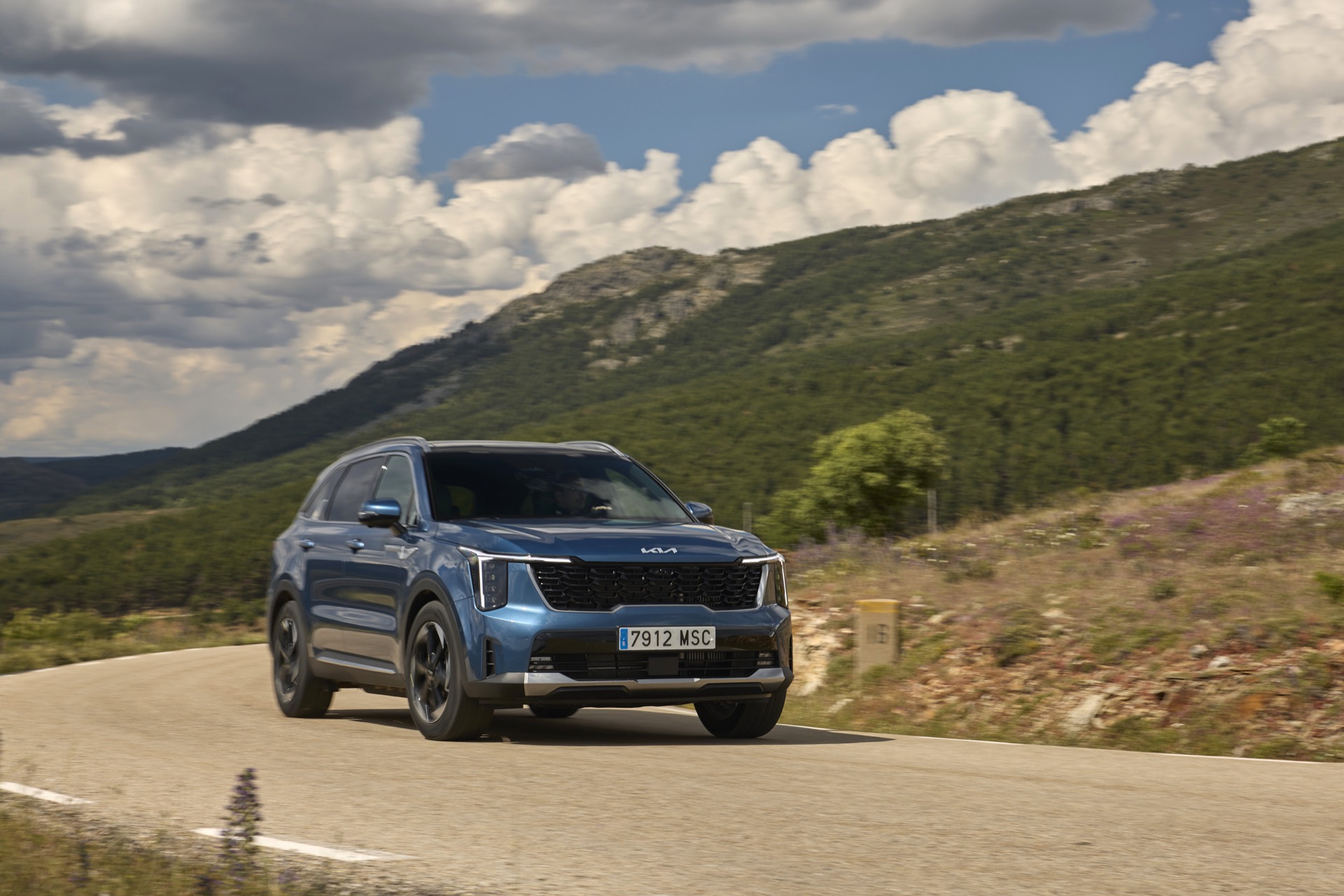
It changes its design and introduces new equipment, but the new Kia Sorento 2024 keeps intact its qualities as a spacious, comfortable and practical seven-seat SUV, with diesel engines and hybrid variants, and a very competitive price.
Some 37,600 units of the Kia Sorento have been sold in our market since the first generation arrived back in 2002, which is no small figure. A model now in its fourth generation, launched in 2020, which is now receiving this update affecting the exterior and interior design and the safety, multimedia and comfort equipment. Let’s look at it in a little more detail, going deeper into the range of trim levels and the engine offering to help you choose wisely. Because if you need a large SUV with seven seats, the Kia Sorento seems to me, as things stand, one of the best options on the market.
But first, and out of curiosity, we share some notes related to the brand, SUVs and electrification that the people at Kia told us during the presentation of the new Sorento. For example, that the SUV range of Kia already accounts for 80% of the brand’s total sales in Spain so far in 2024. Or that three out of every four Kia models sold in our market have some form of electrification. Specifically, in the Sorento’s segment, just 5 years ago the proportion of electrified models in the category did not even reach 10%; today it stands at 80%…
What changes in the exterior and interior design of the new Kia Sorento
Without altering the exterior dimensions — the 4.81-metre length, 1.9-metre width and 1.69-metre height are maintained, with a 2.81-metre wheelbase — the changes to the bodywork of the new Sorento MY24 focus mainly on the front, with a new bonnet that now includes the brand logo, a new grille design with a 3D mesh and, above all, new vertical headlights joined to the daytime running lights, which extend horizontally under the bonnet. The fog lights are also new.
The rear doesn’t change as much, especially compared with the new look provided by the redesigned front. The tail lights, brake light and bumper have been renewed, as has the finish of the exhaust outlet. That said, new wheel designs arrive, which can be 18, 19 or 20 inches for the diesel versions, and always 19 inches for the hybrid versions. There are also three new body colours among the 10 available: the Interstellar Grey debuted on the EV6, the Cityscape Green that debuted on the Niro, and a “Volcanic Sand”.
In the interior, the update can be considered “deep”, with a completely new dashboard design, in line with the brand’s most recent models, where the panoramic dual screen integrated into a single module takes centre stage. One of them is used for the instrument cluster, and next to it sits the touchscreen of the multimedia system, both at 12.3 inches. The Sorento can also be fitted with a head-up display projecting onto the windscreen, which presents information on a surface that simulates a 10-inch screen. The operating system is updated to the latest version, which runs faster and includes new functions.
Driver assistance: some new, others improved
Other novelties include the touch module that allows switching between the controls for the climate system and the multimedia equipment, already used on other models from the brand. The front seats are also new, with a more enveloping design, and new upholstery is added, some with synthetic leather and recycled materials. The option of fingerprint recognition, which we have seen on the EV-9, is incorporated, allowing the vehicle to be linked to the user’s profile and the engine to be started. A new digital key also arrives so that the smartphone can be used as a smart key. In addition to the wireless phone charger, there are two USB-C sockets for each row of seats (six in total), and Kia Connect allows, in the case of PHEV versions, control of the charge level or route planning using online navigation.
In the driver assistance chapter, the new Sorento presents interesting novelties. The new version of the motorway driving assistant now includes automatic lane change assist and intelligent cruise control based on navigation, which automatically reduces speed according to the road layout, for example by recognising junctions or bends. The emergency braking assist with pedestrian and cyclist recognition has also been improved. A front collision prevention assist at intersections is added, along with an additional function for automatic closing of the tailgate, which does not start the process until the user has left the detection zone behind the car.
Engines: diesel, hybrid or plug-in hybrid
In the engine chapter is where we find the fewest novelties, although there are some minor changes to the announced power figures. The range still features the 2.2 four-cylinder turbodiesel engine, which produces 194 CV and a maximum torque of 440 Nm. This engine has no hybridisation of any kind, so it carries the DGT C label. It is combined with an 8-speed dual-clutch gearbox and can be chosen with front-wheel or all-wheel drive. With this engine, the Sorento accelerates from 0 to 100 km/h in 9.5 seconds — 9.7 seconds for the 4×4 version — and reaches a top speed of 201 km/h. The WLTP homologated combined consumption ranges from 5.9 to 6.2 l/100 km, depending on drive configuration and equipment.
The HEV hybrid version is also available with 4×2 or 4×4 drive. It uses the 1.6 TGDi petrol engine producing 160 CV and a 60 CV electric motor coupled to the six-speed automatic gearbox, delivering a combined system output of 215 CV and a maximum torque of 367 Nm. Acceleration and in-gear recovery are very similar to those of the turbodiesel variant, with 0 to 100 km/h in 9.4 seconds for the 4×4 and 9.7 seconds for the 4×2; however, the homologated top speed is lower, at 183 km/h. The high-voltage battery of the hybrid system is 1 kWh, operates at 270 volts and weighs 40 kg.
Finally, the Sorento PHEV plug-in hybrid uses the same petrol engine as the HEV, but the electric motor here is 91 CV and the combined system output reaches 253 CV, with the same maximum torque of 367 Nm. The fuel tank capacity, which is 67 litres on the diesel and HEV, drops to 40 litres in this case to make room for the battery, which has a capacity of 14 kWh and weighs 140 kg. This version, offered only with all-wheel drive, accelerates from 0 to 100 km/h in 8.8 seconds, has a top speed of 183 km/h and an electric-mode range of 55 km on the combined cycle, and 65 km in town.
An important first factor when choosing is price. We will detail the range later, but as a first reference, the Sorento HEV costs around 3,000 euros less than the turbodiesel, mainly for two reasons: it has a larger discount (almost 6,000 euros off the list price, versus 4,200 for the diesel) and its registration tax is 4.75%, while for the turbodiesel it is 9.75%.
If the comparison is between the HEV and the PHEV, the price difference on the few versions that can be matched in equipment and transmission is 4,000 euros, so the PHEV is well worth it. But beware, because if we compare the entry versions in both cases, the HEV is available from 45,660 euros, and the PHEV Drive 4×4 goes up to 55,173 euros; a considerable difference, although the plug-in hybrid has all-wheel drive, which makes you think twice. As a recommendation in case of doubt, always consider the PHEV option if the budget you would allocate to the HEV is 55,000 euros or more, even though that means giving up some equipment.
Behind the wheel of the Kia Sorento
Apart from the details related to the changed interior design in the dashboard and seats, the new Sorento doesn’t change when it comes to sitting behind the controls. It is a car that conveys a sense of quality, especially in the higher trim levels. And the third row of seats is very usable; at least, more than is usual in this type of car, so children who are already “big” can fit comfortably. The second row of seats has longitudinal adjustment, which allows the boot capacity to be varied; it is practically the same across all versions, between about 600 and 800 litres. With all seats folded, the loading volume rises to almost 2,000 litres.
The Sorento that feels most agile in terms of thrust and throttle response is the PHEV, with which you can cover between 150 and 200 km — depending on the road and driving style — with consumption around 6.5 l/100 km… until the battery runs out. In a more in-depth test we will check how the Sorento PHEV performs in “self-charging” hybrid mode, until you can plug it in again. For the car’s size and weight, the HEV holds its own quite well, both when it comes to accelerating or gaining speed and at the petrol station; provided you maintain a relaxed pace, that is. Aiming for average consumption of 8 l/100 km is perfectly reasonable.
As for the turbodiesel, you won’t miss extra power or pulling capacity even when travelling loaded, because the automatic gearbox works to keep the engine always operating in the zone where it delivers most thrust. And you can always opt to switch between the driving mode selector programs, since there is a considerable difference between choosing eco mode or sport mode, both in performance… and in consumption.
Otherwise, the Sorento is a car for wide, open roads, both because of its size and the feel at the wheel — it feels large and heavy — and because of the way its suspension is tuned, clearly oriented towards ride comfort. It is well insulated, the seats are very comfortable and, despite the rather soft suspension, the bodywork does not move excessively. An SUV for long-distance journeys, but one that also handles well in urban traffic despite its size… or for leaving the tarmac, where it also proves very comfortable and solid, with no creaks or strange noises. That said, it is not an SUV designed for heavy off-roading; it is better suited to tracks and paths in good condition.
Equipment, range and prices of the Kia Sorento
Kia offers discounts on the Sorento off the recommended price ranging from 4,000 to 6,000 euros, depending on the version. The Drive, Emotion and Emotion Premium trim levels are offered with all three engines, although the entry-level Drive trim is not combined with the 4×4 variants of the turbodiesel and petrol Sorentos.
Discounted prices start at 48,376 euros for the Sorento 2.2 Drive 4×2 and at 45,660 euros for the HEV Drive 4×2, while the Sorento PHEV Drive 4×4 is priced at 55,173 euros. The step from the Drive to the Emotion trim is between 4,000 and 5,000 euros, depending on the version, while moving from Emotion to Emotion Premium costs around 5,000 euros more.
The Drive trim already includes 18″ alloy wheels, 7 airbags, blind spot assist, emergency braking assist, LED headlights, navigation, parking camera and lane-keeping assist in heavy traffic, among many other items. The Emotion adds 19″ wheels, a panoramic sunroof, Supervision instrument cluster with the 12.3-inch screen, Bose audio system, 360-degree camera, side parking sensors, hands-free tailgate, wireless phone charger and driver’s seat with electric adjustment. The Premium pack for the Emotion adds self-levelling rear suspension, 20-inch wheels, Nappa leather upholstery, digital key, fingerprint reader for keyless start, passenger seat with electric adjustment and driver’s seat memory, head-up display and remote assisted parking from the key.
Our recommended version for tight budgets and high annual mileage is the 2.2 CRDi, because in a car of this size and weight the turbodiesel engine remains unbeatable in the balance between performance and consumption. As for trim, the Drive trim is very complete, but if you can, it is worth stepping up to the Emotion before moving from 4×2 to 4×4. For all uses — daily urban journeys or on ring roads, and weekend or holiday trips — the hybrid makes a lot of sense, and it also already carries the DGT ECO label. And if you have somewhere to plug it in daily, don’t hesitate: look at the PHEV, even though it requires a higher initial financial outlay. For many, the mere fact of having the ZERO label will be justification enough.
The Sorento’s warranty, as on all Kia models, is seven years or 150,000 km.
Alternatives to the Kia Sorento among seven-seat SUVs
With a similar size and that can also be fitted with seven seats, one of the price alternatives to the Sorento is the Seat Tarraco, available from around 40,000 euros with the 1.5 TSI 150 CV engine. It is also offered with turbodiesel engines and in plug-in hybrid version. The SsangYong Rexton is another possibility, in this case only with the D22 turbodiesel engine producing 202 CV. It offers abundant equipment from the entry version, which has 4×2 drive and starts from around 42,000 euros.
Another rival of the Sorento, highly recommended for the versatility of its bodywork and the low consumption of its hybrid propulsion system, is the Renault Espace, which we have already tested. It is available from just over 42,000 euros with the 200 CV E-TECH HEV engine; you can choose between 5- or 7-seat versions at no extra cost, and it is also offered with the sporty Esprit Alpine trim. And if we talk about practicality, we cannot overlook the Skoda Kodiaq, also recently renewed. The range is very wide, with 150 and 190 CV turbodiesel versions, MHEV variants of the 150 CV 1.5 TSI petrol engine and a 204 CV plug-in hybrid with no less than 100 km of electric range. Prices start from around 44,000 euros.
Other options to consider would be the Sorento’s “cousin”, the Hyundai Santa Fe. And, although it is a little smaller in size, also the Nissan X-Trail, available with 163 CV mild hybrid engines from around 40,000 euros, as well as with 204 CV e-Power hybrid versions.
Kia Sorento MY24 – Image gallery
Technical specifications of this car


 Kia offers an electric range of 10 models, 50 versions and 400 possible combinations
 The seven finalists for the 2027 European Car of the Year (COTY) are exclusively electric
 Peugeot E-208 GTi: a battery-powered toy that revives the spirit of the 1980s sports cars
Deja un comentario