The history of the Turbo at Porsche: the key to its wildest versions
 Redacción
19 March 2020
9 min.
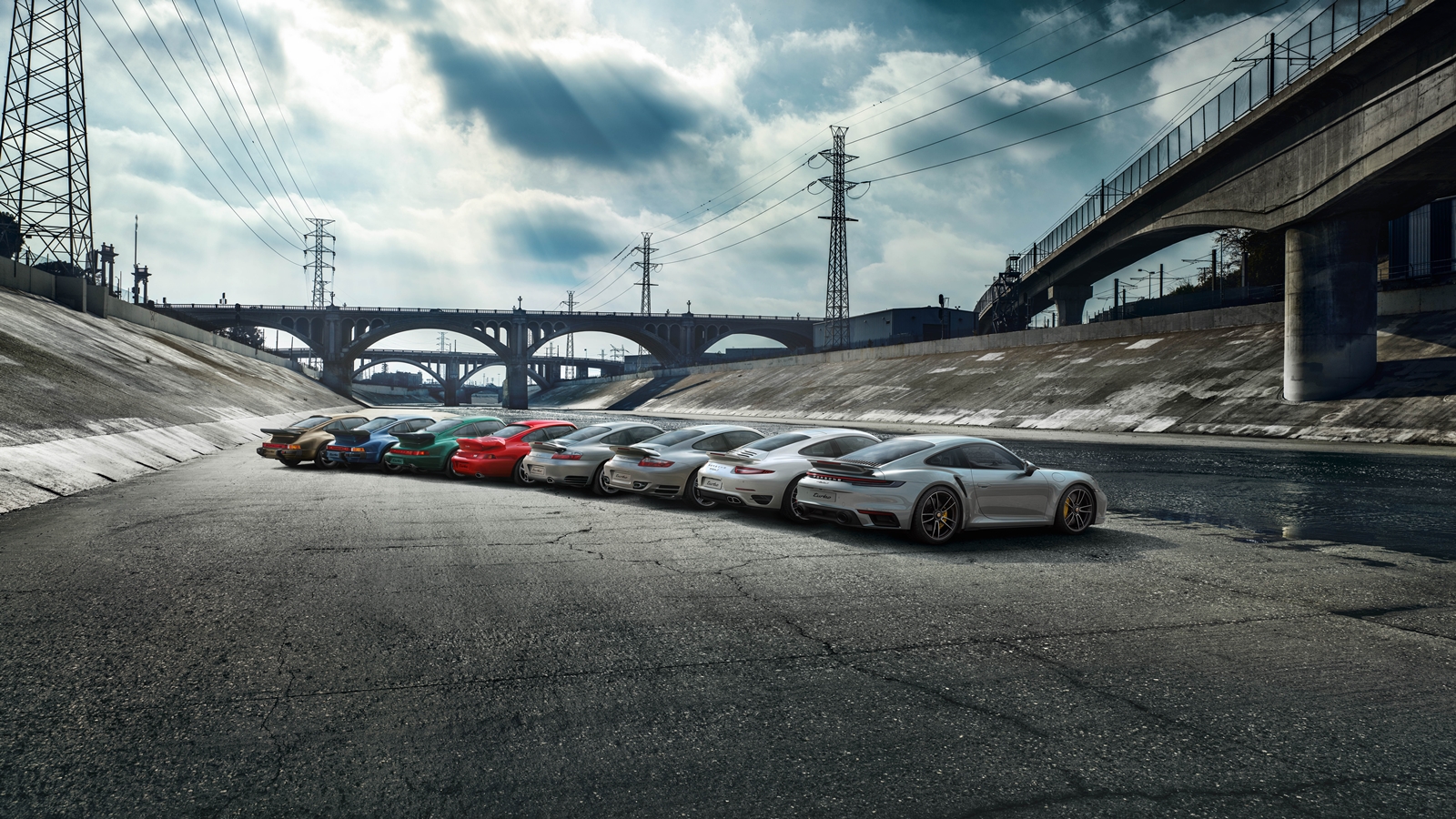
The turbo is a very widespread component today, although Porsche has been working on it for many years of its history to create the most radical versions of its models
The turbo is a mechanical component that is fully widespread in today’s car range, and it is that most cars we can buy today rely on turbocharging, so finding naturally aspirated engines is becoming increasingly difficult.
Your car most likely has a turbo, so we leave you our report on how to look after the turbo in a car. Its history goes back more than 80 years: in 1936 Cliff Garrett founded the first company specialised in manufacturing this type of component, called “The Garrett Corporation”.
How does a turbo work?
This curious system aims to increase performance through the direct injection of air into the combustion chamber. After ignition and the movement of the pistons, the resulting mixture begins to exit through the exhaust valves at very high pressure, so high that it can accelerate a turbine to very high rotational speeds.
Through a shaft, that turbine is connected to a compressor, which is responsible for introducing a greater quantity of air into the combustion chamber through the intake valves.
Developing this technology has been a real headache, since the temperatures a turbocharger can reach can climb as high as 1,000 degrees.
Ideally, the temperature of the air entering the intake should be, at most, twenty degrees above the ambient temperature before it enters the cylinders. If the difference is greater, the air loses density and affects the combustion process.
The first cars to use a turbocharger
The first car to fit one in its production versions was the Oldsmobile Jetfire Turbo Rocket, a genuine muscle car with a turbocharged 3.5-litre V8 capable of producing 215 CV.
From then on, turbochargers were refined to offer better behaviour and optimise the performance of many engines. One of the main drivers of this technology was Porsche, and since the early 1970s it began fitting them to its most performance-oriented models.
In fact, the brand’s first model to use one was the Porsche 917/10, a competition car that won the North American CanAm championship in 1972.
That victory was repeated the following year thanks to the Porsche 917/30, a beast capable of producing a staggering 1,100 CV. This was only the seed of what was to come, the beginning of one of the most celebrated lineages in automotive history.
Porsche brought the turbo to the street for the first time in its history
Seeing the results the turbocharger delivered in motorsport, the engineers in Stuttgart decided to fit it a year later to the first series-production model. This is how the Porsche 911 Turbo was launched for the first time in its 930 generation, a supercar for its day producing 260 CV.
Initially, Porsche only planned to build 500 units of this radical version, that is, the number needed to homologate the competition model. However, this version caused real excitement, so they decided to expand production and update the Carrera’s engine. As a result, it went from 3.0 litres to 3.3 litres, raising output to 300 CV in 1977.
Porsche 911 Turbo (930): the start of the lineage
The first generally known generation of the Porsche 911 Turbo, internally designated 930, was launched in 1974. The turbocharger had an exhaust gas wastegate, a feature the other manufacturers had only dared to use on the track.
The turbo had a maximum boost pressure of 0.8 bar, so it was capable of producing 260 CV. However, this was a very difficult car to drive, since the turbo’s power delivery came on very abruptly from around 3,500 rpm, so it was only suitable for the most experienced hands.
It was in 1977 that the engine of the Porsche 911 Turbo was updated, going from a 3.0-litre to a 3.3-litre and raising its output to 300 CV thanks to a larger compressor. In addition, as a first for a road car, it fitted a charge-air intercooler for the first time.
Porsche 959: Wanted Turbo? Then here are two cups
Porsche had already seen how well a turbo suited its characteristic boxer engines. So it used the 1983 Frankfurt Motor Show to present a prototype aimed at the wild Group B: it was called the
Porsche 959, and its potential was such that it won the 1986 Paris–Dakar Rally with René Metge at the wheel.
That same year, Porsche decided to produce the road version, which, as a novelty, featured four-wheel drive and not one but two turbochargers of different sizes to reach a maximum output of 450 CV and 500 Nm of torque.
The smaller turbo responded at low speeds, while the larger one took over the upper part of the rev counter, so that the Porsche 959 had power across practically the whole rev range.
Porsche 911 Turbo 3.3 (964): the natural successor
In 1991, the
Porsche 911 Turbo in its 964 generation arrived, the natural successor to the 930. It housed in its engine the same 3.3-litre block with a turbo similar to that of the first generation, though this time producing 320 CV.
Naturally, emissions regulations were becoming ever stricter, so this generation addressed exhaust gases by fitting metallic catalytic converters with three-way catalysts and an additional one for the bypass outlet.
It also incorporated a controlled pressure injection system and an intercooler that was 50% larger. Two years later came an even more powerful version with a 3.6-litre engine producing 360 CV.
Porsche 911 Turbo (993): the purists’ favourite
In 1995, the next generation of the
Porsche 911 Turbo arrived, internally designated 993. It is one of the most cherished by purists, as it was the last to feature an air-cooled engine.
In this case, the brand returned to the recipe of the Porsche 959 and decided to fit two turbochargers, although instead of operating sequentially, they worked in parallel – a configuration that has since spread to the other generations. Therefore, both ran at the same time, each serving one bank of the six-cylinder boxer engine. In addition, the wastegate attached to the turbine was also completely new.
With all this, it achieved a total output of 408 CV, although this generation also had extreme versions such as the Porsche 911 GT2, a beast derived from the circuits that could reach 450 CV.
Porsche 911 Turbo S (996): the start of the modern era
It was in 1997 that the
first generation of the modern era of the Porsche 911 arrived. Its internal designation was 996 and, for many years, it has been the “ugly duckling” of the family, as the purists never forgave its headlights losing their classic round design and the fact that, for the first time, it was liquid-cooled.
We had to wait until 2001 for the 420 CV Turbo version, which for the first time added the VarioCam Plus variable valve timing system to its 6-cylinder boxer 3.6-litre engine. This engine had racing genes, as it was entirely based on that of the Porsche 911 GT1 that won the 24 Hours of Le Mans in 1998. This generation also featured elements such as ceramic brake discs, which withstood abuse much better, or the Tiptronic S gearbox.
In 2004 the Turbo S variant arrived which, once again thanks to larger turbochargers, more efficient radiators and new catalytic converters, achieved no less than 450 CV and 620 Nm of torque.
Porsche 911 Turbo (997): the revolution
In 2006 the Porsche 911 Turbo in its 997 generation hit the market, and it came with a surprise that left the most knowledgeable open-mouthed: the engineers had incorporated, for the first time, a
variable geometry turbine (VTG) in a petrol engine.
This technology consists of vanes surrounding the turbine that change the angle at which the exhaust gases reach it. When the engine works at low speeds, these vanes form a specific angle to direct the exhaust gases so that they spin the turbine up faster.
VTG technology was already widespread in diesel engines, but it was far from common in a petrol engine, since temperatures are much higher in the latter and aerospace-industry materials had to be used. With all this, the output of the 3.6-litre six-cylinder boxer with two turbochargers rose to 480 CV.
Porsche 911 Turbo S (992): the latest word
We recently had the opportunity to show you the
latest generation of the Porsche 911 Turbo S, whose internal designation is 992. In this case, the engine is now 3.8 litres and combines wastegates with two variable geometry turbos that are placed symmetrically and have grown in size.
The main advantage of this innovation is that when we start the car cold, the catalytic converters heat up more quickly, since they do so through the electronically controlled wastegates.
In addition, the engine is more efficient: it reduces the exhaust back-pressure when running at full load and reduces residual gases in the cylinder. With this layout, final output now reaches 650 CV with a peak torque of 800 Nm.
That is as far as the history of the Turbo at Porsche goes, and it has become an indispensable element for the Stuttgart company and, unless an electric Porsche 911 arrives, it will continue to be developed for the most performance-oriented versions of the legendary German sports car.
Technical specifications of this car


 Peugeot E-208 GTi: a battery-powered toy that revives the spirit of the 1980s sports cars
 New Lexus ES: luxury grows and goes electric
 First contact with the Dacia Sandero Hybrid 155: power and efficiency from €19,890
Comentarios cerrados