Aston Martin Vantage Tests Supercars
The new Aston Martin Vantage put to the test: a reborn icon capable of standing up to the best in its class
 Antonio Roncero @roncero_antonio
1 November 2024
13 min.
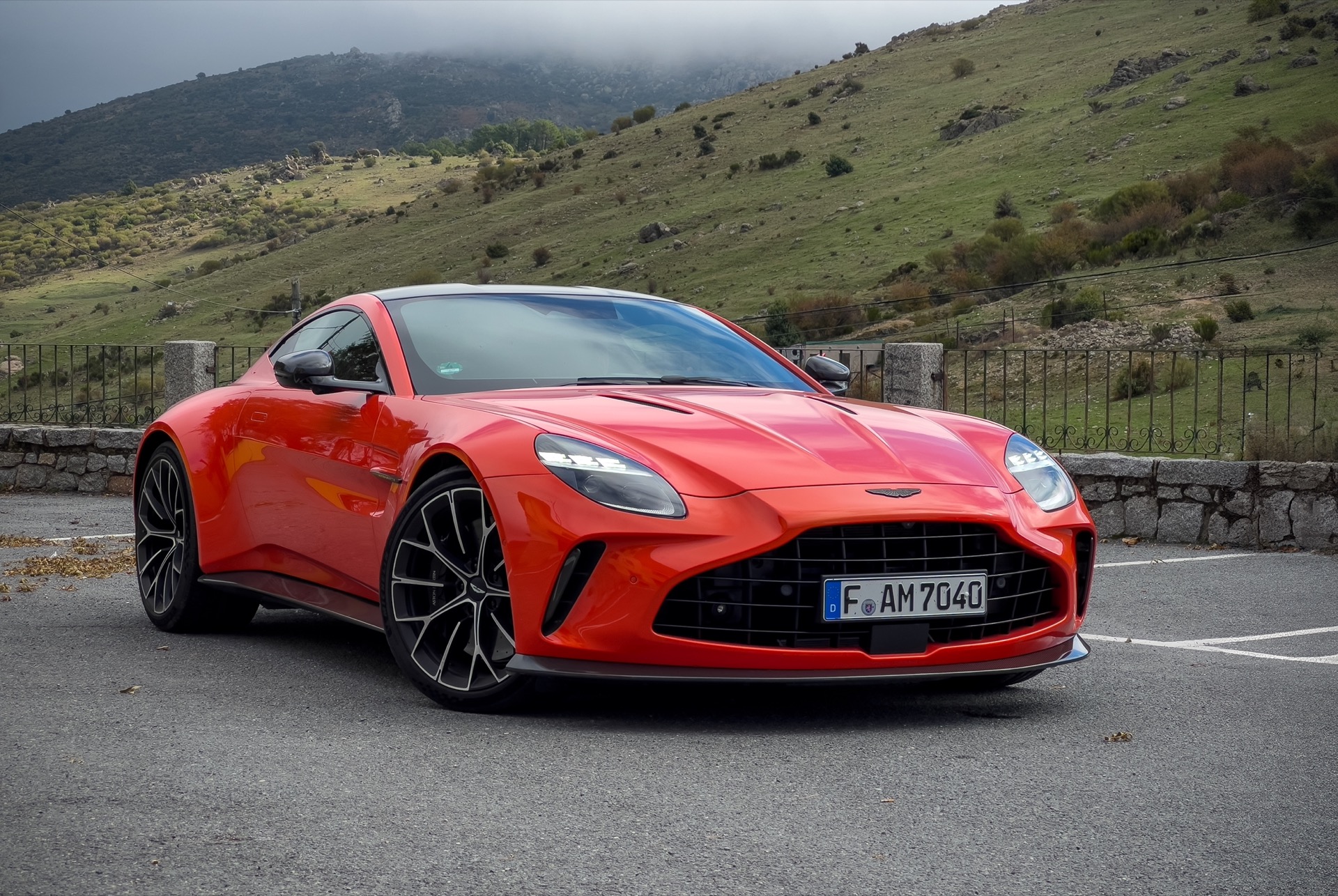
The new Aston Martin Vantage remains one of the most elegant sports cars in its class, but it can now also quicken the pulse of even the most experienced drivers thanks to its powerful V8 engine and, above all, a very well-tuned chassis.
A strong commitment to Formula 1, success in international GT racing, cars such as the Valkyrie AMR to fight for victory at Le Mans in 2025… It is clear that Lawrence Stroll’s arrival at the helm of the British brand, with a major capital injection, has brought a radical change not only in its motorsport activities but also in its road cars. A good example of this is the new Aston Martin DB12 presented last year in Coupé and Volante versions. Or the model that concerns us today, the new Aston Martin Vantage. A car that, from now on, will no longer inspire admiration for its design alone.
And, to get to the point, the previous Vantage did not measure up to the best in its class when it came to performance under demanding driving. But things have changed, and a lot. With an even more powerful V8 and, above all, with chassis adjustments and a new electronic differential, the new Vantage, which remains a thorough evolution of the model presented in 2018, is now more luxurious, more comfortable, faster… and, above all, an authentic sports car when it is time to tighten your seatbelt and put on your driving gloves. Aston claims that its new Gran Turismo is a car that rewards driving skill, yet is capable of delivering an exhilarating experience even to less experienced drivers. And having tested it, I could not agree more.
Pure muscle: an athlete dressed in a suit…
Patience, we will now talk about how the new Vantage performs. But first, let me devote a few lines to its design. Because I am sure that colour Orange Cosmos has caught your eye too… Few cars can look this good, whatever the body colour. In fact, the day I collected it, it shared the garage with another unit in the characteristic green of Aston Martin, with many body elements in a “shrieking” yellow contrast that, on any other car, would look tasteless. But the Vantage looks good in whatever suit you put on it, and there is plenty to choose from: up to 17 shades of grey and black, 10 in blue and purple, 15 greens, 5 reds, 7 oranges, 11 silvers… Even yellow! The catalogue is impressive, even for details like the colour of the brake calipers, with 7 options.
The styling is, quite simply, brutal. There are coupés that have to “dope themselves” with wings and spoilers to show muscle, with which you could never wear a tuxedo. But the Vantage displays sportiness and elegance like few others can. The new front end, with a “properly done” grille, strikes me as a clear success compared with the previous model, where integrating the front splitter into the grille looked most like a last-minute add-on. The new air intakes beneath the headlights, which are now matrix units, the air vents in the bonnet so the V8 can breathe freely, the 30 mm by which the bodywork has been widened, those side gills, or a trimmed, clean rear that gives the diffuser greater prominence, together complete a sublime ensemble.
Our test car, moreover, has undergone an intensive -and costly- carbon fibre treatment: there is carbon fibre, unpainted, on the splitter, the side skirts, the mirror housings, the trim around the air intakes and side gills, the rear diffuser… The roof is also carbon fibre. With the contrasting black roof option you get the same aesthetic effect, but without the weight-saving and lower centre of gravity advantages that carbon provides, which on a car this low and close to the ground should be minimal, yet every bit counts.
The 21-inch forged wheels are also spectacular, but what they enclose impresses me most. On one hand, Michelin Pilot Sport S 5 tyres, which are the real thoroughbreds, if you’ll pardon the expression. They were developed specifically for the Vantage, and I have no doubt they are one of the keys to the magnificent dynamic behaviour of the car. On the other, the optional carbon-ceramic brakes. I’m getting ahead of myself, but let’s close this section: I loved the feel they offer. The advantages of carbon-ceramic brakes in spirited driving are indisputable, but in exchange they tend to feel “difficult” in relaxed driving, when they haven’t reached temperature; yet in the Aston they feel like a luxury car’s. And, above all, they reduce unsprung mass by almost 30 kg compared with the standard brakes, an improvement well worth its weight… in gold, given what this means for dynamic behaviour compared with steel discs.
… and a cabin as comfortable as it is sporty
Yes, I know you’re eager to get going. But first, a tour of the cabin, which has received even more profound changes than the bodywork. The first thing that surprises is the level of superluxury and attention to detail, especially for a sports car, combining materials such as hand-stitched leather and carbon fibre. Comfort too, at least with the standard seats or, at most, the “sport plus” ones. There is a third option, the Performance seats, which are semi-bucket in style, but they are tremendously hard, very uncomfortable for daily driving, and make getting in and out of the cabin much harder.
I really like the new centre console, with plenty of physical controls to handle the main functions without resorting to the multimedia screen. There are direct-access buttons to adjust the climate control, to change the exhaust sound level (my favourite), or the adaptive damping, for traction control… And now a small lever is used for the gear selector, instead of the previous system with separate buttons for each transmission position. The central dial, with the start button, also rotates, and lets you select one of the five available driving modes: wet, sport, sport+, track and individual.
Call me a pedant, but what I don’t like about this console is that glossy black finish that manufacturers love to use in high-end cars, which looks very elegant when clean but is impossible to keep free of dust or fingerprints. The same finish is repeated on the touch controls of the multifunction steering wheel, which, like the indicator and wiper stalks, come straight from Mercedes-Benz models. Details that can be forgiven, especially when the V8 under the bonnet, which is the car’s true star, also comes “borrowed” from the brand with the star.
And I don’t want to overlook the effort Aston Martin has made to bring the Vantage up to date in connectivity, with the infotainment system developed in-house from scratch, first seen in the DB12. It has a 10.2-inch touchscreen much better integrated into the dashboard design, which works very well, although it now sits lower and so you have to take your eyes further off the road to consult it. It could be slightly quicker and smoother when navigating the menus, but it does the job. In return, the new digital instrumentation is much more complete. There is also a new smartphone app that lets you locate the vehicle, send points of interest to the navigation system or interact with the car itself and even with other Aston Martin users. What I did miss is wireless Apple CarPlay; for now it works by cable, although wireless is reportedly due in a future update.
Finally, a special mention for the sound system. The standard one has 11 speakers and 390 watts. The optional system fitted to our test car is a Bowers & Wilkins with 1,170 watts and no fewer than 15 speakers. To be honest, I didn’t enjoy it much, because I preferred to “tune in” to the V8’s frequency. But I did play the game of trying to find all 15 speakers in such a small cabin… and I’m still looking for them.
Twin-turbo V8: an engine that wins you over
And finally it’s time to press the “start” button. The V8 wakes with a discreet growl, and we let it warm up while we get familiar with the controls. It’s drizzling slightly, but not enough to start in Wet mode. That said, I keep traction control at level 5 of the 8 settings it offers, which is the default. To do this you press the corresponding button on the centre console for a few seconds, then turn the driving mode selector. Level 1 is the most restrictive, but at 5 you already need to be careful with your right foot. If you turn it off completely, the Vantage becomes a true “drifting machine”.
Getting around the city until you reach open road is not difficult, beyond the care needed with speed bumps or the garage ramp, since the front splitter sits very, very close to the ground. Visibility is good and, despite the width and the long bonnet, which seems to go on forever, it manoeuvres well. And as soon as the “track is clear” is when you really start to enjoy it. The original Mercedes-AMG twin-turbo V8 is an absolute marvel. Aston Martin has increased power by no less than 155 hp over the previous Vantage, and peak torque by 115 Nm, reaching 665 hp and 800 Nm. To achieve this, larger turbochargers have been fitted, along with modified camshafts, new lubrication and cooling systems…
Its throttle response is, quite simply, fantastic. Regardless of the gear selected or the revs, the response is always instant and forceful. It doesn’t fade even up to the rev limiter, which kicks in a little before 7,000 rpm, though it feels like it could keep climbing another 1,000 revs without a problem. And the ZF gearbox works so well that you never miss a dual-clutch transmission. I test the throttle response in the various driving modes, and you can really feel the difference.
I also play with the exhaust sound button, which never becomes alarming even in the most sporty setting. In fact, I’d say it sounds like an American V8. It’s as if it wants to hide its ferocity, although it treats you to a “crackle” on full acceleration or on overrun that sends your pulse racing. Something you will never feel in an electric car, however capable it may be of accelerating from 0 to 100 km/h in 3.5 seconds, like the Vantage.
And a chassis that enchants
This car is clearly quick, very quick. At least in a straight line. But then the bends come… and it’s no longer raining, but the tarmac is still a little damp. Absorbed by the engine’s noise, fiddling with the big paddles behind the wheel, getting a feel for the brakes and steering to try to “connect” with the car, I barely noticed. But the “no fear” light comes on (in my head, not on the instrument cluster) and I keep traction control at level 5 and Sport mode. And the Vantage starts to inspire a confidence I honestly didn’t expect at first.
You don’t normally start to get in tune with a car like this by rounding corners with a slight counter-steer, but the Aston rolls out the red carpet for it. The connection with the car is total from the very first moment. As I look to brake a little later and accelerate earlier at every corner, I recall some data I’d read beforehand in the dossier: 50/50 weight distribution, a 30% increase in rigidity, new adaptive Bilstein DTX dampers -the same ones Porsche uses-, a new electronic rear differential… And in particular the sentence I highlighted in fluorescent yellow: “The Vantage is a car for real drivers, inviting them to explore its limits. It rewards driving skill, but does not depend on it to deliver an exhilarating experience”. And I think it’s a wonderful way to describe what this car is like.
The tarmac dries, the road twists, and it’s time to switch to attack mode, so I select the Sport+ programme and set traction control to level 6. Even so, the Vantage still feels like a “beast” that lets itself be tamed very easily. Through electronics, that is. Though I don’t want to take anything away from the tyres, those fantastic Michelin Pilot Sport S 5, developed exclusively for the Vantage. When you drive a car like this, one that lets you reach and stay at the limit so easily, that’s when you really notice whether the tyres are up to the job.
https://youtu.be/ZXeW4GXhoe0
It was neither the right moment nor the right place, but I couldn’t let the Aston go without experiencing, if only for a few moments, “Track” mode. After all, we were only going to spend a few hours together. As you will understand, it’s impossible to draw conclusions on that. But I will tell you one thing: I can’t think of another car with which you can truly indulge yourself by drifting, or constantly drive at the limit chasing your own personal fastest lap, which you can also drive to the circuit like a gentleman, with maximum comfort and refinement.
I have always said my favourite car, the one I would buy with my eyes closed if I had a quarter of a million to spend on a sports car, would be a Porsche 911 Turbo. But I admit that, at times, the Aston Martin Vantage made me hesitate. I even think it could hold its own in a match of “pito-pito-gorgorito”.
Aston Martin Vantage – Image gallery
Technical specifications of this car


 Peugeot E-208 GTi: a battery-powered toy that revives the spirit of the 1980s sports cars
 New Lexus ES: luxury grows and goes electric
 First contact with the Dacia Sandero Hybrid 155: power and efficiency from €19,890
Deja un comentario