EX30 Volvo Electric Cars Tests SUV
Volvo EX30: we test drive the new electric mini SUV from Volvo
 Rafa Guitart @GuitartRafa
14 November 2023
9 min.
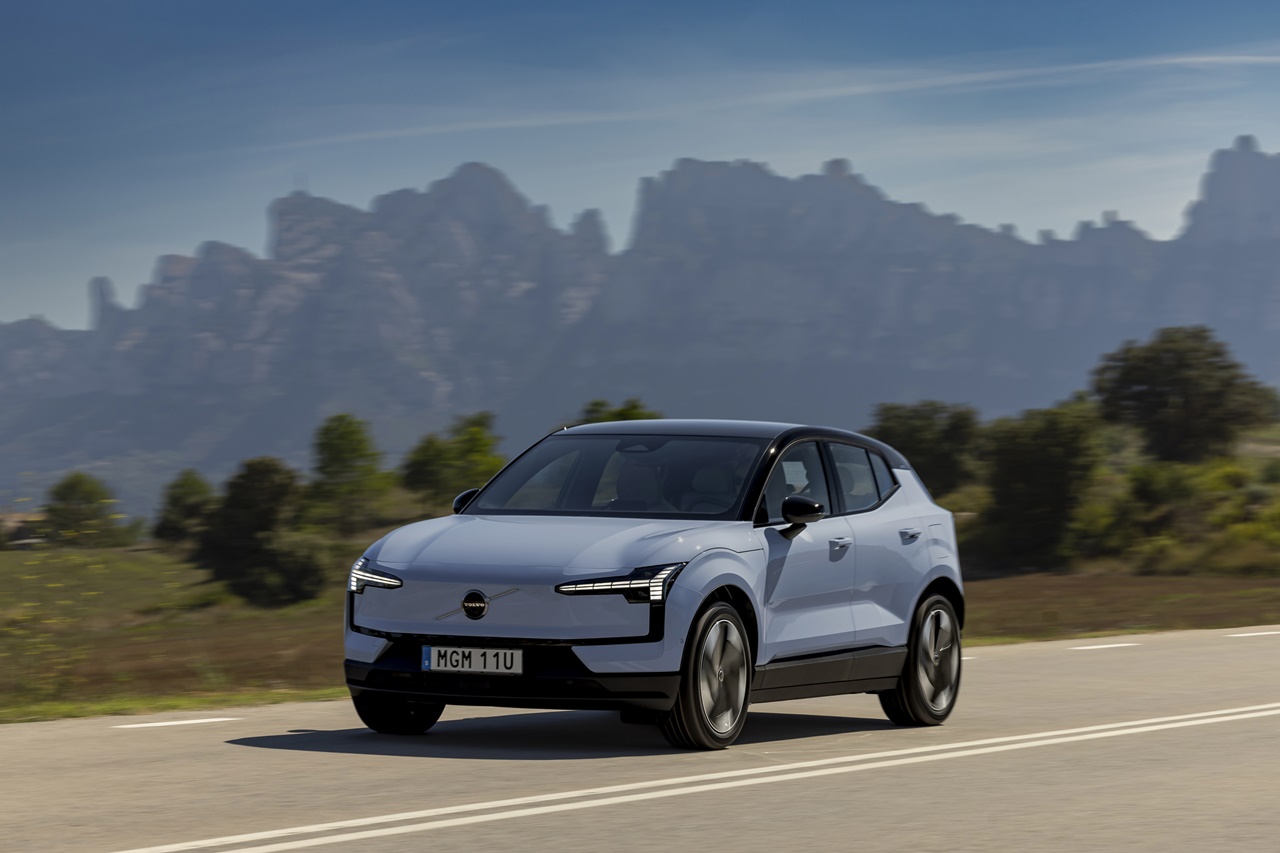
From January, the new electric SUV from Volvo will be available at dealerships, a simple and affordable model with which the brand aims to popularise fully electric mobility, as it will be offered from €36,770, not counting possible grants
It shares its front end with the largest model from the Swedish brand, yet it is the smallest car in the range. With exterior dimensions of 4.23 metres long, 1.84 m wide and 1.55 m high, the new Volvo EX30 is 19 cm shorter, 2.6 cm narrower and almost 10 cm lower than the XC40, placing it somewhere between the B and C segments. But if we look at the model’s power levels, it could even be above the average of D-segment models, since power levels range from 272 CV to 428 CV in the two-motor variant.
Initially it is built in China, sharing the SEA Entry platform with the Smart #1 and Zeekr X, although Volvo has confirmed that it will also be produced at its Belgian plant in Ghent, alongside the C40 and XC40 from 2025, to meet the strong demand expected in Europe.
It will be available from €36,770 in its rear-wheel-drive 272 CV version, with a 51 kWh battery and a range of 344 km, which makes the EX30 a very attractive option, since its likely rivals start above €38,000. Only the MG ZS, Fiat 600e or Jeep Avenger are slightly cheaper, but also much less powerful.
The secret behind Volvo’s approach with the EX30 lies in its design, conceived to save production costs, since all of the car’s controls rely on the central screen, with barely any physical buttons; in its batteries, of only 51 or 69 kWh; and in its shared platform policy with other models.
Very simple interior
Even simpler than that of a Tesla, Volvo has opted for a minimalist cabin, with a dashboard that features only a 12.3-inch central screen where absolutely all the available information is concentrated, as there are no other screens or gauges. Only the steering wheel switches and the window switches—shared for the front and rear doors—are the physical controls located on the centre armrest found throughout the car. There is not even an ignition key, as this function is handled by an electronic card (like a Tesla), and later this function can also be complemented by a smartphone to unlock and start the car or to share it with other people.
The driving position is good, with ample space, as nothing gets in the way between the driver and their surroundings. Only an iris control system behind the steering wheel—flattened at the top and bottom, with an almost square shape—since absolutely everything is entrusted to the central screen (navigation, climate control, music, phone—compatible with wireless Android Auto and Apple CarPlay—camera view, speedometer, consumption indication, battery level, driving indicators or turn signals).
Precisely this overwhelming concentration of data means that the figures shown on the screen are excessively small, and their position in the centre of the dashboard forces the driver to look away from the road quite a lot.
It is also striking that the mirror positioning or the glovebox opening system is controlled through the central screen, which is uncomfortable for anyone not very accustomed to this type of technology.
Curiously, the glovebox, which is not very large, is located in the centre of the dashboard, instead of the traditional position in front of the passenger seat. That said, there are plenty of storage spaces in the centre console, the armrest or the door pockets for leaving objects.
As for the rear seats, there is not much room to spare, and two occupants will travel considerably better than three. The solution Volvo has found to compensate for the high floor (the batteries sit under the floor) is to tilt the rear seat slightly so that the knees sit in a higher position, thereby achieving better accommodation. Nevertheless, it has split-folding rear seatbacks in a 1/3–2/3 configuration to improve the boot’s carrying capacity when needed, as under normal conditions it offers 325 litres of capacity. It has a floor that can be set in two positions so that the horizontal surface matches the folded rear seatbacks.
To prevent the charging cables from interfering with luggage, there is a small 7-litre compartment at the front, with a plastic cover, which can hold the cables if we are especially careful when stowing them, as there is not a centimetre to spare.
Plenty of power
Even the most affordable version, with 272 CV and rear-wheel drive, is particularly brilliant in performance: 0 to 100 km/h in 5.7 s and a top speed of 180 km/h, the same as the rest of the brand’s models. It promises 344 km of range with its 51 kWh battery (49 kWh net) and a maximum charging power of 135 kW, which is not bad at all. The large-battery versions, with 69 kWh (64 kWh net), increase charging power to 150 kW and range to 480 or 460 km, depending on whether they have one or two motors.
In the case of the two-motor, 428 CV variant, the acceleration figure is spectacular, as it needs only 3.6 seconds from standstill to reach 100 km/h, making it the Volvo that accelerates best across the entire range.
For the moment, three versions are available : with a 272 CV motor and 51 kWh battery (consumption of 15.7 kWh/100 km and a range of 344 km). With a 272 CV motor and 69 kWh battery (480 km of range), or the all-wheel-drive version, with two motors and 428 CV, a 69 kWh battery and a range of 460 km. Later on, by the end of 2024, there will be an EX30 Cross Country version, equipped with specific wheel arch extensions, front and rear plastic protection, and greater ground clearance.
The large-battery versions allow DC charging at 150 kWh, while the smaller version accepts 135 kW. On AC they can charge at 7.4 kW (single-phase), 11 kW (three-phase) and, in the Ultra trim, with a special on-board charger, at 22 kW. The brand admits that it can go from 10 to 80% charge in 28 minutes on 175 kW DC chargers.
As for trims, the brand offers three different equipment levels, Core, Plus and Ultra. All of them include active cruise control, parking sensors, rear camera, lane departure warning, blind-spot detection, LED headlights and free internet connection for three years. The Plus adds front parking sensors, dual-zone climate control, a wireless smartphone charger, an audio system with a Harman Kardon soundbar, and a boot with electric opening.
The Ultra top-of-the-range trim includes the 22 kW three-phase on-board charger, 19-inch alloy wheels, electric seats and a panoramic roof.
Sustainability has been a fundamental premise of the EX30, since recycled materials are used in all trims, such as denim fabric, recycled plastic from items like window frames and roller blinds, linen (a renewable fibre derived from flax plants), a blend of wool and recycled polyester, PET bottles, and bio-attributed materials sourced from forests in Sweden and Finland.
The brand claims to have a lower CO2 footprint than any other Volvo vehicle built to date and to allow a reduction of its carbon footprint below 30 tonnes after a 200,000 km service life, which represents 25% less compared with the fully electric C40 and XC40. In addition, it announces that the EX30 has been designed so that 95% can be recovered at the end of its useful life, recycling materials and recovering energy from elements that cannot be reused.
Range and prices
Although reservations are open both online and at dealerships, deliveries will not begin until early next year. The EX30 prices and trims are as follows:
- Single Core RWD 51 kWh €36,770.
- Single Plus RWD 51 kWh €39,735.
- Single Extended Range Core RWD 69 kWh €42,034.
- Single Extended Range Plus RWD 69 kWh €45,603.
- Single Extended Range Ultra RWD 69 kWh €48,749.
- Twin Plus AWD 69 kWh €48,265.
- Twin Ultra AWD 69 kWh €51,411.
Among the available options are tinted glass, for €325; heated steering wheel and seat, €295; 20-inch wheels, €795; metallic paint, €550; vinyl interior, €850; textile interior, €850.
Good handling
The overall handling is very good, very precise and fairly predictable, although in the rear-wheel-drive versions on a wet surface, the rear end tends to edge slightly outwards in corners when the power demand is excessive. Nevertheless, the stability control takes care of managing the power demand and reducing torque delivery to prevent oversteer.
In the all-wheel-drive variants, despite the brutal power delivery, traction is more balanced since the power is split between both axles. It can also be pushed into trouble, but it is more difficult.
The steering is not especially quick, with 2.8 turns lock to lock, but it does have a pleasant assistance, adjustable in firmness from the central screen itself, and it transmits quite well what is happening under the front wheels. For its part, the brakes offer sufficient bite and stopping power, although, as is usual in electric models, they have an initial regenerative phase in which the feel is somewhat different from that of the mechanical part. It also features a “one pedal” mode that holds the car on descents without needing to press the brake pedal and achieves greater energy regeneration.
As for the suspension, it is not especially firm for a model that can deliver up to 428 CV, but the truth is that it manages to keep the bodywork fairly well controlled through sequences of bends, isolates well from road imperfections and is quite comfortable for occupants.
Regarding consumption, we have not had the opportunity to carry out very precise measurements, but on the single-motor, 272 CV unit, the trip computer recorded an average of 19.2 kWh/100 km driving at a lively pace and, in the two-motor, 428 CV version, in considerably sportier driving, the average figure shown by the trip computer was 21.3 kWh/100 km, which is not bad at all for a model with such power and performance levels.
Technical specifications of this car


 Peugeot E-208 GTi: a battery-powered toy that revives the spirit of the 1980s sports cars
 New Lexus ES: luxury grows and goes electric
 First contact with the Dacia Sandero Hybrid 155: power and efficiency from €19,890
Deja un comentario