Alfa Romeo Giulia Stelvio Sedans SUV
We drive the most sporting models of Alfa Romeo on track: the Super Sport versions of the Giulia and Stelvio Quadrifoglio
 Antonio Roncero @roncero_antonio
15 July 2024
7 min.
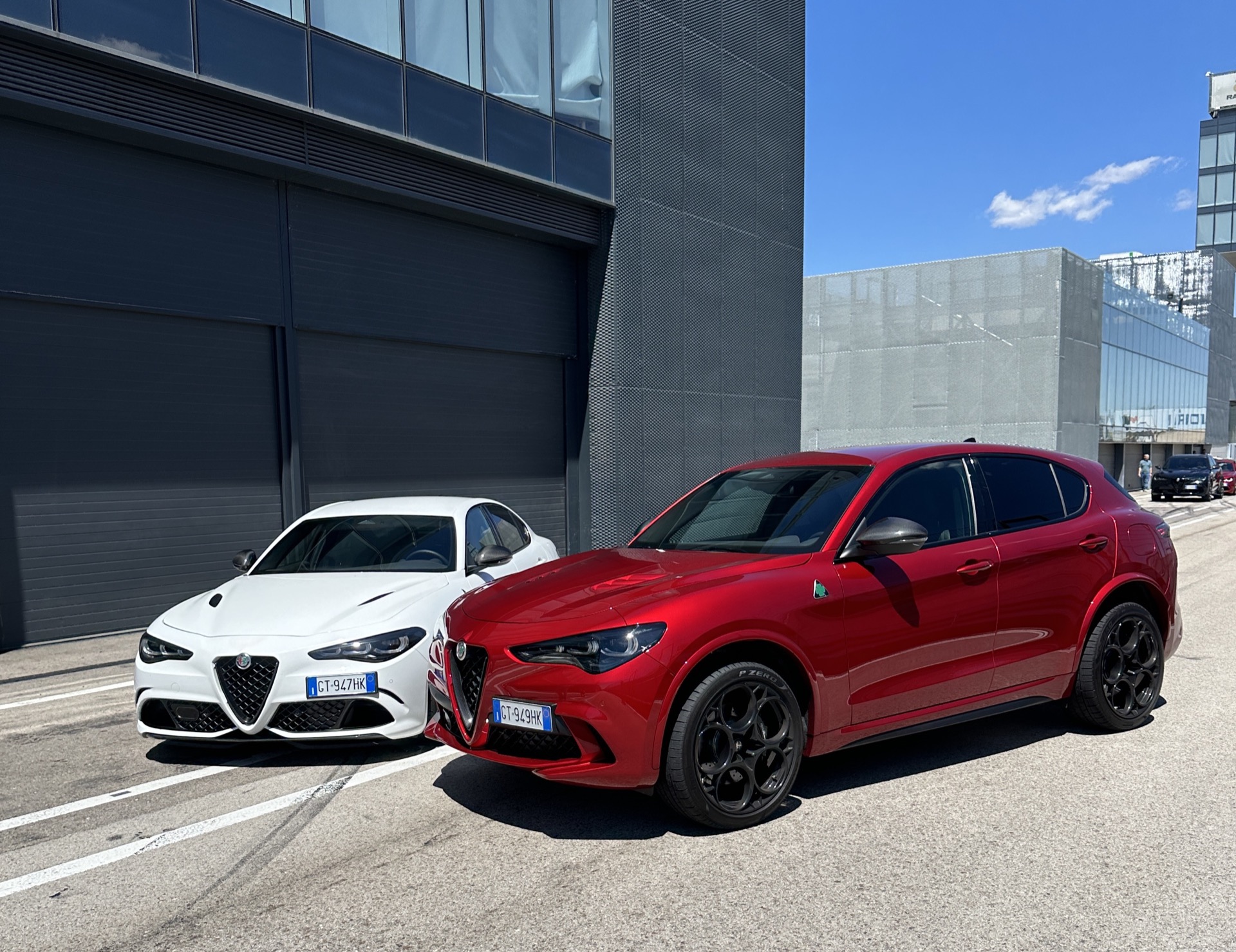
We get behind the wheel of the Super Sport editions of the Stelvio and Giulia Quadrifoglio at the Jarama Circuit, and we check why this exclusive, limited series sold out in just a few days.
Both the Alfa Romeo Giulia and the Stelvio were updated in 2023, basically receiving some cosmetic tweaks to align them more closely with the design of the Tonale and a digital instrument cluster, although in the case of the saloon the update was also used to simplify the engine range. And in this update, which also reached the Quadrifoglio performance versions, the 2.9-litre twin-turbo V6 engine gained slightly more power, going from 510 to 520 CV.
On these Quadrifoglio versions of the 2023 Giulia and Stelvio range, Alfa Romeo launched last spring two very special limited editions called Super Sport, in homage to the brand’s sporting history. Specifically, to its first victory at the Mille Miglia, achieved by the Alfa Romeo 5C 1500 Super Sport in 1928. It seems like a good excuse to put 275 units of the Giulia Quadrifoglio Super Sport on the market, and 175 units in the case of the Stelvio Quadrifoglio Super Sport. In fact, as of today they have all been sold.
So when Alfa Romeo invited us to the Jarama Circuit in Madrid to learn firsthand what makes these Super Sport versions special, you can imagine how quickly we changed our plans and cleared the diary: more or less the same time the most sporting Giulia needs to accelerate from 0 to 100 km/h.
What makes these Alfa Romeo Super Sport models special?
To begin with, their price. Those who have bought one of the 175 Stelvio Quadrifoglio Super Sport have paid 121,800 euros each, and 111,600 euros for the Giulia. Yes, on paper it’s a lot of money; but what if I told you that, with a calculator in hand, they’re not so expensive? Let me explain. To start with, these Super Sport editions cost “only” about 6,600 euros more than the Quadrifoglio versions they are based on. Now I’ll tell you what they include, apart from the fact that they are a limited edition, something that carries its own value, especially for some collectors.
But we must not forget what other cars cost that are capable of delivering driving sensations like those these sports models from Alfa Romeo offer. As an alternative to the Giulia, and although there are others, the first that comes to mind is, inevitably, the BMW M3 Competition, with 510 CV and a price from around 118,000 euros. However, finding an SUV capable of holding its own against the Stelvio Quadrifoglio on track is much harder. At least, the only one I remember driving is the Porsche Macan GTS, with 441 CV and a price that at the time started at 112,000 euros, and which is no longer on sale. The new Macan Turbo Electric should not be far behind, although I haven’t tried it yet: it produces 585 CV and costs close to 118,000 euros.
Returning to these Alfa Romeo Super Sport models, there are no changes to the engine, which still delivers 520 CV. But work has been done on the suspension, with specific adjustments to the electronically controlled dampers and the steering. The mechanical limited-slip differential has also been recalibrated. And those are the only modifications that may affect the sensations these Quadrifoglio Super Sport models convey when driven compared with the versions they derive from, because the rest is “cosmetic”.
Alfa Romeo Giulia Quadrifoglio Super Sport – Image gallery
On the Giulia, for example, the distinctive five-hole alloy wheels are 19 inches, and 21 inches on the Stelvio, both with brake calipers finished in black. The Quadrifoglio logo features a black background for the first time, and carbon fibre appears on numerous bodywork elements, such as the grille, the mirror housings, the front splitter and the rear spoiler on the Giulia… On the saloon, the roof can also be made of carbon, but as an option. The units we saw and drove did not have it, but the brand tells us that practically all units sold included it as an extra. The brakes on the Giulia are standard carbon-ceramic, and optional on the Stelvio.
Another important feature on the Giulia is the Akrapovič exhaust, also standard on the Super Sport edition, and pure “music” to the ears. In addition, these versions add a specific display mode in the instrument cluster when the “Race” programme is selected on the driving mode selector. As for the interior, the special series identification logo could not be missing, in this case embroidered in red letters on the headrests. Also exclusive to these variants are the red 3D carbon inserts on the centre console and dashboard. For the bodywork, the Stelvio and Giulia could be specified in either Vulcano black or Etna red, while the saloon was also offered in Alfa white. Of all of them, the red is undoubtedly the most beautiful, and I won’t entertain any debate on the matter.
An SUV and a saloon that exude… pure adrenaline!
Everything looked very promising, until the briefing before the driving session arrived… and the anticipation turned into disappointment: we would only drive one complete lap, because of the three in total I don’t count the exit lap, nor the entry lap to the pits, since that one was to be used to cool the brakes. And, to make matters worse, with a “pacesetter” in front. Normally at presentations or events of this kind the instructors give you free rein, and let you go fast if they see you are able to do so safely: they only need to watch how you take the first corners. But in this case the “pacesetter” was a Tonale, which, however skilled its driver, could do little against the horsepower unleashed behind it.
So there you go, my joy was short-lived. On the one lap and little more that I could really take in each car, the sensation was similar to what an F1 driver must feel when the safety car comes out: going nowhere. That is why I tried to enjoy every second of those emotions that, with the arrival of electrification, we are gradually losing: an absolutely marvellous engine that revs past 7,000 rpm while you feel the gearbox engage each gear precisely and quickly, an exhaust that produces an absolutely addictive sound and a tremendously agile and responsive chassis. By the way, to put things in context: remember we are talking about two cars that dip under 4 seconds for the 0 to 100 km/h sprint (3.9 seconds for the Giulia, one tenth less for the Stelvio, which gains an advantage from its all-wheel drive despite a less favourable power-to-weight ratio), and that reach 308 km/h in the case of the saloon, while the Stelvio tops out at 285 km/h.
I admit it would be impossible for me to assess, even in terms of sensations, the effect of the specific suspension adjustments for these Super Sport versions compared with what I remember of the Giulia and Stelvio Quadrifoglio. And not because I don’t remember the latter well, they are hard to forget, but because the driving session allowed for little more than what I have told you. I was, however, able to confirm what I already suspected and had not been able to verify until now: that an SUV can hold its own very well on track if it wears the emblem of Alfa Romeo and a four-leaf clover… And that inertia, weight and the centre of gravity are everything on a circuit, not only when braking. That is why I chose to drive the Stelvio first. If I had to keep just one, I would choose the Giulia, even if I weren’t going to drive on track regularly.
Alfa Romeo Stelvio Quadrifoglio Super Sport – Image gallery
Technical specifications of the cars in this article
 Kia offers an electric range of 10 models, 50 versions and 400 possible combinations
 The seven finalists for the 2027 European Car of the Year (COTY) are exclusively electric
 Peugeot E-208 GTi: a battery-powered toy that revives the spirit of the 1980s sports cars
Deja un comentario