Clase V EQV Mercedes Furgonetas Minivans
We drive the new Mercedes-Benz V-Class and EQV: less and less van, more and more MPV
 Antonio Roncero @roncero_antonio
12 June 2024
7 min.
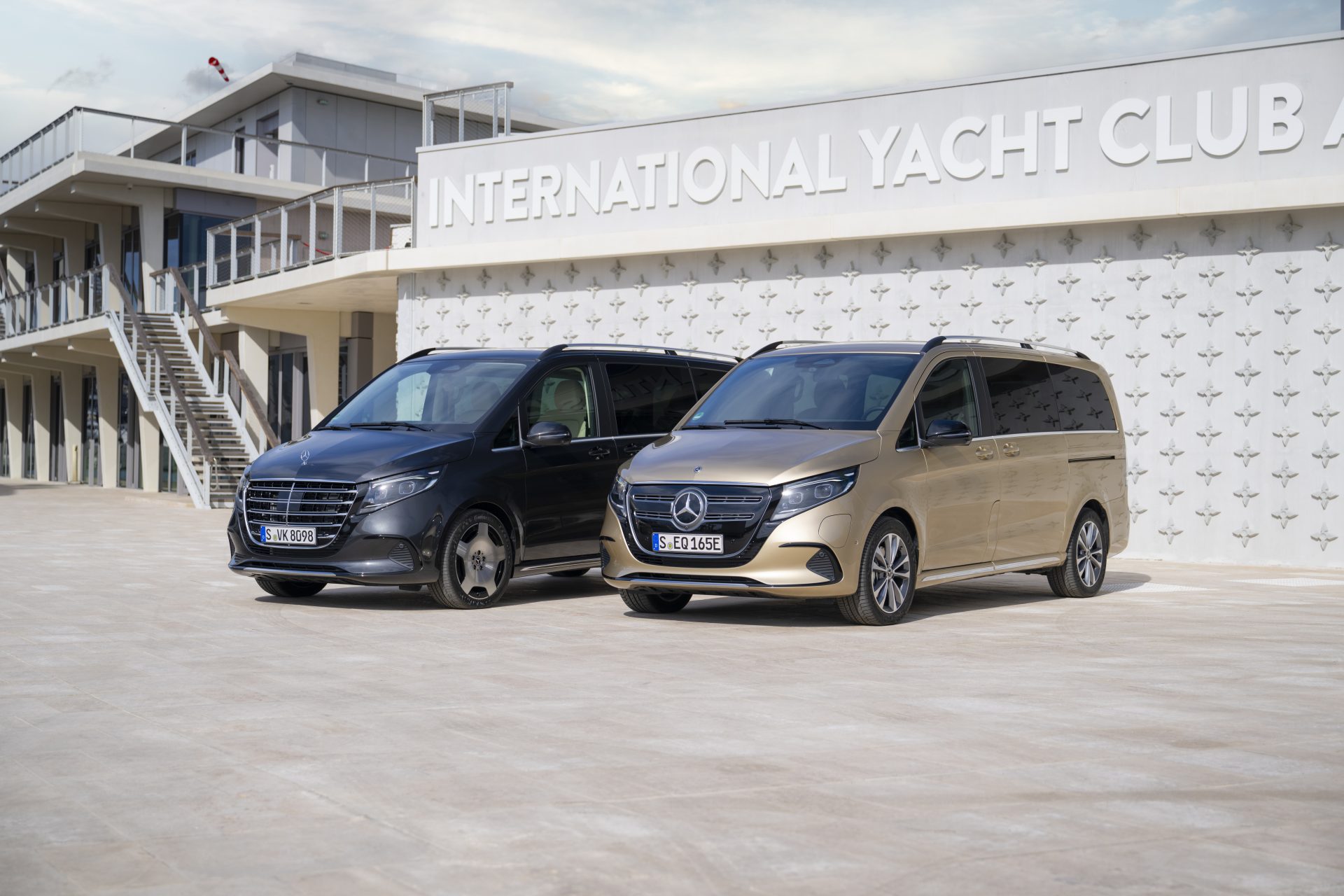
With a new exterior and interior design and more comfort and safety equipment, the new Mercedes-Benz V-Class and EQV take one more step up in sophistication to remain the benchmark among large luxury MPVs.
Mercedes-Benz has given its V-Class and the electric version, the EQV, a thorough makeover. These passenger vans from the star brand are less and less van and more and more MPV. In fact, the brand already announced a few months ago that its strategy for its future MPVs is to focus even more on luxury, and even to take a “premium” approach for its range of commercial vans too, applying the standards of comfort, safety, design and finishes it uses in its passenger cars.
Changes to the design of the new V-Class
They are not many, but the touches applied do make it clear this is a new edition of the model, which keeps its dimensions unchanged. The most notable change is the new grille, with different finishes depending on the equipment version; in some versions the grille even incorporates a LED light strip. Also new, though only on the top Exclusive finish, is the vertical star on the bonnet for the first time, in the purest style of the passenger cars. On the best-equipped versions the LED headlights become adaptive Multibeam units.
The rear light clusters are also new, and now include a chrome trim with the brand’s lettering. And, as is usual with this type of update, the range gains new wheel designs -ranging from 17 to 19 inches- and, in this case, four new body colours in the paint offer -twelve are now available in total-, always with the bumpers and mirrors in the same colour as the rest of the vehicle. Besides the aesthetic differences associated with each of the finishes, base, Style, Avantgarde and Exclusive, the AMG Line trim and the Night package add further customisation options.
The changes go much deeper on the inside, with a complete redesign of the dashboard. And I really liked the previous one… but if what Mercedes-Benz wanted was for both driver and passengers in a V-Class to feel the same as being in one of the brand’s passenger cars, they have achieved it. The design is now much more horizontal and conveys a very digital, extremely high-quality feel. The multimedia screen is no longer an “add-on” on top of the dashboard; it sits next to the instrument screen under a glass cover, so it looks like a single screen. Each of them measures 12.3 inches and has a resolution of 1,920 x 720 pixels.
New functions for greater comfort and safety
Also new are the multifunction steering wheel with touch-sensitive buttons and capacitive controls -I’m sorry, I still prefer the press-and-turn ones, the classic kind-, the comfort seats, the keyless push-button start system, the wireless phone charger and the ambient lighting system with up to 64 colours to choose from. The only thing I didn’t like about the new dashboard design is that the instrument cluster and the multimedia screen sit very low, forcing you to constantly “refocus” when checking the instruments, since you can’t glance at them peripherally: you have to take your eyes off the road, no question about it.
The multimedia system is the brand’s MBUX, with the “Hey Mercedes” voice assistant as standard, seven user profiles that can be synced from the cloud with the Mercedes me account and the Mercedes me App, all kinds of digital services, optional augmented-reality navigation and the ENERGIZING comfort control, also available for the first time on the V-Class and EQV, which groups the operation of the climate control, music and ambient lighting according to each user’s preferences at that moment. As I said: just like the brand’s passenger cars.
Other interesting functions that improve comfort are the “car wash” mode in the MBUX, which closes the windows and deactivates the wipers and parking sensors, and the free-space display mode, which shows a shaded area on the screen where the rear doors or tailgate can be opened safely.
As for safety systems, some are new and others improved, completing an equipment list that lacks absolutely nothing. As standard, the V-Class and EQV include the DISTRONIC active distance assistant, light assistant, active brake assist with cross-traffic function, blind-spot assist, active lane-keeping assist, a parking package with reversing camera and eleven airbags. As part of an optional assistance package, DISTRONIC can have additional functions such as route-based speed adjustment and restart after stopping in traffic. The active steering assist, for its part, helps keep the vehicle centred in its lane, improving comfort on long motorway journeys. There is also a new parking package with a 360-degree camera.
The usual turbo diesels… and a new petrol engine with an ECO label
There is no news for the V-Class turbodiesel engines, with the reliable 2-litre 4-cylinder unit, which is kept in three power variants: 120 kW (163 CV), 140 kW (190 CV) and 174 kW (237 CV), all with the 9G-TRONIC automatic gearbox and optional all-wheel drive. With the most powerful engine, the one we tested at the first drive, the V-Class is a true motorway devourer. It is surprising how easily it moves the car with two people on board. Although based on what we know of the previous generation, I would even dare to recommend the intermediate version if the vehicle is going to be used fully loaded: it is an engine with a magnificent balance between performance and consumption.
An interesting addition to the range, arriving a little later, is the 2-litre petrol engine with 179 kW (231 CV) and mild-hybrid system, which earns the ECO label from the DGT. That said, it homologates provisional consumption figures clearly higher than the turbodiesels, and in real-world use you will easily be around 3 l/100 km more on average. However much some people want to wipe them off the map, diesels remain the best option for a car of this size, weight and aerodynamics.
Of course, all the changes in design, multimedia, comfort, equipment, etc., also apply to the electric version of the V-Class, the Mercedes-Benz EQV. Here too there are no changes in power or battery capacity: the motor delivers 150 kW (204 CV) and you can choose between two options, with 60 kWh or 90 kWh, both available with the Long and Extra-Long body variants. With the combustion engines you can also choose the short or compact version, although 80% of V-Class sales are of the Long version. Optimised thermal management of both the motor and the battery improves efficiency and allows ranges of up to 365 km to be claimed in the most favourable case.
Prices for the Mercedes-Benz V-Class start from 74,869 euros for the 220 d with base finish and compact body, from 77,316 euros with the 250 d engine, and from 84,064 euros for the 300 d, which in this case starts from the Style finish. The petrol V3 3” with long body and base finish costs 82,102 euros. The most expensive and luxurious version, the V-Class with Exclusive finish, extra-long body and 300 d engine, goes up to 113,070 euros, making it the most expensive vehicle built in Spain.
For the EQV, the price of the 250 Long version is 89,014 euros, and 89,928 euros for the version with Extra-Long body. The EQV 300 with the larger-capacity battery, available with the long body, is priced at 96,658 euros.
Mercedes-Benz V-Class and EQV – Photo gallery

 Kia offers an electric range of 10 models, 50 versions and 400 possible combinations
 The seven finalists for the 2027 European Car of the Year (COTY) are exclusively electric
 Peugeot E-208 GTi: a battery-powered toy that revives the spirit of the 1980s sports cars
Deja un comentario