Behind the wheel of the Explorer, Europe's first electric SUV from Ford
 Rafa Guitart @GuitartRafa
8 August 2024
7 min.
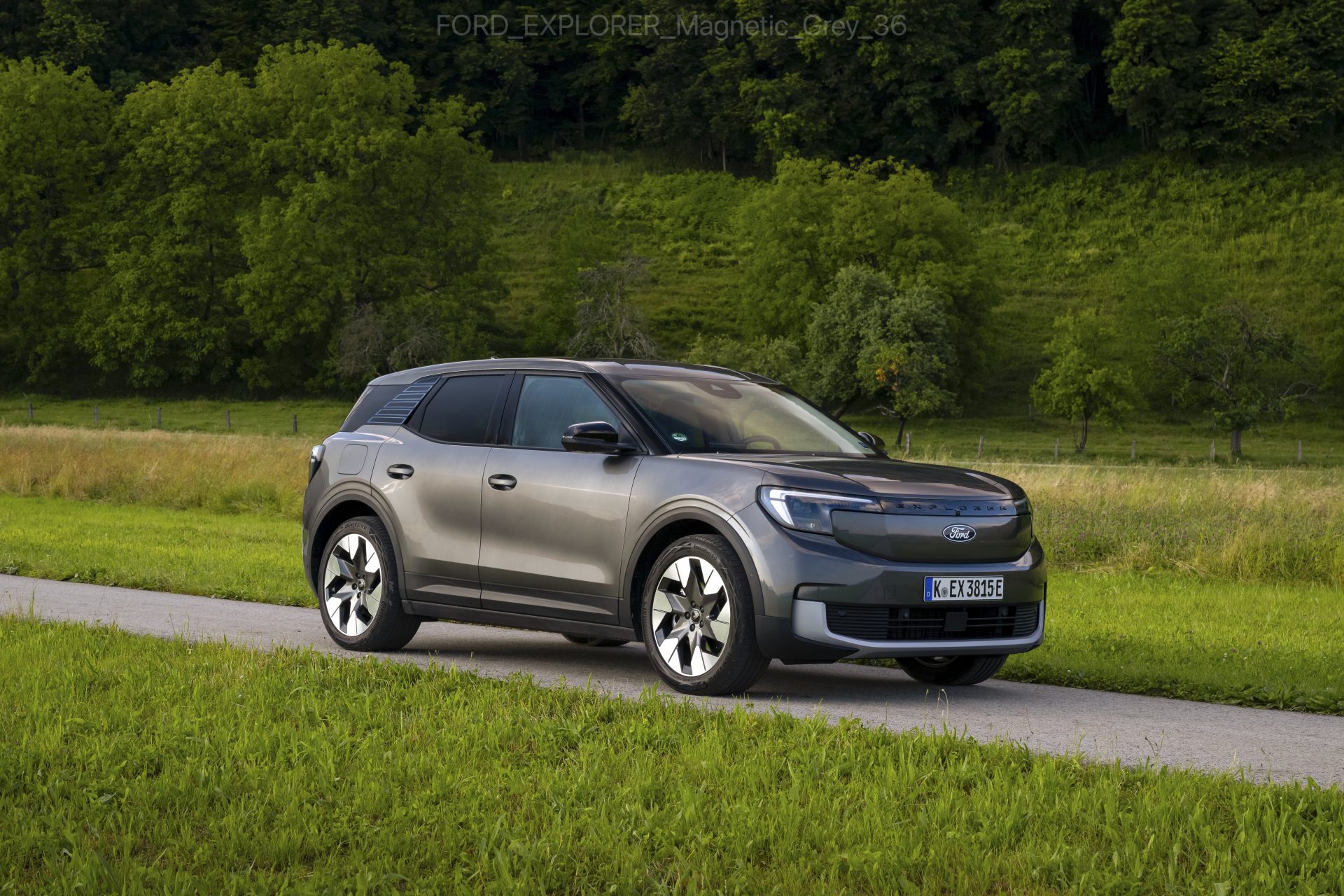
With the new Explorer EV, available with rear-wheel or all-wheel drive, two power levels, a practical body and a reasonable range, Ford aims to bring the electric SUV within reach of a larger part of the population.
It keeps the name of another legendary model from the oval-badged brand, but in reality it has very little to do with it, as its dimensions are considerably more modest and its propulsion system is limited exclusively to electric power. Designed in Europe and built in Cologne, it promises more than 600 km of range and charging power of up to 185 kW.
The new edition is based on the MEB platform of the Volkswagen group, with which it shares many mechanical and electrical components. Its dimensions place it in the middle of its category, with a length of 4.47 metres, a width of 1.87 and a height of 1.63, and a wheelbase of 2,770 mm. The advertised boot capacity is 470 litres (1,460 with the rear seatbacks folded), and the weight difference between the rear-wheel and all-wheel drive versions is not very striking: 77 kg. 2,090 kg for the RWD version and 2,167 kg for the AWD.
The performance of the new Explorer is striking, capable of accelerating faster than a Ford Performance Focus ST with 340 CV, which means the Explorer AWD can reach 100 km/h in 5.3 seconds and is also capable of towing up to 1,200 kg. The lower-powered variant reaches 0 to 100 km/h in 6.4 seconds and offers a top speed of 180 km/h, as do the all-wheel drive versions.
Two engines, two propulsion systems
The rear-wheel drive configuration features a 77 kWh lithium-ion battery, delivers 210 kW and a peak torque of 545 Nm, while the all-wheel drive variants have a 79 kWh battery (with a different cell configuration), 250 kW of power and 545 Nm of torque for the rear motor and 134 Nm for the front. A single-motor RWD version with a 52 kWh NMC battery and 170 CV will also be launched later. All versions accept three-phase AC charging of up to 11 kW.
The homologated consumption figures are very impressive for a model of these dimensions, power and weight: the single-motor, rear-drive version promises 13.9 kWh/100 km, while the more powerful all-wheel drive variant raises energy consumption to 15.7 kWh/100 km. As a result, the maximum WLTP ranges are 602 km for the rear-drive unit and 566 km for the more powerful version with the larger battery. The real difference lies in the maximum DC charging power: the small battery accepts peaks of up to 135 kW, while the 79 kWh battery rises to 185 kW, which in theory would allow a 10 to 80% charge in 26 minutes.
Spacious and practical interior
The cabin design is very carefully considered, with well-finished materials and excellent fit and finish. It feels especially spacious and airy; in addition to around 470 litres of combined storage -including the 17-litre MegaConsole and the My Private Locker secure compartment- every Explorer comes with the SYNC Move 2 connected infotainment system with a 14.6-inch adjustable central touchscreen that can be raised and lowered through an arc of more than 30 degrees. We are not convinced by the side window control system, inherited from Volkswagen, which has only two buttons for all four windows (you must activate a switch that selects the front or rear windows).
The heated steering wheel and front seats, the driver’s seat with massage function and wireless phone charging are also fitted as standard. It includes an original soundbar to improve audio quality, which can be played through wireless devices connected via Android Auto and Apple CarPlay.
The Premium trim levels add a 10-speaker B&O sound system and ambient interior lighting, 20-inch alloy wheels and dynamic matrix LED headlights with high beams that avoid dazzling other drivers through independent segments.
The optional extras are limited to a panoramic sunroof with more than 1 square metre of glass area and a driver assistance package that includes hands-free tailgate, head-up display, 360-degree camera and assisted lane change system. These features add to the driver assistance technologies fitted as standard, among which the adaptive cruise control with stop-and-go function and exit obstacle detection warning stand out, among others.
Smooth and pleasant handling
Like most fully electric models, smoothness, silence and the absence of vibration are the most notable characteristics when driving. In the case of the Explorer these qualities are enhanced, as it is quieter than other competing models. The sealing work on the seals appears to have been more thorough, as no noise from the bodywork or the tyres is noticeable.
This is also worth highlighting, as the car feels planted, inspires confidence and offers high driving enjoyment, thanks to an excellent setup of the steering, suspension and brakes. It is not especially firm, but the suspension filters out road imperfections well and feels very comfortable and effective. The steering is very precise, although it seems to have too much assistance, so the wheel moves in an excessively light way that sometimes requires corrections to the line. The driving modes, accessed through the central screen, do not seem very intuitive either, although once you understand how the car works they pose no problem.
The gear selector, identical to the one used in Volkswagen electric models, is comfortable to operate, as it is located on the steering column next to the wheel, and does not require you to move your hand far to engage the higher regenerative braking mode B, although on one occasion it was left in N mode (neutral) after turning the control in the opposite direction.
It has a customisable driving mode to modify the engine response and, in the all-wheel drive variants, is complemented by a Trail mode that changes the traction system management to improve grip.
Range and prices
For the moment two mechanical options are offered with two different equipment levels: the Explorer RWD 77 kWh with 286 CV, priced at 46,562 euros; in Premium trim it costs 49,582 euros. The AWD Explorer with 340 CV costs 55,851 euros and, in Premium trim, rises to 58,851 euros, excluding state aid. It is available in six colours (Artic Blue metallic carries no surcharge), while white costs 269 euros; black and Magnetic metallic cost 620 euros, and the Premium colours My Mind Blue and Red Lucid cost 878 euros.
As for equipment packs, the Driver Pack, which includes head-up display, lane centring with lane change assist, Active Park Assist (with 12 sensors), 360º camera and hands-free tailgate (standard on Premium), costs 1,610 euros on the base version and 1,130 on the Premium trim.
The AGR seats, with electric adjustment, massage and memory function, available for both trims, cost 610 euros. The retractable towbar costs 900 euros; the panoramic sunroof (only available on Premium) is priced at 1,240 euros, and the heat pump, available on both trims, 1,300 euros. The 21-inch alloy wheels cost 1,200 euros for the standard version and 600 for the Premium.
Image Gallery

 Peugeot E-208 GTi: a battery-powered toy that revives the spirit of the 1980s sports cars
 New Lexus ES: luxury grows and goes electric
 First contact with the Dacia Sandero Hybrid 155: power and efficiency from €19,890
Deja un comentario