Nissan X-Trail Hybrid Cars Tests SUV
Test drive and buying guide: Nissan X-Trail, a very family-friendly SUV ready for adventure
 Antonio Roncero @roncero_antonio
8 August 2024
10 min.
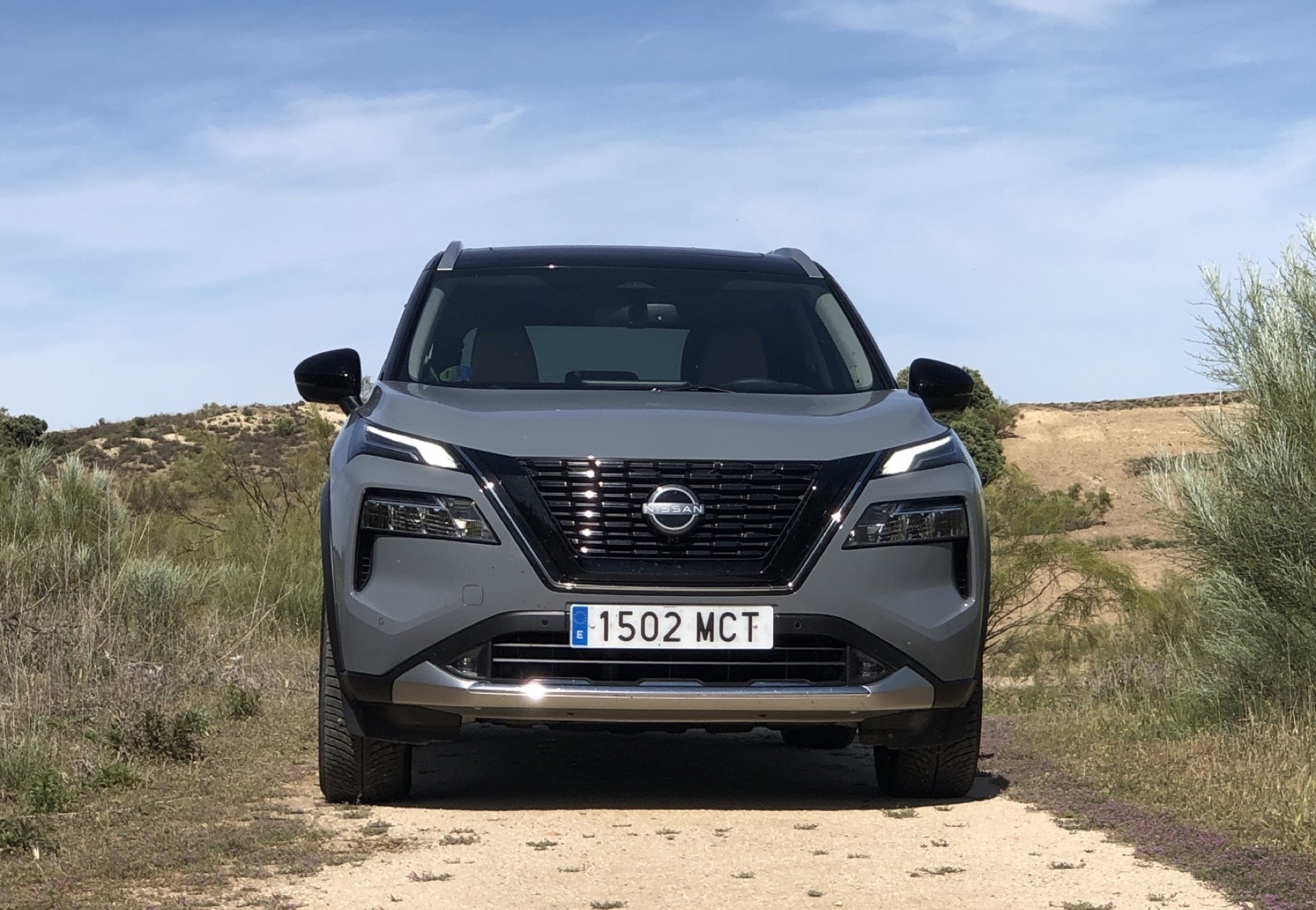
The fourth generation of the Nissan X-Trail arrived in our market at the end of 2022. It is not a model you see very often on our roads, as SUV sales are concentrated in the two lower segments. And just below the X-Trail, Nissan already has a real “bestseller”: the Qashqai.
What you may not know is that the price difference between a Qashqai and an X-Trail is not that large, and it is not unreasonable to consider stepping up to the “big brother”. Above all, if you travel frequently, need a lot of interior space (with the option of even seven seats) or value the extra refinement the X-Trail offers, in addition to it being a model better prepared to leave the tarmac from time to time.
In terms of size -almost 4.7 metres long- and price -from 33,700 euros up to 50,600 euros, with discounts applied and financing the purchase-, the “natural” rivals of the X-Trail are cars such as the Peugeot 5008, the Skoda Kodiaq or the Renault Espace. But be careful, because depending on your budget and needs, the X-Trail can also be an alternative to a Volkswagen Tiguan or a Kia Sportage, for example.
Let’s get to know the X-Trail a bit more thoroughly. I’ll explain why I think it is a good alternative for those looking for a large but manageable family SUV, well equipped without a large outlay and, above all, very satisfying as a car for travelling, thanks to the quality of the experience it offers on board.
The main features of the Nissan X-Trail
Although it may not be relevant, it is worth knowing that the X-Trail shares the same platform as the Qashqai. One difference that is important when comparing both cars is that in the less powerful versions with 4×2 traction, the rear suspension of the Qashqai is a torsion beam axle, simpler than the multi-link type used on all X-Trail versions.
Its dimensions are 4.68 metres in length, 1.84 metres in width and 1.71 metres in height, with a wheelbase of 2.70 metres. A Qashqai is about 25 cm shorter, just as wide and almost 10 centimetres lower, although there is a significant difference in weight: the X-Trail is about 200 kg heavier, considering equivalent mechanical versions.
The current X-Trail range offers three mechanical configurations to choose from, combined with the Acenta, N-Connecta, Adventure and Tekna trim levels. The 1.5 Turbo version is only combined with the two lower trims, while the two e-Power variants can be chosen in any trim. This is the range and price band, according to the configurator on Nissan and considering all possible discounts, including financing:
- 1.5 VC Turbo MHEV 4×2 120 kW (163 CV): from 33,700 euros to 36,600 euros
- 1.5 ePower 4×2 152 kW (204 CV): from 37,500 euros to 47,200 euros
- 1.5 ePower e-4ORCE 4×4 158 kW (213 CV): from 40,900 euros to 50,600 euros
All versions are based on the same petrol engine, a three-cylinder 1.5 that, for the more curious or mechanically minded, has a unique feature: it includes a system that allows the compression ratio to be varied. In practical terms, the important thing is that all versions carry the ECO label from the DGT. The 1.5 VC Turbo MHEV because it incorporates mild hybridisation, which in this case is one of the simplest, at 12 volts. In the ePower versions because they are hybrids, although it is a very special system, which I will explain in more detail shortly. The gearbox is always automatic, and with the ePower version you can opt for Nissan’s e-4ORCE all-wheel drive system.
The peculiarity of the e-POWER hybrid system is that, unlike what is usual in hybrid cars, the petrol engine never drives the wheels. On 4×2 versions this is handled by an electric motor, while on the 4x4s a second electric motor is added of almost 130 CV on the rear axle. The petrol engine in the e-POWER versions therefore works solely to drive a generator that supplies the electricity needed to power the electric motor (two, in the case of the 4x4s) and to keep the battery sufficiently charged, which has a capacity of about 2 kWh.
We will see later what this configuration means in practice, because although it may seem counterintuitive to burn petrol to generate electricity on board rather than using it to drive the wheels directly, e-POWER technology has many good points, and also some “contraindications”.
What we can already do is make some observations regarding prices. For example, that with equal mechanical specification a Qashqai is around 5,000 euros more expensive than the X-Trail; I’ll leave it there. Or that between the 1.5 MHEV and the e-POWER 4×2 there is a difference of almost 4,000 euros. My recommendation here would be the e-POWER, with better performance, much more pleasant to drive thanks to the “electric push” and with lower consumption, especially in town.
As for choosing between 4×2 or 4×4, it is true that the e-4ORCE traction improves the dynamic behaviour. But considering that there is not much difference in total power -nor in performance-, that the 4×4 consumes more, loses almost 100 litres of boot space and carries a premium of 3,500 euros, I would “save” on all-wheel drive and opt for good all-season tyres.
Interior and equipment of the X-Trail
I really liked the driving position of the X-Trail. The materials and finish convey a sense of quality, in some respects even bordering on premium, at least in the most luxurious version. The seats are excellent, the digital instrumentation -less so in the basic trim, which has analogue dials- is very complete and the multimedia touchscreen sits in an elevated position to make it easy to use. It has very high resolution and lets you configure shortcuts for the most used functions, although there are also physical controls for the climate system -which is also very powerful-, something that, unfortunately, is being lost.
The X-Trail is one of those cars where, without giving up any technological equipment, you don’t need to study the manual or go through an adaptation period to get familiar with the car and its functions, and you feel comfortable from the very first moment.
The generous space available in the rear seats, even greater than in larger cars, makes the X-Trail an ideal car for travelling as a family. In addition, this row of seats can slide longitudinally by about 20 cm, to favour legroom for passengers or luggage space. And the seatbacks are also adjustable for recline. Things change if you need seven seats, and in that case I would recommend other alternatives. This option costs about 800 euros, but access to the third row is not easy and its seats are very small, suitable only for children.
As for the boot, it has 585 litres according to Nissan’s measurement standard, and 485 litres for the 4×4 versions. Compared with SUVs of its size it is not among the best, but it has very regular shapes and is very usable. Be aware, however, that when the third row of seats is fitted, which can be hidden under the floor when not in use, you lose around 100 litres of capacity.
The equipment is very complete already from the Acenta versions, but it is worth paying the 3,000 euro premium for the N-Connecta; it’s the best seller for a reason. Now, in addition to all the extra equipment over the Acenta, this trim includes synthetic leather upholstery, the ProPILOT driver assistance, hands-free tailgate, 12.3-inch digital instrumentation and a wireless phone charger.
Since April 2024 the range has a new trim called Adventure, which for now is only available for the e-POWER variants, although it was also announced for the 1.5 Turbo. Compared with the equipment of the N-Connecta versions, for about 1,500 euros it adds elements that give a more rugged look, such as a dark finish for the grille, darkened chrome trim, specific-design 18-inch wheels and water-resistant upholstery.
Behind the wheel of the Nissan X-Trail e-POWER
Smoothness and comfort are the characteristics that best define the sensation the X-Trail conveys from the wheel in the e-POWER version, the one I find most recommendable. And here we enter fully into the chapter on the advantages and drawbacks of this technology.
Its main advantage, the pleasure of driving, is directly linked to the way the electric motors deliver torque, though also to the good cabin insulation, the steering’s composure and how well the suspension absorbs bumps. The petrol engine can be felt, but it is never intrusive. If you didn’t know how the system works, you might even think you were driving a conventional hybrid and that the combustion engine was the one driving the wheels.
But it is not so, and the first clue is the immediate response to the accelerator, which is especially welcome when driving in town or on the motorway: it gives the sensation of driving a smaller, lighter car. Or an electric one, were it not for the noise of the combustion engine, which connects and disconnects on its own to generate electricity on board when needed. It is also possible to force electric mode without the combustion engine starting using a button on the centre console; but it will only work in this mode during manoeuvres and at low speed, and at most for 2 or 3 km, as in “conventional” hybrids.
Acceleration is also good, as long as the battery has sufficient charge, which will be the case in 99% of situations. In reality it is hard for the battery capacity to drop below 20%, except in very specific situations, such as very sporty driving up a mountain pass. If this does happen, the maximum available power decreases and performance suffers, until you slow down and the battery recovers energy. This happens with most hybrid cars, but I would say it is harder to trigger on the X-Trail.
However, for so much onboard technology, the X-Trail is not a car that stands out for especially low consumption. To achieve averages around 8 l/100 km you have to aim for it, using ECO mode -the difference in performance between ECO and NORMAL is more noticeable than between NORMAL and Sport- and driving efficiently. This would be easier with different levels of energy recuperation and paddles on the steering wheel, rather than having to switch between “D” and “B” modes directly through the transmission selector. If you drive carelessly, without worrying much about efficiency, it is easy to exceed 10 l/100 km.
Otherwise, the X-Trail also stands out for off-road capabilities superior to what is usual in this category. The suspension continues to work very well on tracks and dirt roads, where, in addition to the rear-axle traction provided by the e-4ORCE versions, we have the help of the specific “snow, gravel and mud” driving modes. Neither in terms of ground clearance nor in how the traction system works is it a 4×4 for many adventures, but it does allow certain thrills that are beyond the reach of the 4×2. You will need to judge whether you really need it.
Nissan X-Trail – Image gallery

 Kia offers an electric range of 10 models, 50 versions and 400 possible combinations
 The seven finalists for the 2027 European Car of the Year (COTY) are exclusively electric
 Peugeot E-208 GTi: a battery-powered toy that revives the spirit of the 1980s sports cars
Deja un comentario