John Cooper Works Countryman MINI Compact Sports Cars Tests
Behind the wheel of the MINI Cooper JCW Cabrio: a small, convertible sports car with 231 hp and a great deal of excitement
 Óscar Sanz
22 June 2026
11 min.
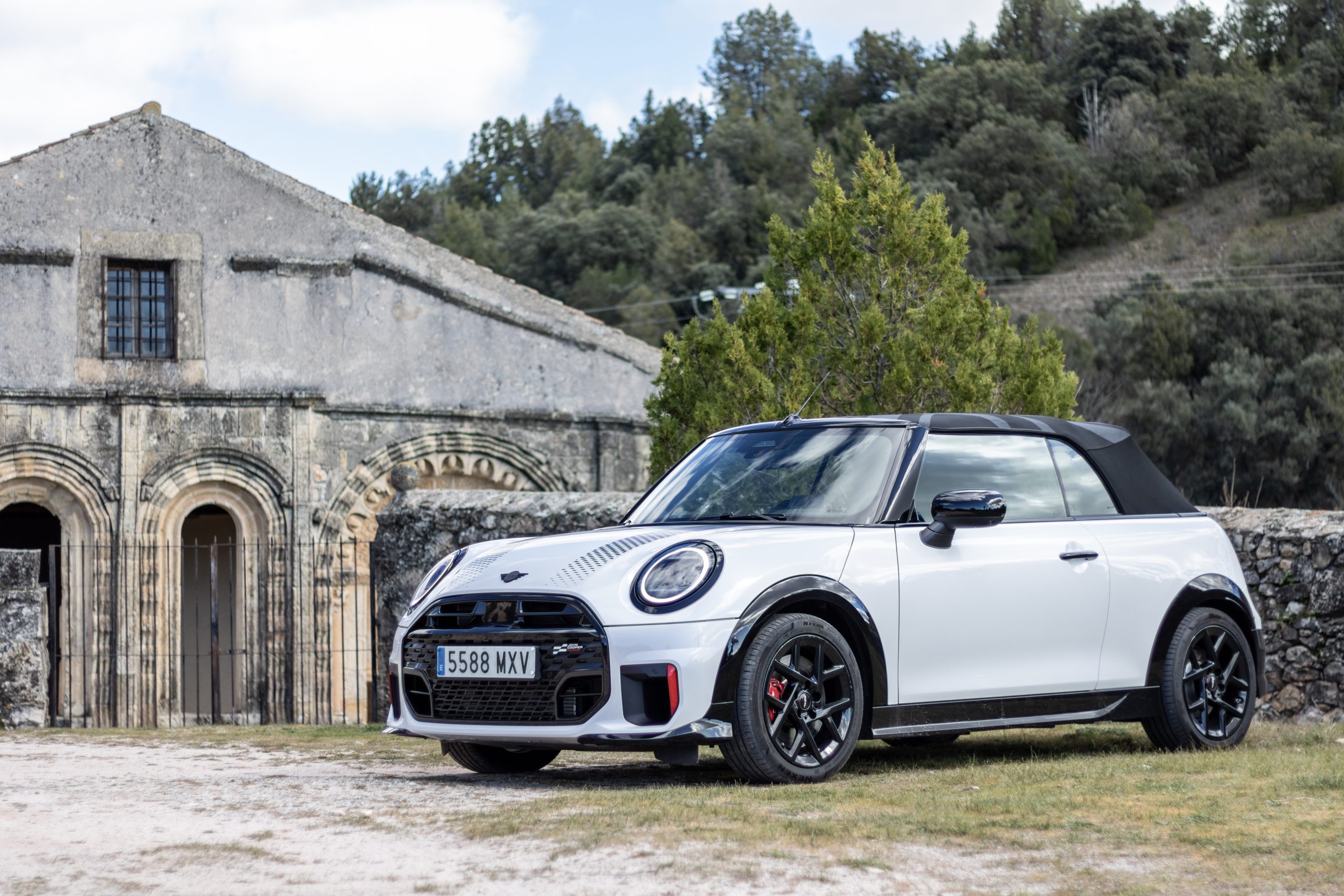
In recent years we have watched, almost without making a sound, a very particular way of understanding the car disappear. The Ford Fiesta ST is gone, the Hyundai i20 N has faded away, the Abarth 595 has left its purest formula behind, and small cars such as the Peugeot 208 GTi or the Renault Clio R.S. now stand as memories of an era when it was still fairly normal to find small, light cars with character, designed to be enjoyed.
That is why, every time you get out of a MINI John Cooper Works Cabrio, the feeling is not just that you have driven a fun car. It is closer to having taken advantage of one of those last chances that remain before this kind of sports car disappears altogether. Because this MINI is not about impossible figures or lap records. It is about the roof down, quick steering, a petrol engine that has not been electrified, a firm suspension, an exhaust with real presence and that physical connection with the road that so many modern cars have been filtering out until it is almost unrecognisable.
In a market dominated by SUVs, electrification and an increasing homogenisation of the car, the MINI Cooper JCW Cabrio represents an ever more valuable rarity: a small, powerful, convertible car designed to generate sensations. It is not the most rational model in its segment, nor does it pretend to be. Its argument lies elsewhere: in the feel, in the sound, in the immediacy of its responses and in its ability to turn any journey into something with far more purpose.
A real JCW, not just a sporty look
It is worth making this clear from the start: this is not simply a MINI Cabrio with a John Cooper Works trim. This model offers the best engine in the range, retaining the 2.0-litre, four-cylinder turbo petrol engine with 1,998 cm³, producing 231 hp between 5,000 and 6,000 rpm and 380 Nm of peak torque available between 1,500 and 4,000 rpm. And I can assure you that both the automatic gearbox and the sport mode with paddle shifters work perfectly.
The drive is front-wheel and power is transmitted through a seven-speed dual-clutch automatic gearbox. There is no manual option, and in a car with so much emotional appeal that absence stings a little. Even so, the transmission performs well in spirited driving, allows sequential shifting via the paddles and offers a Boost mode that releases maximum performance for 10 seconds when you hold the left paddle.
The figures are serious enough for a convertible 3.88 metres long: it accelerates from 0 to 100 km/h in 6.4 seconds and reaches a top speed of 245 km/h. It is not especially light, weighing 1,425 kilos kerb, but it maintains a lively, direct response very much in the John Cooper Works tradition.
Homologated fuel consumption is 6.8 l/100 km. In the road test used as a reference, the real average was 8.2 l/100 km, with more spirited driving than normal, although we even saw a figure of 5.5 l/100 km on secondary roads with free-flowing traffic.
A convertible that follows its own path
Although it shares its name with the current MINI Cooper, the Cabrio does not use the same architecture as the closed three-door. It retains the platform of its predecessor, so this version should be understood more as a facelift than as a completely new generation. That difference also explains why it does not use the same rear lights as the Cooper 3-door and why, in the case of the Cabrio, there is no electric version.
The redesign is seen in the reworked octagonal grille, the new light animations and an updated light signature. On the John Cooper Works, moreover, the previous central double exhaust gives way to a single visible outlet. It is the only Cabrio variant that keeps the exhaust on display, an important detail in a car that still understands sportiness as something more than a trim line.
The look is completed by darkened headlights and rear lights, a black lower body perimeter, a side air intake on the front, 17 or 18-inch wheels, red brake calipers, a specific diffuser and, optionally, a roof decorated with the Union Jack. These are recognisable features, but without going overboard. It has presence, it has attitude and it has that special-car quality that does not need much explaining.
A modern interior with MINI spirit
The interior adopts the brand’s latest design language. There is no traditional digital instrument cluster: instead there is a Head-up Display projected onto a polycarbonate screen and a 9.4-inch round OLED central screen. It is a very MINI solution, more emotional than conventional, although not always perfect from a functional standpoint.
The John Cooper Works atmosphere comes through in the thick-rimmed steering wheel with specific lettering, the sport seats with integrated headrests, red stripe and red stitching. They are not radical seats but everyday sports seats. They hold you well, although a slightly more inclined cushion to support the thighs better would be welcome. On the plus side, they offer electric adjustment and a memory function, which is practical when getting into the rear seats.
In front of the passenger there are backlit red stripes and a decorative leather strip. The roof control is located at the top of the cabin and allows two opening stages: a first partial position, similar to removing the glass from a panoramic roof, and a second in which the roof folds down completely.
The system takes 18 seconds to open and 15 seconds to close, and it can be operated on the move up to 30 km/h. It is one of those details that define the car: there is no need to stop, no need to look for an excuse. Just press a button and let the car change character.
Roof down, better with a windscreen deflector
The optional windscreen deflector noticeably improves the experience. With it fitted, the buffeting is reduced and you do not need to raise your voice much at legal speeds. The trade-off is clear: it eliminates the two rear seats, which are already small and have a very upright backrest.
The boot is not a champion of practicality either. It offers 160 litres with the roof folded and 215 litres when driving with the roof up. MINI retains a useful solution to slightly widen the loading opening if bulky luggage has to go in, but it is best to accept from the outset that this is not a car designed for long trips with a lot of luggage.
It is, rather, a car for travelling light. In every sense.
On the road: lively, firm and very much its own thing
Where the MINI JCW Cabrio truly justifies itself is on the road. Its 2.5-metre wheelbase, direct steering and engine thrust make it a very responsive car on narrow, twisting stretches. It does not have the planted feel of a sporty compact or the stability of a car with a longer wheelbase, but that is partly where its charm lies: it moves, it communicates, it demands and it rewards.
It is worth getting to know it before looking for its limits. The steering is quick and the car has a lot of potential, but it can also be more delicate than other small sports cars when tackling corners with real commitment. It is not a dangerous or excessively nervous car, but it does ask for attention and a light touch when driven quickly. This is down to its remarkably sophisticated chassis (a strong point of MINIs), which helps you take the car wherever you look, with precise steering and an incredible feel that makes the car depend solely on your own skill.
The specific suspension is very firm. In town it shows over speed bumps, road humps and broken asphalt. On the open road that firmness makes more sense: it controls body movements well and helps the car feel planted, precise and ready to change direction quickly.
The brake system, with front ventilated discs, offers good bite from the very first part of the pedal travel. And the exhaust sound, especially in Go-Kart mode, provides a soundtrack present enough to remind you that this is still a JCW, although, to my taste, not quite enough. It does not reach the excess or artificial crackling of some more radical systems, but you can hear it coming from afar and it complements the experience well.
In Go-Kart mode, moreover, the OLED screen displays performance data such as torque, power and G-forces. It is also the only setting that shows the rev counter on both the Head-up Display and the central screen.
What could still be better
Not everything is perfect. The main dynamic weak point is the absence of a mechanical limited-slip differential. The car relies on an electronic differential control that acts on the brakes, but it does not fully eliminate tugging in the steering under hard acceleration. This torque steer appears when the front axle is pushed hard, especially when using the full 380 Nm of torque.
It does not ruin the experience, but it limits precision when driving very quickly. It is a shame, because the overall package has enough engine, chassis and attitude to deserve a more serious solution at the front axle.
It is also a shortcoming that, during sequential shifting, the selected gear is not shown on the Head-up Display. In a sports car, that information should be right in front of the driver, not force them to divert their gaze to the central screen.
Furthermore, the driving experiences available do not profoundly transform the car’s behaviour, so their real contribution is limited. In a model so focused on enjoyment, a clearer differentiation between modes would be appreciated.
A usable convertible, with the expected limitations
When travelling, the noise coming in from the rear is louder than usual, although overall insulation is acceptable for a convertible. It is not a saloon, nor does it pretend to be. There is more noise, more exposure and more of a sense of being inside something mechanical and alive.
In town, the roof affects rear diagonal visibility and can also make it harder to look upwards when stopped at some traffic lights. These are the trade-offs of a small convertible, especially with such a compact body and such a distinctive design.
In return, few cars of this size make it so easy to move from everyday use to purely emotional driving. Closed, it can be a quick and usable MINI. Open, it turns into something much more special.
Equipment and price
As standard, the MINI John Cooper Works Cabrio includes dual-zone climate control, a rear parking camera, sat nav, Android Auto and Apple CarPlay compatibility, a wireless charging pad, LED headlights and keyless entry, in addition to the specific equipment mentioned above. As is usual with MINI, much of the personalisation and the additional features are arranged in optional packs.
The starting price is 43,955 euros. It is not a cheap car, nor does it try to be. It is small, it has two rear seats that are very tight, a limited boot and a suspension that makes no concessions to comfort. From a strictly rational standpoint, there are many ways to spend that money on roomier, more practical or more efficient cars.
But that is not the right way to understand it.
The MINI John Cooper Works Cabrio belongs to that category of cars that are not bought for what they offer on paper, but for what they stir up when you drive them. It has flaws, yes. It also has personality, sound, character, a roof that opens in seconds and a 231 hp petrol engine that does not yet need to justify itself with a battery.
And that, in 2026, I can assure you, is starting to feel almost like an act of resistance. A small, imperfect and exciting convertible sports car, the kind we will probably miss once there are none left, or maybe not…
MINI Cooper JCW Cabrio image gallery


 Kia offers an electric range of 10 models, 50 versions and 400 possible combinations
 The seven finalists for the 2027 European Car of the Year (COTY) are exclusively electric
 Peugeot E-208 GTi: a battery-powered toy that revives the spirit of the 1980s sports cars
Deja un comentario