Mercedes Coches clásicos Curiosities
Cars with history: Mercedes-Benz W125
 Fernando Alvarez
8 December 2011
2 min.
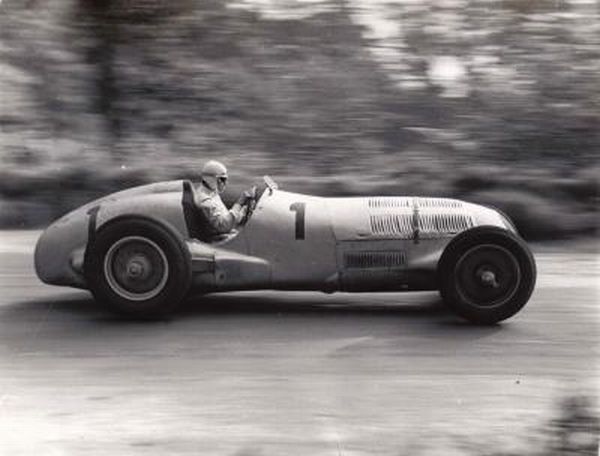
In Cars with History we take a look at the “Silver Arrow”. The 1937 Mercedes-Benz W125, one of the most impressive racing cars in history.
Shortly before the Second World War, Germany under Adolf Hitler wanted its country to be a power that dominated not only all sports but also racing. To that end, in 1934 it granted a subsidy to Mercedes-Benz and to Auto Union, which allowed both brands to throw themselves fully into the world of international competition and dominate it almost at will.
In 1937, although the Mercedes W25 and the Auto Union Type C had won many of the races of the 1935 international season, the year 1936 had not been very favourable for the Star’s cars; the German engineers began to envisage the successor to the W25. Helped by the extreme freedom that existed in those years regarding the regulations (the requirement was that the cars weigh less than 750 kilos), there was no limit on power. For 1937, Mercedes presented a new car powered by a 5.7-litre, eight-cylinder in-line engine supercharged by a compressor.
Keeping the maximum weight of these Mercedes cars down was a considerable technological challenge that demonstrated Germany’s advance in engineering over its fierce rivals, the Italians, or over Auto Union itself (the brand that preceded Audi). Thanks to the use of aluminium and nickel-chromium-molybdenum steel, the W125s turned out to be light, even counting the weight of the brutal engine, yet with enviable rigidity. With independent front suspension and generally softer settings than in the 1935 season, the W125 presented itself in 1937, ready to dominate the season.
With Rudolf Caracciola, Manfred von Brauchitsch, Hermann Lang, Richard Seaman and Christian Kautz, the German cars won almost all the races of the year, plus the races that did not award points. The only victory that escaped them was in Belgium. On fast circuits such as AVUS, a special version with bodywork was used that allowed it to reach a top speed of 380 km/h. There is no doubt that such speeds and such power were not achieved until many years later, in Formula 1.
With the limitation on engine size for the following years, the W125 was withdrawn from competition, although there was still one more record the W125 was going to claim: the world land speed record. In 1938, a special version of the W125, streamlined and with a V12 engine of nearly 750 horsepower, was going to set a top speed of 433 km/h, a record that still stands today.
Source | Ultimate Car Page, Supercars


 The seven finalists for the 2027 European Car of the Year (COTY) are exclusively electric
 Peugeot E-208 GTi: a battery-powered toy that revives the spirit of the 1980s sports cars
 New Lexus ES: luxury grows and goes electric
un comentario
Deja un comentario
HOLA MI NOMBRE ES ANTONIO RESIDO EN MURCIA POR MOTIVOS DE TRABAJO Y OCIO ME DESPLAZO EN MI VEHÍCULO PARTICULAR Y HAGO UNA MEDIA UNOS 660 KILÓMETROS POR SEMANA, POR UN MÓDICO PRECIO OFREZCO MI VEHÍCULO PARA LLEVAR PUBLICIDAD EN FORMA DE ROTULO NO IMPORTANDO EL TAMAÑO DE ESTE NI CUANTOS RÓTULOS PONGAN e INCLUSO QUE ME PONGAN UN CHIP DE SEGUIMIENTO EN EL MISMO.
GRACIAS POR ATENCIÓN, UN SALUDO .