BMW Sedans Coches clásicos Reports
History of the BMW 3 Series. Part I (1975 to 1994)
 Pablo David González
2 April 2011
4 min.
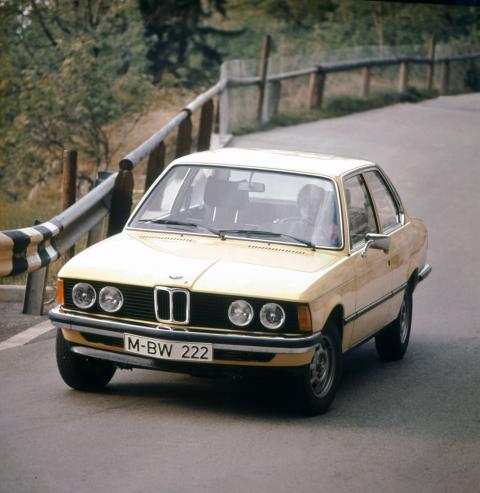
The 3 Series is one of the models most representative of the spirit of BMW. It embodies the values of a sports saloon like no other and has done so since its debut in 1975. Now, after 36 years and more than 12 million units sold worldwide, it is set to be reinvented with a new generation, the sixth, which will soon reach dealerships. It will have the complicated task of continuing the line of success maintained throughout all this time.
For this reason, I believe it is the right moment to take a brief look back at the history of the 3 Series, which began almost four decades ago as a two-door body style.
First generation (E21), 1975 to 1983
In July 1975, BMW presented the first generation of the 3 Series. It was a two-door saloon with compact dimensions and a sporty character. It measures 4,355 mm long, 1,610 mm wide and 1,380 mm high. The front axle benefits from a MacPherson-type suspension, while the rear has independent suspension with trailing arms.
Initially, all engines were four-cylinder units (code M10), whose designations corresponded to the following displacements: 316 (1,573 cm3), 318 (1,766 cm3), 320 (1,990 cm3) and 320i (1,990 cm3). The 320i was distinctive for featuring a mechanical petrol injection system that replaced the carburettor. In 1977 a six-cylinder inline engine (code M20) was added, marketed under the designations 320/6 (replacing the 320) and 323i. This latter version also incorporated disc brakes on all four wheels. The 6L engine produced 143 PS in the 323i, enabling a top speed of 190 km/h. Not bad for the time. All versions, except the entry-level ones (316 and 318), featured dual headlights.
Between 1979 and 1980 the four-cylinder engines were updated. The 316 increased its displacement to 1.8 litres and its power reached 90 PS (it still used a carburettor). The 318, meanwhile, kept the same displacement but swapped the carburettor for an injection system. It achieved a maximum output of 105 PS and was renamed the 318i. In 1981 the 315 arrived, the new entry-level model of the range. It had a 1.6-litre engine producing 75 PS.
Six years after its launch, the first generation of the 3 Series had sold more than 1 million units.
Second generation (E30), 1982 to 1994
Progress was made in every area: a more aerodynamic design, more interior space and comfort, more powerful engines and a more varied range. In 1983 the four-door version appeared, in 1985 the convertible variant and the M3, and in 1987 the estate, which combined practicality and sportiness. Furthermore, this is the generation in which a diesel engine and all-wheel drive were introduced for the first time. More than 2.3 million units were sold.
BMW’s advances in fuel economy began with the 6L “eta” engine (a designation identifying the most efficient versions, characterised by an earlier fuel cut-off and a series of measures aimed at improving fuel use). This engine powered the 325e, with 122 PS, which was also the first 3 Series to feature a catalytic converter.
In 1985 the 325i and 325is joined the range (a version with better equipment than the 325i). They shared a 2.5-litre engine producing 170 PS. In this case BMW focused on offering performance rather than reduced consumption, which is why the rev limit was raised from 5,000 rpm to 6,500 rpm. In 1986 the all-wheel-drive 325ix arrived, first as a saloon and then, in 1987, as an estate. The 318is of 1989 also deserves mention: it was the first production BMW to feature a four-cylinder engine with four valves per cylinder, producing 142 PS.
The diesel range consisted of two versions: the 324d, with a spirited 86 PS, and the 324td, same engine but with a turbocharger and 115 PS.
The BMW M3 began its life using the four-cylinder M10 block, 2.3 litres and 195 PS. Successive improvements culminated in the M3 Sport Evolution III, with 238 PS and capable of going from 0 to 100 km/h in 6.1 seconds. It marked the beginning of one of the legendary names in the automotive world, which still endures with all its vigour today.
Click here to see the second part.
Sources | BMW and Wikipedia


 Kia offers an electric range of 10 models, 50 versions and 400 possible combinations
 The seven finalists for the 2027 European Car of the Year (COTY) are exclusively electric
 Peugeot E-208 GTi: a battery-powered toy that revives the spirit of the 1980s sports cars
un comentario
Deja un comentario
Pues la verdad que el M3 de la primera época sigue siendo uno de los coches que algún día me gustaría tener.