EX90 Volvo Electric Cars ECO Tests SUV
I tested the Volvo EX90 and I'll tell you why it's one of the best electric SUVs for travelling
 Antonio Roncero @roncero_antonio
25 February 2025
10 min.
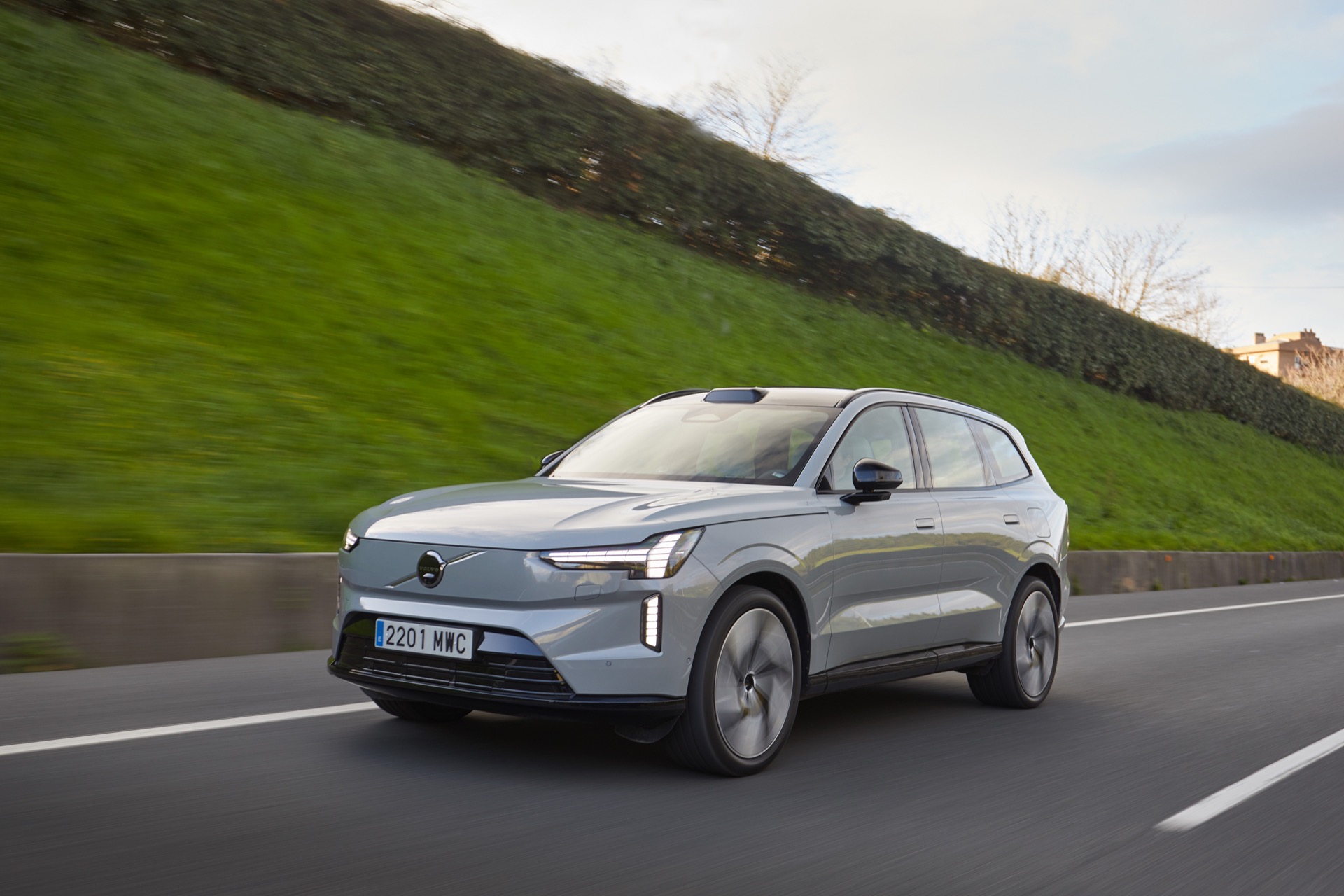
The electric SUV from Volvo combines the virtues of the Swedish brand’s combustion models with impeccable ride comfort, and eliminates the stress of travelling by electric car thanks to its more than 600 km of certified range.
From Madrid to Bilbao, with a stop halfway to “recharge energy”, quite literally, with the new Volvo EX90. That was the proposal the Swedish brand made us to test its new seven-seater electric SUV where it performs best: when it comes to travelling. Yes, you read that right. Travelling by electric car is already becoming possible with more and more models. And the EX90, which we can consider the electric alternative to the XC90 within the Swedish manufacturer’s range, excels at it.
Now let’s get into the details and I’ll tell you why I think the EX90 is, today, one of the best electric SUVs for travelling and one of the best options in its category, that of large seven-seater electric SUVs, where the EX90’s main rivals are the recently renewed BYD TANG, somewhat more affordable, and the KIA EV9, the flagship of the Korean brand. There are two other models that meet these characteristics, but with a much higher starting price: the Tesla Model X and, even further away, the Mercedes-Benz EQS SUV.
A brief review of the technical features of the Volvo EX90
To put things in context, the EX90 is even slightly larger than the XC90. It exceeds 5 metres in length by 4 centimetres, with a width of 1.96 metres and a height of 1.74 metres. Curiously, when you have it in front of you it doesn’t seem as large and bulky as the XC90; at least, that’s the impression it gives me. It is built on a platform specific to 100% electric vehicles, the SPA2, and it is manufactured in the USA, although it is also going to be manufactured in China.
Some details that stand out in the exterior design are the frameless exterior mirrors, the door handles flush with the bodywork, the wheels of up to 22 inches with plastic elements to improve aerodynamics which are very well resolved aesthetically, or a sort of “chapel” on the roof just above the windscreen, which houses various sensors for the assistance systems, and which doesn’t integrate well aesthetically into the design; it looks more like a last-minute “add-on”.
The range includes three mechanical versions. The EX90 Single Motor uses a single motor on the rear axle that delivers 205 kW (279 CV) and is paired with a 104 kWh gross capacity battery, with a WLTP range of up to 610 km. The EX90 Twin Motor adds a second motor on the front axle, for a total system power of 300 kW (408 CV), while the Twin Performance variant, also with two motors, raises the power to 380 kW (517 CV). Both Twin versions carry a larger battery, with 111 kWh of capacity, and claim a range of up to 615 km.
And while we’re at it, a look at prices too. The entry version of the range, the EX90 Single Motor in Core trim, starts from 83,127 euros with five seats, and 85,426 euros with seven seats. From here on, all engine and trim combinations come with the third row of seats as standard. The Twin Motor version is priced from 91,295 euros, which is some 6,000 euros more than the Single Motor with the same trim and seven seats. The step up to the Twin Performance costs another 5,000 euros.
By the way, the EX90’s prices are, in comparison, very similar to those of the equivalent XC90s in terms of price and performance.
Up to seven seats and plenty of luggage space
This is one of the main reasons why I say the EX90 is an ideal car for travelling: it is a very comfortable vehicle. And this high level of comfort comes from the sum of many factors.
To begin with, the interior space, at least in the first two rows of seats. There is plenty of room, both for head and legs, and in terms of width it could even be a good alternative if you frequently have to use the rear seats with three occupants. Furthermore, the second row has individual longitudinal adjustment for each seat. The centre seat is slightly narrower than the side ones, but perfectly usable. Another matter is the third row, which folds and unfolds very easily via an electric mechanism. Although the seats have good dimensions, as tends to happen in all seven-seater SUVs, they are seats for occupants up to 1.70 metres tall at most, depending on the brand; I would say slightly less, and I would only consider these seats for carrying mainly children.
As for the boot, there is 310 litres of capacity with all three rows of seats in use, 655 with the third row folded, and 1,040 with only two seats in use. This is less than other cars of its size, such as the Kia EV9, but in any case more than enough for any kind of use. The boot has a double floor with plenty of space, and there are another almost 50 additional litres under the front bonnet, the best place to carry the charging cables. In versions with air suspension (optional, for about 2,700 euros, including adaptive damping), a feature that makes loading easier is the ability to lower the height of the rear axle considerably.
Details that add up: ergonomics, visibility, quality, connectivity….
It’s not the first time I’ve said it, and I don’t think it will be the last, but I feel particularly comfortable in the Volvo, especially because of how comfortable the seats are for me. In the EX90, moreover, there are many details that make daily use easier… and some others that are less so. It takes getting used to and feels a bit strange at first, but not having to take the key out of your pocket or press any button to get in, get out, start the car or switch it off is a real luxury. From the very first moment you also feel the attention the brand has paid to the selection of materials and their fit: they convey a sense of warmth… and quality.
Contributing to this is a completely clear dashboard, with hardly any controls other than those on the steering wheel. I don’t like this quite so much; there is still no voice control system or touchscreen that makes me forget conventional controls for the main functions. But in the EX90 even to adjust the height of the steering wheel or the mirrors you have to navigate through the infotainment system’s screen. To be fair, if you are the owner of the car, you memorise your position in one of the user profiles and that’s that. We’ll have to get used to it, because it seems the trend is towards eliminating more and more buttons, as many as possible.
What I don’t like much is the instrument cluster screen, small for what is used nowadays -it’s 8 inches- and with few configuration options. In exchange, the 14.5-inch screen of the infotainment system is magnificent in fluidity and resolution, although it requires an adaptation period to navigate through so many menus. And during the trip, once again, I could see how well the Google and Android Automotive ecosystem works. In particular, Google Maps literally “nails” the charging forecasts for arriving at a given destination, and plans the necessary stops on a route very well.
Range and recharging: ready for long distances
With certified ranges above 600 km in any of the versions, the EX90 allows you to plan trips with some peace of mind. That said, as with all electric cars, and more so if they are large and powerful like this Volvo, the real range differs greatly from the certified one… and depends far more on driving style.
On our trip, with two people and little luggage, we drove all the time at a relaxed pace and motorway speed, with cruise control engaged and maintaining a comfortable temperature in the cabin. The total distance -we set off from the outskirts of Madrid, already on the A1- was almost 400 km, with an average consumption of 23.5 kWh/100 km. We made a lunch stop in Burgos, where we took the opportunity to charge up to 100% again, although in reality it would have been enough to reach our destination without problems or anxiety with about 15 minutes of fast charging; the typical stop for a drink or coffee and stretching the legs.
The maximum DC charging power is up to 235 kW for the single-motor versions, and up to 250 kW for the dual-motor versions with the larger battery. This allows very reasonable charging times for planning any kind of trip, since in less than half an hour you will have recovered up to 80% of capacity at a high-power station. In addition, the Plug & Charge functionality is included as standard, which at stations compatible with this technology lets you plug in the vehicle and forget about it: the vehicle “identifies” itself and both the charging process and billing -which requires being registered with a charging service- are carried out automatically.
Behind the wheel of the EX90 Twin Motor
I forgot to say that the unit I was able to drive of the EX90 was a 408 CV Twin Motor. I would also have liked to try the Single Motor version, which I dare say with its 279 CV will be more than enough even for travelling with the car loaded. Especially for travelling at the pace we did. Because the EX90 Twin Motor gives plenty of play when you need it. For example, in a tight overtaking manoeuvre on a two-way road. Or simply when you plant your right foot on the accelerator looking for that forceful response from a car you know produces more than 400 CV, despite weighing almost 2.8 tonnes.
The truth is that when you drive it, it doesn’t feel like it. Nor does it feel like it’s 5 metres long. Like all Volvo, it turns a lot and well, and the cameras are a great help when manoeuvring. On the move, it is surprising how well insulated the cabin is, both from wind and road noise. And also the comfort over bumps, at least with the air suspension; and that despite having very wide, low-profile tyres: no less than 265/45 21 on the front axle and 295/40-21 on the rear with the top Ultra trim.
Volvo has also found the key to making its electric cars offer a good braking feel throughout the pedal’s travel, which is appreciated, although regenerative braking often helps to reduce the need to use the brakes, especially in automatic mode or in the one-pedal mode. Again, one thing I don’t like is that to switch between these modes you have to go through the screen and menus. The same goes for activating the permanent “All-wheel drive” mode, since with it deactivated the EX90 moves propelled by only one motor, and only engages the second motor under hard acceleration, with a slight delay being noticeable in the delivery of its maximum thrust. With how little it would have cost to add a button…
Other details that make journeys a whole experience in the EX90 are the magnificent Bower & Wilkins 1,640-watt audio system with 19 speakers and subwoofer fitted to the unit I was able to drive (it is an extra that costs almost 3,000 euros), the magnificent matrix LED headlights when driving at night, and how well the driver assistance systems work, especially the adaptive cruise control.
Volvo EX90 – Photo gallery
Technical specifications of this car


 Peugeot E-208 GTi: a battery-powered toy that revives the spirit of the 1980s sports cars
 New Lexus ES: luxury grows and goes electric
 First contact with the Dacia Sandero Hybrid 155: power and efficiency from €19,890
Deja un comentario