It remains the smallest and cheapest SUV in Audi, and also the oldest: up to 10,000 euros less than a Q3
 Antonio Roncero @roncero_antonio
14 March 2024
10 min.
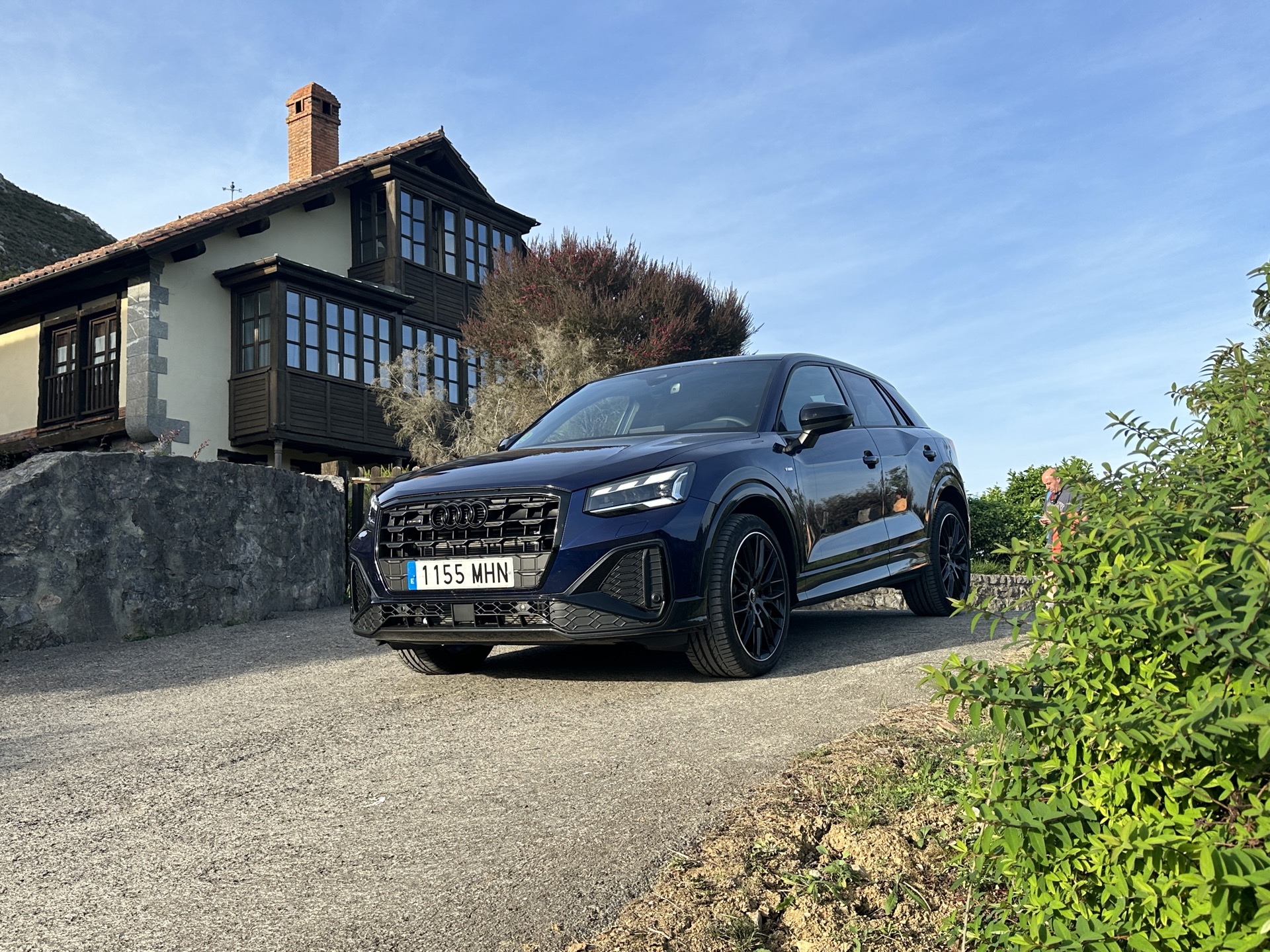
The Audi Q2 remains the entry point to the Audi SUV range in terms of size and price, and despite its age it can be an attractive purchase. We tested the range-topping version, the 35 TDI S line with S line trim and quattro traction.
The Audi Q2 has been on the market for eight years. It launched in 2016 and received a facelift in 2021, so it would not be fair to call it an “old-timer”. In fact, although the competition that has emerged over these years is increasingly strong, the Q2 is fully up to date in terms of platform, engines, driver assistance systems… If anything, we could say it only lagged behind in infotainment, something Audi has addressed with the update of the Q2 for this same year.
It is also true that if you put it next to the Q3, the next model up in the Audi SUV range in terms of size and price, the Q2 suddenly looks five years older. But there will always be those who don’t mind, or even prefer the squarer, more solid lines of the Q2, which is instantly recognisable as a Audi – that Singleframe grille is unmistakable – even though it is far removed from the design language that practically all the brand’s models now present.
Design aside, which is always very subjective, the fact is that the Audi Q2 is, and will remain for some time yet, the most affordable SUV in the Audi range, by a wide margin. Compared with the Audi Q3 you are talking about roughly 10,000 euros depending on the version, which together with its good qualities as a car for all uses make it an attractive purchase. That said, I should warn you it is not cheap: the version we tested, the 35 TDI S tronic with 150 CV, S line trim and quattro traction comes to almost 43,500 euros, whereas a 110 CV Q2 30 TFSI costs 34,000 euros. We will also give a brief overview of the rest of the range later on.
Small on the outside, large on space and quality
With its 4.20 metres of length, the Q2 has always stood out for an interior that makes very good use of its exterior size. The driving position is very similar to that of a saloon, although the seats sit slightly higher, which makes it easier to get in and out of the cabin, something many users of this type of car look for. The build quality is excellent, which largely justifies a price higher than its rivals from mainstream brands. And I really liked the sporty seats in this S line version.
I was able to cover many kilometres in the Q2 on all kinds of roads, including a couple of long motorway journeys, and these seats seem perfect to me in terms of comfort and how they hold your body, without having to keep readjusting yourself. Without doubt, the perfect excuse to opt for the S line trim – about 1,300 euros more than the Advanced – which, in addition to these standard seats, adds more equipment and design details – 18-inch alloy wheels, sill trims, rear pillar in a contrasting colour – that give the Q2 a sportier and more sophisticated look. Other aspects of the Q2 that I particularly value, not only when travelling but also day to day, are the adequate storage spaces for objects, good visibility in all directions and a generous, solid footrest for the left foot.
The rear seats are more than adequate for two adults to travel with reasonable comfort, although I always say this type of car gains a lot in versatility with a longitudinally sliding rear bench, which the Q2 does not offer even as an option. The boot, with very regular and usable shapes – and also with a higher-than-usual finish quality in the trim for this category – offers 405 litres of capacity in the front-wheel-drive versions, a very good figure… which is not quite so good in the case of this quattro version, which loses 50 litres. Under the false floor, our unit had a emergency spare wheel and the subwoofer of the optional Sonos audio system, which is magnificent. The tailgate can be electrically operated.
Connectivity and multimedia: the touchscreen arrives
The Audi Q2 unit I tested is not yet a MY24, which will come with the infotainment system update. There are still units without this upgrade, and that can be a good argument for negotiating a discount. For orders of the new model, what you need to know is that the digital instrumentation disappears and all Q2s will come with the Audi Virtual Cockpit with a 12.3-inch screen, which our test unit does have as it is an S line. I still think it is one of the best of its kind, especially for those who do not want to give up the option of checking information as if they were conventional watches, with the ability to change the design occasionally or give prominence to the navigation map so as not to have to look away towards the multimedia screen.
And here comes the second major change: the characteristic rotary controller of the MMI between the seats is eliminated and control is entrusted to the new multimedia screen, which grows slightly to 8.8 inches and becomes a touchscreen, in addition to incorporating new software. The design does not change, except that in the space where the MMI used to be, behind the gear lever, there is now a storage gap for objects. In the following images you can see the difference.
What can I say, I have always really liked how the MMI works with its rotary controller. But it must be acknowledged that the new touchscreen with Full HD resolution is an advance, although it sits a little far away, which may require you to pull your back away from the seat backrest to operate it. The good news is that conventional physical controls are retained for the climate control system and a row of buttons below the distinctive round climate vents provides direct access to some main functions, and the voice control system has also been improved.
TDI engine, S tronic gearbox and quattro traction: “devours kilometres”
Driving the Q2 TDI, after having gone through several electric cars one after another, makes you feel “free” again: you don’t have to plan your stops to recharge, you can give it a bit of throttle whenever you like without fear of the range suddenly dropping and you don’t have to keep an eye on the range. If anything, on the AdBlue range, but that is another story. With the 55 litres of diesel that fit in the tank you can easily cover 800 km before the reserve light comes on, knowing that in five minutes, at any petrol station, you are ready to go again for another stretch…
We are not going to reveal the virtues of this well-known 150 CV 2.0 TDI engine now, and it is most associated with the S tronic dual-clutch gearbox. It has plenty of performance; I’ll tell you upfront that if your budget doesn’t stretch, the 116 CV TDI will also do the job. In the Q2 it seemed a little “rougher” in operation than in other cars in the Group Volkswagen, at least at low speeds and in low gears. But nothing that detracts from its good responsiveness and pleasant pull, and even its ability to rev up without suddenly losing steam, within what you can expect from a diesel.
The gearing is long but the engine handles it, and if you need to downshift the best thing is to accelerate and let the S tronic do the work. The Q2 35 TDI makes overtaking entirely safe, tackles mountain passes even fully loaded… and uses very little: hovering around 5 l/100 km on country roads, between 6.7 and 7 l/100 km at cruising speed on the motorway, and it is rare to exceed 8.5 l/100 km in town. If you are going to cover a lot of kilometres a year, this 150 CV TDI (or even the 116 CV one, which costs 3,000 euros less) is the best option. But don’t lose sight of the 150 CV petrol TFSI, with similar performance and a slightly “smoother” character, although more sensitive to driving style when it comes to visiting the pump. That said, it is almost 2,000 euros less in base price. The shame in any case is that none of the Q2 engines has mild hybridisation, so you will not be able to get the ECO label.
Driving the Audi Q2 35 TDI S tronic quattro
And how does it handle? Wonderfully. Overall, setting aside the mentioned detail of the mechanical noise at low speeds, the Q2 is very well insulated from outside noise. And especially in this S line version with sports suspension – in this trim it is an option at no extra cost – it feels very planted, agile and precise, almost as if you were driving a compact such as the Audi A3 rather than an SUV.
Being picky, and I do like how large wheels look, I would prefer it with the standard ones, with 215/50-18 tyres, instead of the optional 19-inch alloys on this unit, with Bridgestone Potenza S001 235/40-19 tyres that are excessive for the car’s set-up. With the standard ones I would not lose much in agility or precision, I would gain in comfort and somewhat in consumption and even road noise, and also in peace of mind when mounting kerbs or driving on poor roads. Because with these wheels, and with the lowered body height of this S line suspension, it is best not to venture onto unpaved tracks.
As I said, I was able to test this Q2 over a good many kilometres, many of them on the roads of northern Spain in heavy rain and slippery asphalt. And I do not deny that knowing you have quattro traction, ready to kick in – you know, an electronically controlled clutch system that connects the rear axle if it detects loss of grip at the front – is reassuring. But in today’s cars, with good electronic aids – and the Q2 has them – if you fit good tyres, all-wheel drive is not as decisive as it was a few years ago. Furthermore, with front-wheel drive you save money – in this case about 2,200 euros -, the car uses less – almost half a litre per hundred according to official figures, which is not negligible – and you get more boot space. Although it is also fair to say that with quattro traction the Q2’s rear axle is a trapezoidal deformable link design, more sophisticated and effective than the torsion beam axle of the 4×2 versions, which also has a positive effect on dynamic behaviour.
Otherwise, I would also highlight how well the driver assistance systems work, and they are not at all intrusive. And the LED headlights with automatic high beam, which light up very well and never showed any sign of dazzling oncoming traffic. As with the Audi drive select. At first you always “fiddle” with the modes: a bit of Sport, see how Efficiency feels… The difference between them is slightly noticeable, both in the feel of the accelerator and in the steering assistance. But if you leave it on automatic, or set the individual mode to your liking, you set it… and like with the lights, you forget about it.
Audi Q2 2.0 TDI quattro – Image gallery
Technical specifications of this car


 Kia offers an electric range of 10 models, 50 versions and 400 possible combinations
 The seven finalists for the 2027 European Car of the Year (COTY) are exclusively electric
 Peugeot E-208 GTi: a battery-powered toy that revives the spirit of the 1980s sports cars
Deja un comentario