Lancia Voyager Photos Minivans Tests
Lancia Voyager 2.8 CRD 163 CV Aut., road test (Engine and performance)
 Diego G. Moreira
30 December 2012
4 min.
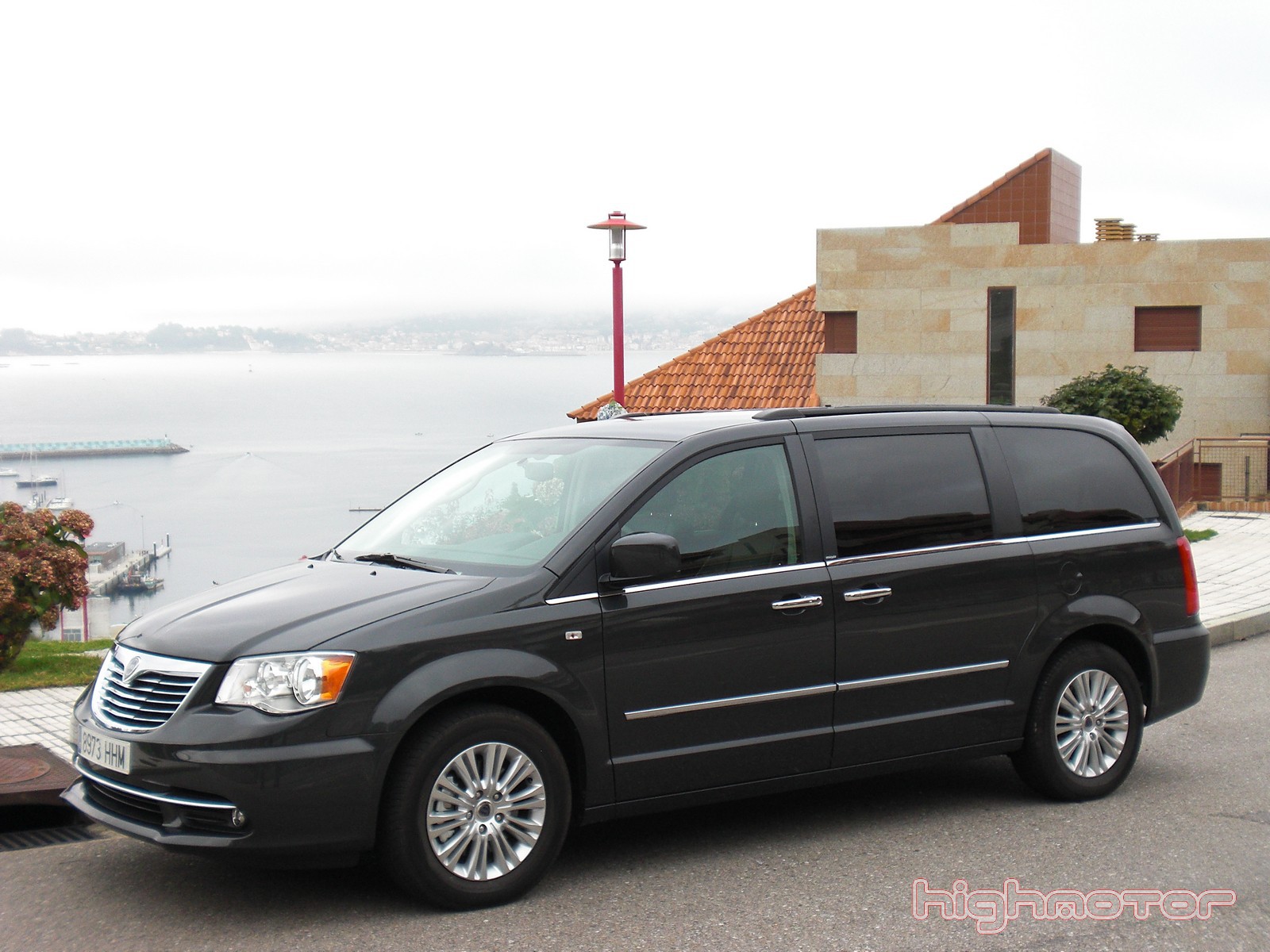
We tested the Lancia Voyager, a seven-seat MPV with a 2.8 CRD 163 CV diesel engine paired with a six-speed automatic gearbox. In this first part of the road test we look at the engine, performance, consumption and behaviour.
Some absent-minded reader might think I got the title of this road test wrong, the “Lancia” and “Voyager” in the name sounds strange. Nothing could be further from the truth: for the past three years Fiat has owned the Chrysler Group, and that has brought a series of changes to its European models.
Lancia has gained two models in its range, an MPV and an executive saloon. Both carry the American badge and both have plenty of qualities to carve out a place in the market. Today we take the wheel of the Lancia Voyager.
This MPV is practically identical to the Voyager that was previously sold under the Chrysler umbrella and that is still sold in the USA (the American brand disappeared from Europe when Fiat bought it). As a curiosity, the Voyager is not the first Lancia MPV that is not 100% Italian, previously the Phedra was a product of the joint venture with PSA Peugeot Citroën, derived from the 807/C8.
It is a vehicle that has enjoyed a certain reputation on the European continent for many years, and is very appealing for a family looking for space and travelling in comfort wherever its seven occupants want to go.
Engine and performance
The engine used to drive the Voyager is quite well known, used by other models in the group such as Jeep. It is a four-cylinder unit developed by VM Motori that produces 163 CV of power. VM Motori is the same manufacturer that builds the diesel engines for Chevrolet and some units for the Fiat Group, since the factory now belongs to General Motors and the Italian group.
Paired with this 163 CV engine is a six-speed automatic gearbox, a veteran unit but one that works more than adequately. Even in manual sequential mode we can get a good deal out of the engine.
The engine is quite performance-oriented; it lacks some smoothness, but in return it moves the Voyager with great force, which it needs since it is a heavy vehicle (2.2 t) with seven seats. Torque is 360 Nm, with a response from just over 1,800 rpm up to 3,500 rpm.
The torque is felt especially when pulling away, so you have to dose the power to avoid overly brisk starts. Returning to the gearbox, the typically American lever position and its operation stand out; it always shifts close to 4,000 rpm and will not let you downshift if that would push the engine above 4,000 rpm.
Behaviour
The suspension is geared towards comfort; on the road it is very comfortable, approaching the behaviour of an off-roader in terms of suspension firmness. At the rear a solid axle has been fitted, which gives us an idea of how the Lancia Voyager behaves.
Although it is comfortable on the road, it looks after its passengers very well and keeps its comfort on the most uneven surfaces. Dynamically it has its limitations, mainly due to its dimensions and weight. We are talking about a vehicle over five metres long (5.21 m) weighing 2.2 tonnes, with a rear suspension not designed for rally driving.
In short, it is a calm car, with plenty of power, ideal for enjoying long journeys on country roads or motorways where the comfort level is high and the soundproofing really good.
An outstanding element, in keeping with the power, size and weight, is the brakes, with 330 mm front discs and 328 mm rear discs, all to keep the Voyager firmly under control.
Consumption
Consumption is in line with the type of car: although it is a diesel, moving 2.2 tonnes over five metres in length is no easy task, and that shows. On the motorway it hovers around 8.1 litres per 100 km. The figure we obtained on country roads is between 8 and 9 litres per 100 km; it all depends on how careful we are with the accelerator.
In town the figures climb, and our urban consumption test was carried out in a city with many hills, where the average consumption is even more noticeable. Overall, on our usual route the average has been around 12 litres per 100 km.
In the second part of the road test we will analyse the strong point of the Lancia Voyager, its design and above all its interior. It is a true business-class transport, ideal for a large family wanting to travel with every comfort and with space as the top priority.
Photos | Diego G. Moreira
Photo locations | Nigrán, Baiona and Caminha (Portugal)


 The seven finalists for the 2027 European Car of the Year (COTY) are exclusively electric
 Peugeot E-208 GTi: a battery-powered toy that revives the spirit of the 1980s sports cars
 New Lexus ES: luxury grows and goes electric
2 comentarios
Deja un comentario
Diego, anótate un sobresaliente por hacer una prueba completa y bien informada. Tengo entendido que el Voyager en un futuro próximo va a montar también a este motor 2.8 en la versión de 200 cv que ya lleva el JEEP Wrangler
Hola Mario, gracias por tus comentarios. Ya están las demás partes de la prueba para tener toda la info sobre el coche. Sobre el motor, supongo que será cuestión de tiempo que se actualice al de 200 CV.
Un saludo