Plan Auto+: the "master key" to accelerate the electrification of Spain's car fleet
 Antonio Roncero @roncero_antonio
12 December 2025
5 min.
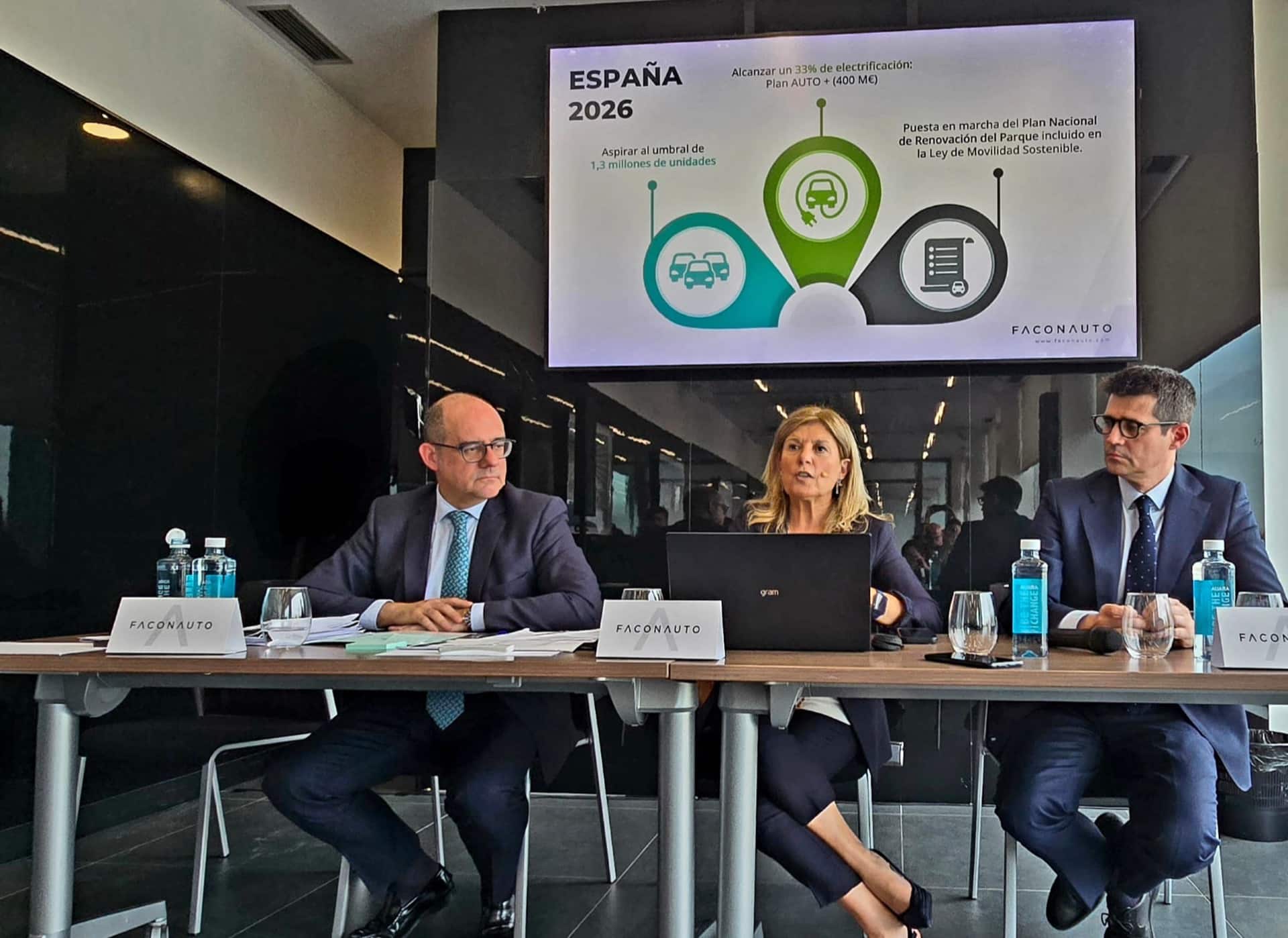
The Spanish car market reaches a turning point at the end of 2025, having once again come close to 1.2 million registrations. But Faconauto warns that the real leap will only come if the new Plan Auto+ is activated as soon as possible, complementing the National Fleet Renewal Plan foreseen in the Sustainable Mobility Law. The dealers’ association puts figures on that opportunity: a stable market of 1.3 million units, which would be ideal for sustaining the industry, securing investment and consolidating employment linked to the automotive sector in Spain.
According to Faconauto, the 2025 registration pace, which will close with a figure close to 1.2 million vehicles, is due to a specific combination of factors: purchase incentives, the boost from electrification and the effect of regional plans. To this we must add the specific impact of the Plan Reinicia Auto, set up after the DANA storms, which allowed thousands of families to quickly replace their damaged vehicles and regain their mobility. The association stresses that, without this framework of aid, the market would have lost around 120,000 transactions and would have closed at practically the same levels as 2024. The message is clear: when agile plans are launched, allowing direct processing without burdens for the dealership network, buyers respond and the market moves in the direction set by decarbonisation and industrial objectives.
What the Plan Auto+ is and why it matters
In this context, the new Plan Auto+ is presented as the natural evolution of the purchase aid from the MOVES III Plan, but with greater ambition: connecting the ecological transition with the economic reality of families and businesses. Faconauto insists that, for the first time, Spain has a coherent legal and strategic framework, thanks to the Sustainable Mobility Law and to the coexistence of the Plan Auto+ with the National Fleet Renewal Plan, which sets a maximum period of three months for its launch.
The association sees in the combination of both plans something more than a subsidy scheme: it speaks of a “life insurance” for the sector, because it allows a strong domestic market to be maintained, an essential condition for attracting investment and guaranteeing the future of the automotive value chain. Moreover, its design seeks to leave no one behind in the transition, guiding buyers towards electrified and connected models without imposing a single type of technology and without penalising middle-income households.
Electrification: a realistic target of 33% for 2026
One of the most relevant data points left by 2025 is the acceleration of electrification, which already approaches 25% market penetration in Spain, thanks to an incentive framework that “this year has worked” and to an offer that customers are beginning to perceive as more affordable. The deployment of charging infrastructure also helps, with more operational points and a REVE map that unifies the information available to users. Not to mention the avalanche of new electrified models (plug-in hybrids and battery electric vehicles) that practically all brands are launching onto the market, in a product offensive that will continue to unfold in 2026.
On this basis, Faconauto considers it realistic that next year the Spanish market will clearly exceed a 30% electrification share. To achieve this, the association highlights the importance of maintaining incentives through the Plan Auto+ and of continuing to bring electrified products to market at more competitive prices. The message to the Administration is direct: if aid is given stability and its management is simplified, buyers perceive certainty and electrification advances naturally, not by imposition.
In parallel, 2025 has confirmed the decisive role of the autonomous communities as the driver of fleet renewal, thanks to an unprecedented deployment of their own programmes that have brought aid closer to the territories. These plans have not only boosted the market, but have also helped close less visible gaps: the difference between countryside and city, the social gap, the mobility gap and even the gap in access to technologies such as connected and, in the future, autonomous vehicles.
Employment, dealerships and the need for a strong market
Behind the registration figures there is a dealership network that sustains a large part of the sector’s employment in Spain: Faconauto represents 2,143 official dealerships, on which some 5,300 sales points depend, 163,000 direct jobs and annual turnover of 48,000 million euros, close to 3% of GDP. The association anticipates that 2025 will close with employment in dealerships being maintained, even though average profitability barely reaches 1.4% and the talent shortage, especially in after-sales, keeps growing.
In this scenario of tight margins, a domestic market capable of sustaining volumes of 1.3 million units is not just any figure, but the line separating a sector with the capacity to invest and attract new brands from one that is limited to surviving. Hence Faconauto insists that the activation of the Plan Auto+ and the National Fleet Renewal Plan should not be seen as a cyclical expense, but as an industrial policy decision that protects employment, competitiveness and future tax revenue.
Looking ahead to 2026, Faconauto outlines two scenarios: a conservative one, with a market around 1.25 million registrations; and another of solid growth that would allow reaching 1.3 million registered vehicles. But for the association, this second scenario will only be viable if the three-month deadline set by the Sustainable Mobility Law to activate the National Fleet Renewal Plan is met and if the new Plan Auto+ comes into operation in time to sustain demand.


 Peugeot E-208 GTi: a battery-powered toy that revives the spirit of the 1980s sports cars
 New Lexus ES: luxury grows and goes electric
 First contact with the Dacia Sandero Hybrid 155: power and efficiency from €19,890
Deja un comentario