Seat León 1.4 TSI 140 CV road test (performance, handling and fuel consumption)
 Leo Montiel @lemonti
24 February 2014
6 min.
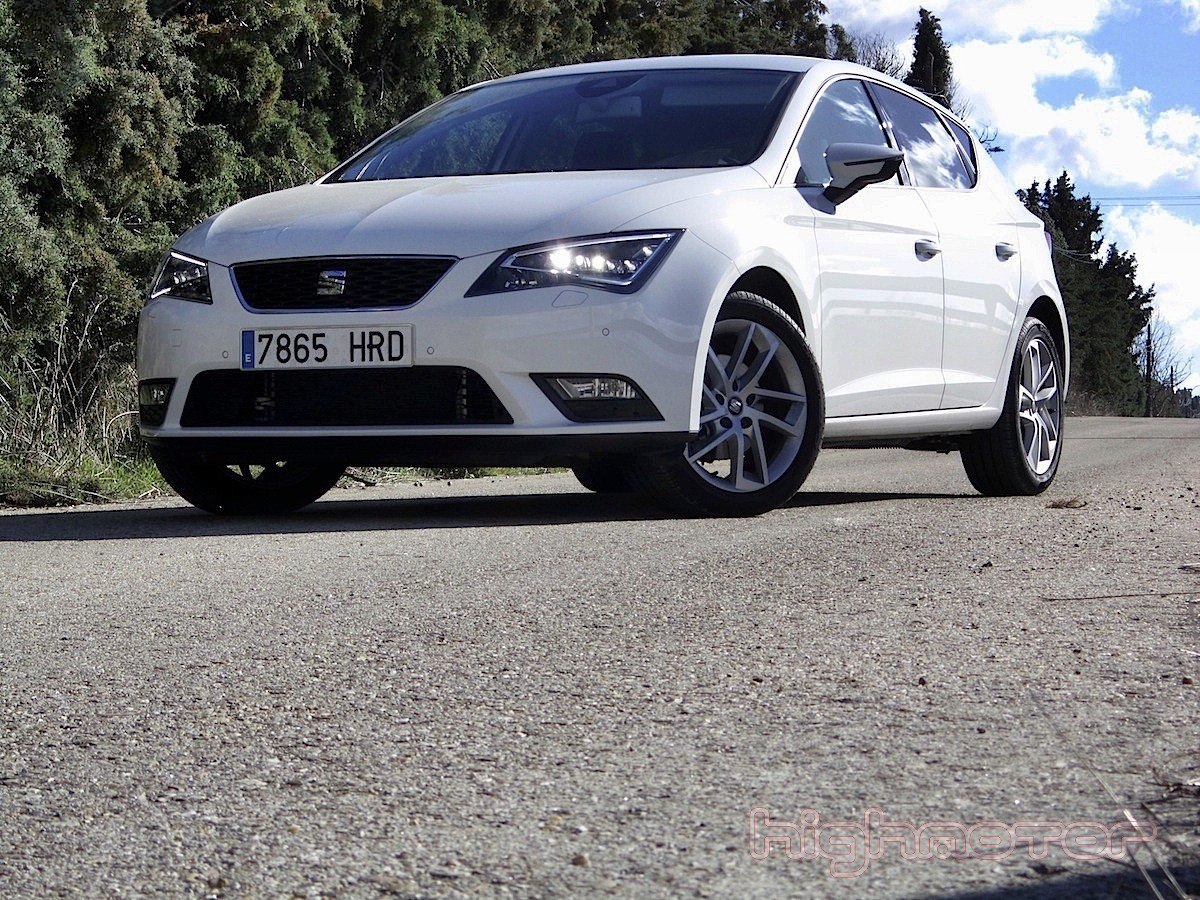
The third generation of the Seat León brings a thorough overhaul. The Spanish brand now offers a product aimed at attracting a wider audience, without forgetting previous generations. Seat takes a qualitative and quantitative leap with the new León: design, technology, performance. We have a more complete Seat León. Below is our road test.
Engine and performance
We tested the León 1.4 TSI 140 CV Style, which fits a 1,395 cc engine capable of delivering 140 CV between 4,500 and 6,000 rpm, plus 250 Nm of peak torque available from 1,500 rpm up to 3,500 rpm. With this direct-injection, turbocharged unit, the Seat León TSI 140 CV is capable of accelerating from 0 to 100 km/h in 8.2 seconds.
As for the response of this petrol engine, you notice it pulls from very low down, but it really comes alive from around 1,800 rpm. The turbo’s contribution becomes evident from 2,200 to 2,500 rpm, and the push is quite good from that point, allowing you to gain speed with confidence. The first impressions are very good; it’s a pleasure to accelerate in this León.
This TSI unit continues to pull solidly even beyond 3,000 rpm, and past 4,000. If you reach 4,500-5,000 you notice it hitting its peak output, but the range in which it delivers its full power is more than generous and lets you “play” to tackle different situations, and also enjoy driving it.
Another plus is how the 1.4 TSI unit maintains its revs. You have CV and torque available for overtaking, merging, or simply gaining some pace or going “spiritedly” on twisty stretches, all with ease and efficiency. That said, if you get very enthusiastic, you will see average consumption figures in double digits; I’m talking close to 10 l/100 km.
But if we are subtle and obey the gear-change indicator, the result is a very smooth, quiet, comfortable drive with a very good average consumption. At this point it’s worth mentioning the suspension, which has the right firmness to inspire confidence at high speeds as well as for city driving (and its potholes).
Gear management is correct, with a medium-to-long travel clutch that does not prevent quick shifts. Fourth gear lets you make the most of the engine’s wide power band from the 1.4 TSI, while sixth gear delivers comfort. The gear change is reasonably precise, and is complemented by a gear knob with good grip.
In any of these situations, city, interurban road, motorway or country road, it’s worth highlighting how quiet this León TSI 140 is, both at idle, at low-to-medium speeds, and also when cruising above 110 km/h. In town, the effectiveness of the Start-Stop system stands out: quick and silent when you pull away again.
Handling
Looking at how the León moves, the car sits well planted, although we did notice, and were surprised by, certain lateral inertia, a little uncomfortable when linking several bends quickly. Here it’s worth mentioning that I had the chance to test -for another publication- the new Seat León FR (with multi-link rear suspension), whereas the Style uses a torsion beam axle.
Apart from this difference, the new Seat León feels composed; at all times you go with confidence and, above all, comfort. You also enjoy good visibility, a comfortable steering wheel and excellent support from the front seats; these are some of the elements that enhance the experience. The trim and setup are more focused on comfort, but they work very well.
An important point: despite being shorter and wider than the second-generation León, the wheelbase of the new León is longer. The MQB platform of the Volkswagen Group has made it possible to achieve a setup that provides composure, stability and lightness to the new León, thanks to its 1,231 kg, around 100 kilos less than the León II. Simply an efficient package.
The brakes work well, although the pedal offers little bite in terms of feedback. You notice how the calipers, especially the front ones, do a good job. Let’s not forget it has ventilated discs at the front (288 x 25 mm) and 253 x 20 mm discs at the rear. The steering communicates well what is happening under the chassis, although there is that slight artificial feel, the “fault” of the assistance systems, but the sense of control and comfort is more than adequate at all times.
The running gear also adapts very well to the road surface. We have medium-firm, short-travel suspension, which provides comfort when cruising, yet offers the firmness that inspires confidence when travelling faster or on poor roads. It contributes greatly to communicating what happens beneath the cabin.
Cabin soundproofing is something that stands out -and a lot- in the new León. It really impresses at all times and at any speed. In addition, forward visibility could not be better; the central rear-view mirror and the side mirrors, although they may seem small at first, provide good visibility and a clear image, a plus for safety too.
The seats in the new León, as I say, are comfortable and hold driver and passenger well. The leather upholstery feels fresh and comfortable, and we must not overlook the sensation of sitting really low from the driving position, an effect created by the lower centre of gravity. The León stands 1,459 mm tall.
This also creates the generous interior space the new Seat León offers, especially for head and shoulder room. Other ergonomic details worth mentioning are the suitable size and texture of the steering wheel, the correct placement of the gear knob and the orientation of the controls on the centre console. Driving the Seat León is enjoyable in terms of comfort and performance.
Consumption
As for consumption, in town we obtained average figures of around 9 litres, while on interurban roads (100 km/h) the trip computer showed 4.9. Overall, after more than 300 kilometres of testing in different situations, the 140 CV TSI averaged 5.9 l/100 km, fairly close to the 5.2 litres of average consumption it is homologated for, a figure we consider very good.
In short, the 140 CV 1.4 TSI León in Style trim delivers satisfying driving sensations. It is a product that adapts very well to many types of user: an engine with good pulling power and moderate consumption, together with a package of rigidity and composure for tackling different roads, and a spacious, comfortable cabin. We will tell you more about that in the next instalment.
Technical specifications of this car


 Peugeot E-208 GTi: un juguete con pilas que recupera el espíritu de los deportivos de los ochenta
 New Lexus ES: luxury grows and goes electric
 First contact with the Dacia Sandero Hybrid 155: power and efficiency from €19,890
Deja un comentario