Subaru WRX STI, road test (engine, performance, handling and consumption)
 Daniel Valdivielso @valdi92
9 March 2015
6 min.
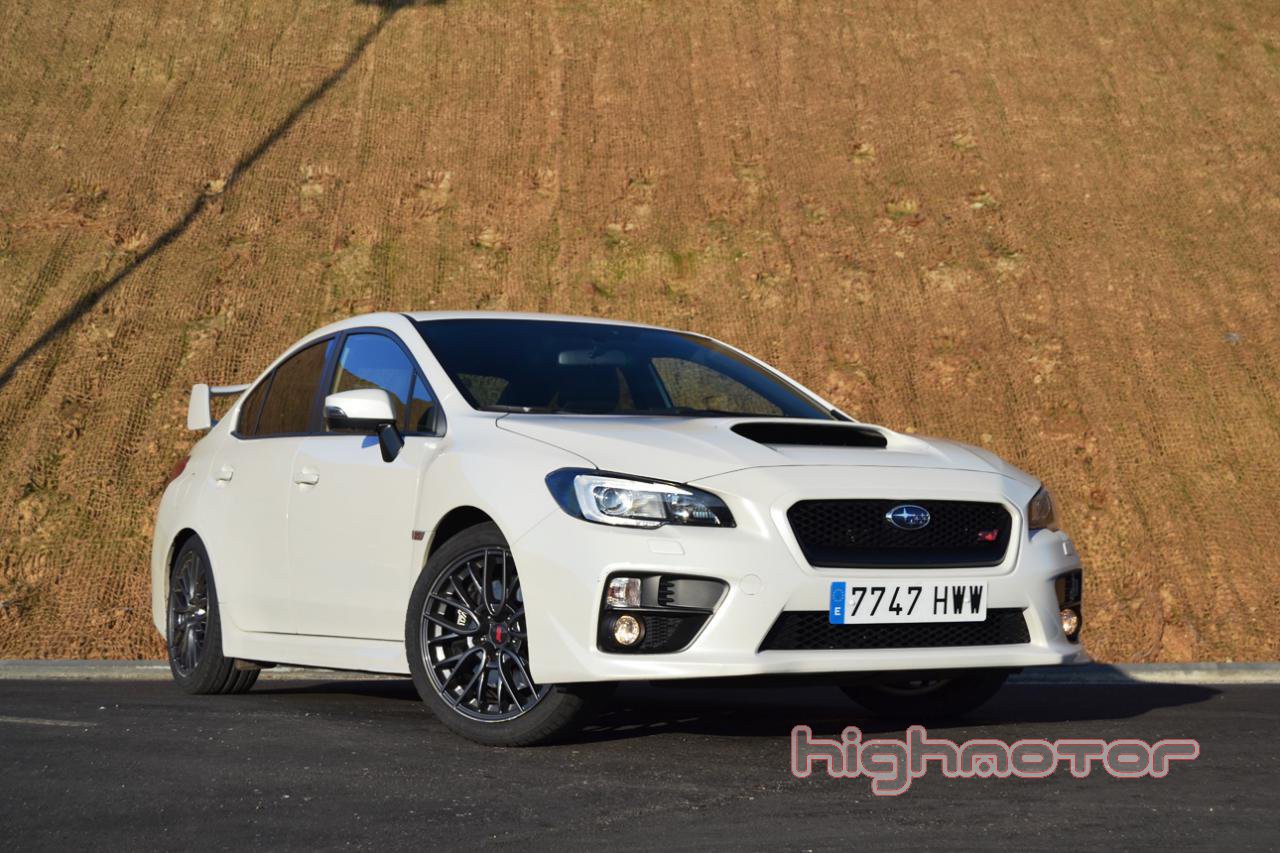
It’s time to write about one of those cars that has crossed the mind of every car enthusiast at least once in their life.
In my case it has been even more recurrent, which is why it’s a pleasure to bring you the analysis of the latest generation of the Subaru WRX STI, whose every last detail we will break down.
Engine
The engine of the WRX STI (which in this new generation drops the Impreza name in our market) is, essentially, a reissue of the one fitted to the previous version. With a boxer architecture, the powerplant features 2.5 litres of displacement across four cylinders. Naturally, it is turbocharged by a large fixed-geometry turbocharger.
The figures speak for themselves: 300 CV and 407 Nm, which means there is no improvement over the last edition. This is possibly one of the weak points of the package, since many hopes had been pinned on this new generation introducing a significant technological load with elements such as variable-geometry turbo or direct fuel injection.
This is one of those engines “of the old school”. By this we mean it is one of the few current powerplants in which we once again feel sensations that seemed forgotten, such as the “kick” or the “turbo-lag“. Although it pushes from quite low down, you need to rev the Subaru above 3,500 rpm to get a response befitting a 300 CV turbo engine.
Performance
The WRX STI’s figures have improved slightly over the last generation, being capable of accelerating from 0 to 100 km/h in 5.2 seconds, reaching a top speed of 255 km/h. These are, therefore, very notable performance figures, the Subaru is a very fast car.
However, compared with rivals of similar power, it is somewhat slower than it should be. In comparison, models such as the Golf R or the Audi S3 Sedán are quicker in manoeuvres such as acceleration from standstill or in-gear recovery, the difference being most evident in the latter, mainly due to a much less pronounced turbo character in the German models.
That is not to say the Subaru is a slow or clumsy car; it would be absurd to claim such a thing. The WRX STI is a terribly quick and very effective vehicle, something also helped by its famous symmetrical full-time all-wheel-drive system, which allows it to transfer all its horses to the road with total fidelity.
Handling
The handling of the WRX STI is, without a doubt, one of the most outstanding aspects of the Japanese model. Once again, as soon as we set off we begin to feel things that seemed forgotten. The feel of the steering wheel, pedals and gear lever is decidedly firm, “warning” that we are dealing with a “serious machine”.
As for the steering, it is hydraulically assisted, and while at first it takes some getting used to the sensations it transmits, over the kilometres it begins to communicate more, although it is not as informative as it should be in a car of this calibre. That said, it is quite quick, with just 2.5 turns lock to lock.
The braking system consists of ventilated discs of 326 mm on the front axle and 316 mm on the rear. Gripped by Brembo fixed calipers with 4 and 2 pistons respectively, the response is always excellent. It feels as if we are “dropping the anchor” every time we press the centre pedal.
Transmission is handled by a 6-speed manual gearbox, with ratios similar to those of the previous generation, being slightly longer in the upper gears. Operation of both the clutch and the gear lever is firm, in the style of racing cars.
We also cannot fail to mention the all-wheel-drive system, which features three limited-slip differentials. Under normal driving conditions, power is distributed in a 41:59 ratio, and can reach 50:50. The WRX STI’s all-wheel-drive system is one of the most complete and effective on the market. It offers three automatic modes (Auto, Auto- and Auto+), as well as six manual alternatives including a final lock of the centre differential (Torsen type).
And the suspension? The suspension is possibly one of the great highlights of the Subaru. It is very firm but not harsh, which means that in town we don’t encounter bouncing or unpleasant jolts. Nevertheless, it always maintains full control over the car’s inertia however fast you drive, maximising tyre contact with the road despite having no electronic and/or intelligent system whatsoever.
Combining all the elements we have covered in this section, the result is a vehicle that, the faster it goes, the better it feels. Grip limits are extremely high, and handling is precise and quick. Despite its size, it is a very agile car as it has virtually no lag in changes of direction, with a very aggressive front axle and a rear that never steps out of line unless provoked in a very abrupt and deliberate way.
The Subaru comes as standard with ESP, which can be disabled in two stages. The first, called “Track”, delays its intervention threshold, allowing the car to slide slightly before it starts to act, always with noticeable smoothness and precision. The second variant is total deactivation, where we completely remove any electronic assistance except ABS. It is one of the few cars where ESP OFF really means OFF.
Consumption
Anyone who says the Subaru WRX STI is a frugal car is lying. That is the truth, no two ways about it. The 300 Japanese CV drink frequently, so the 60-litre fuel tank can, on occasion, run a little short. The manufacturer homologates 10.4 litres per 100 km on the combined cycle, something that is practically impossible to achieve. Only on long motorway runs at speeds no higher than 110 km/h will we see figures around 9 litres on the trip computer.
If you use the WRX STI in town, you need to prepare your wallet, because it is very hard to get below 14 litres per 100 kilometres, a figure that, incidentally, is the homologated one for the urban cycle. Therefore, in normal use of the vehicle, mixing road and town driving, average consumption can sit around 11.5-12 litres per 100 kilometres. It is also worth noting that this engine only performs at full capacity with 98-octane petrol, which is the one recommended by the manufacturer.


 Peugeot E-208 GTi: a battery-powered toy that revives the spirit of the 1980s sports cars
 New Lexus ES: luxury grows and goes electric
 First contact with the Dacia Sandero Hybrid 155: power and efficiency from €19,890
Deja un comentario