Ariya Nissan Electric Cars Tests SUV
Test drive of the Nissan Ariya 63 kWh and 87 kWh 4x4: which version is the most recommended?
 Diego G. Moreira
18 November 2024
8 min.
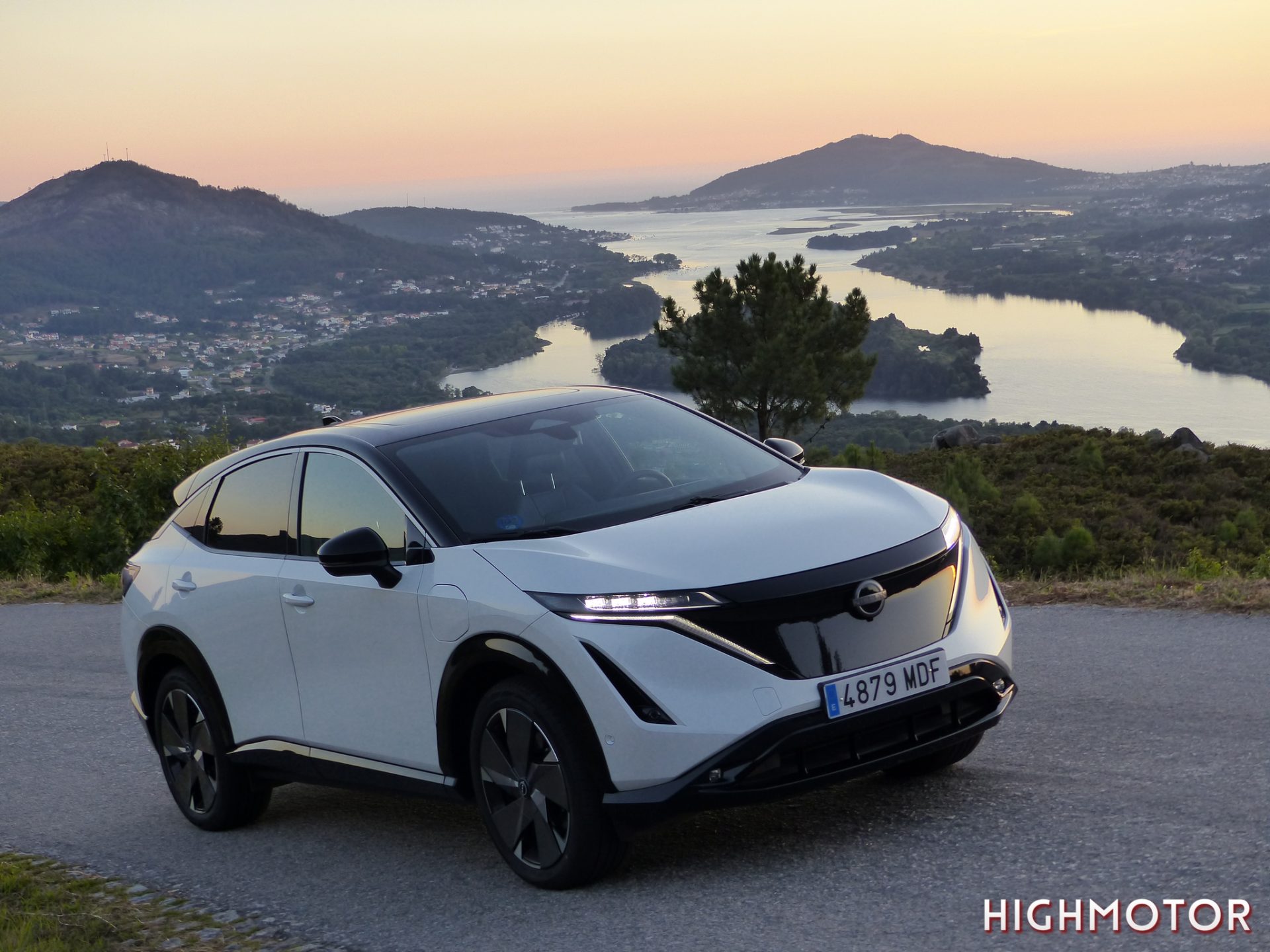
In this in-depth review of the electric Nissan Ariya, we tested two versions with ranges of up to 450 km to see which one may interest you most. 63 kWh Ariya or 87 kWh 4×4?
In our test team we wanted to take a closer look at an electric car that seems like a stranger, although it shares many elements with recent launches from the French brand Renault. An electric car that has a lot to offer and stands out for details others don’t have, such as its outstanding interior finishes and spaciousness.
If you’re looking for a spacious electric that feels like an MPV but with SUV design, this Nissan Ariya will interest you. But which version, the 63 kWh battery or the 87 kWh one? 4×2 or 4×4? We analyse two different versions to clear up your doubts and tell you the best of each one.
Exterior SUV design: Made in Nissan
The Ariya can’t deny its Japanese origin, nor that it is a Nissan, since its design follows the typical lines of other models from the brand, such as the Qashqai. SUV look, a raised car, with a huge front grille (completely closed for the efficiency typical of an electric car).
From the side, the enormous surface of its doors stands out, which already gives us an idea that in the Ariya everything is spacious and big (especially the interior). The wheels would ideally be a little smaller to gain efficiency, but they start at 19 inches and can reach 20 inches depending on the equipment level and options.
While the design surprises us at the rear, where sharp, avant-garde touches stand out, and where the two-tone exterior colour helps create the image of a modern car.
It is tall, like a good SUV, and it even has all-wheel drive. But it is a detail to keep in mind when getting in, or when an elderly person has to access it.
Interior design: space for five and premium finishes
If I had to highlight one characteristic that defines the Ariya, it would be its spacious interior with premium finishes. It is not a cheap car, but at least inside we are surrounded by quality materials, something that doesn’t always happen in electric models that are supposedly premium.
But let’s take it step by step: when we sit at the wheel, we find a spacious interior. A centre console that doesn’t confine us, that offers plenty of width, and that can also slide forwards or backwards with an electric control (optional). There is also an electric control to adjust the seats or the steering wheel position.
The feeling that comes over us is one of comfort. A huge screen runs across much of the dashboard, a screen surrounded by a soft, pleasant-to-the-touch fabric material of good quality (it is equipment that comes with the leather seats, which have ventilation and heating). Right at the bottom, a wood finish, with the climate controls on it, stands out for its quality. That said, for certain climate functions you often have to resort to the main screen.
It is fair to say that the sense of quality is high. It is pleasant that, at this stage, when interiors feature huge screens and cheap glossy black plastics, a manufacturer has made the effort to offer different, quality materials.
The sense of space is also noticeable in the rear seats, with an enormous amount of room for both feet and head, with seats that are more like armchairs, and which in the “Envolve” trim level have heating.
Another detail we liked is the numerous large storage spaces spread throughout the interior, highlighted by a large central glovebox with electric opening and closing, another detail we liked for its unusual nature (a point for Nissan, let some Europeans take note, since some of their models save on quality). That said, the main glovebox is small, as is the armrest storage, both compensated by large door pockets and that central electric glovebox.
Engine and performance: from 218 CV up to 394 CV in its most powerful version
The Ariya’s performance and horsepower vary depending on the battery and version chosen. If we opt for the 63 kWh battery, the engine has 218 CV output and front-wheel drive. Meanwhile the version with the 87 kWh battery has an output from 242 CV, and if we opt for the larger-capacity battery and 4×4 drive, the engine rises to 304 CV (there is even a top version with 394 CV).
We tested the 63 kWh Ariya 4×2 with 218 CV and the 87 kWh Ariya e-4ORCE (4×4) with 304 CV, both powertrains more than sufficient for everyday use. Although the all-wheel-drive 304 CV version has extraordinary acceleration, going from 0 to 100 km/h in 5.7 seconds.
In fact, figures such as torque give an idea of how the power increase translates: the 218 CV engine has 300 Nm of torque, while the 304 CV version offers 600 Nm. In Sport mode it puts a smile on your face.
Which engine is recommended? The answer is clear to me: the important thing is to opt for the 87 kWh battery for range, but in terms of engine, the 87 kWh e-4ORCE (4×4) version we tested is for a very specific audience who can make use of the traction (mountain environments, or climates where it may be useful) or those who want a fast car, though not a sports car. In other words, the sweet spot is the 242 CV engine with the large battery.
Handling: a comfortable SUV that goes well in its e-4ORCE version
As I anticipated in the previous section, the Ariya is not a sports car. It has versions with a lot of power and an acceleration capability that surprises, but its dimensions, height and chassis do not offer the precision needed to make the most of those 304 CV.
That said, on the road or in the city it is a very comfortable car, which isolates us from the outside sublimely, with a high level of ride comfort, and suspension that strikes a middle ground between firmness while absorbing road irregularities very well.
It has several modes: ECO, Normal and Sport, and in the 4×4 version it adds a mode for low-grip situations. Again, this version makes most sense in places where all-wheel drive is necessary or improves road safety; that is where you have a fast SUV with good traction capability.
Consumption and battery of the Nissan Ariya
The Ariya version with the 63 kWh battery is rated at 17.5 kWh/100 km, while the version with the 87 kWh battery is rated at 18 kWh/100 km. The difference is very small, not enough to justify the smaller battery, except on price.
A practical detail is the 22 kW charging capacity, which is welcome when charging at a public post, since at home we won’t have as much power available.
Comparatively, in terms of range, the 63 kWh battery has a real-world range of 350 km (rated at 400 km) as long as we drive on the road and calmly; if we do it on the motorway, the actual range figure will be 250 km. Meanwhile, the version we tested with the 87 kWh battery and all-wheel drive reaches 450 km in urban driving and up to 300 km on the motorway, figures that will undoubtedly improve in the single-drive version with the large battery.
In general, driving calmly in urban settings or nearby, average consumption hovers around 17-18 kWh/100 km if we are careful with the pedal, a figure that rises to around 20-21 kWh/100 km on average (in the 4×2 version) and increases slightly in the e-4ORCE version, sitting between 19-23 kWh/100 km depending on driving style and type of road.
We put both models through a rigorous test exceeding 2000 km, with 1200 km on the motorway (Madrid > Vigo > Madrid) and the remaining distance on city and country roads. The 63 kW Ariya had an average consumption of 21 kWh/100 km. Meanwhile, on the same route and similar mileage, the Ariya e-4ORCE with 87 kWh battery had an average consumption of 22.5 kWh/100 km.
The maximum charging power of both batteries is 130 kW, maintaining outputs of more than 70 kW up to nearly 90% charge.
Equipment
From the base “Advance” trim level, the Ariya’s equipment is complete, with standout systems such as ProPILOT Assist with Navi-Link (an adaptive cruise control that intervenes on the steering with the help of the navigation system), heated electric front seats, a 360° parking camera with moving-object detection, an electric tailgate, or a wireless smartphone charger.
Our trim level (and one of the most recommended for those who want everything) is the “Envolve“, which adds the BOSE sound system with 10 speakers (and outstanding quality), a glass panoramic roof, a head-up display, or the electrically sliding central console.
We liked the operation of the ProPILOT system, as it is really smooth on the motorway, keeping the car in lane without abrupt movements. On the other hand, we feel the graphics of both the navigation and the digital instrumentation could be improved, although they provide a lot of information.
Photos | Test team
Technical specifications of this car

 Peugeot E-208 GTi: a battery-powered toy that revives the spirit of the 1980s sports cars
 New Lexus ES: luxury grows and goes electric
 First contact with the Dacia Sandero Hybrid 155: power and efficiency from €19,890
Deja un comentario