Clio Renault Hybrid Cars Tests Urban
Test drive Renault Clio E-Tech Esprit Alpine: we analyse the 5 key points of this urban sports car ECO
 Óscar Sanz
25 March 2024
5 min.
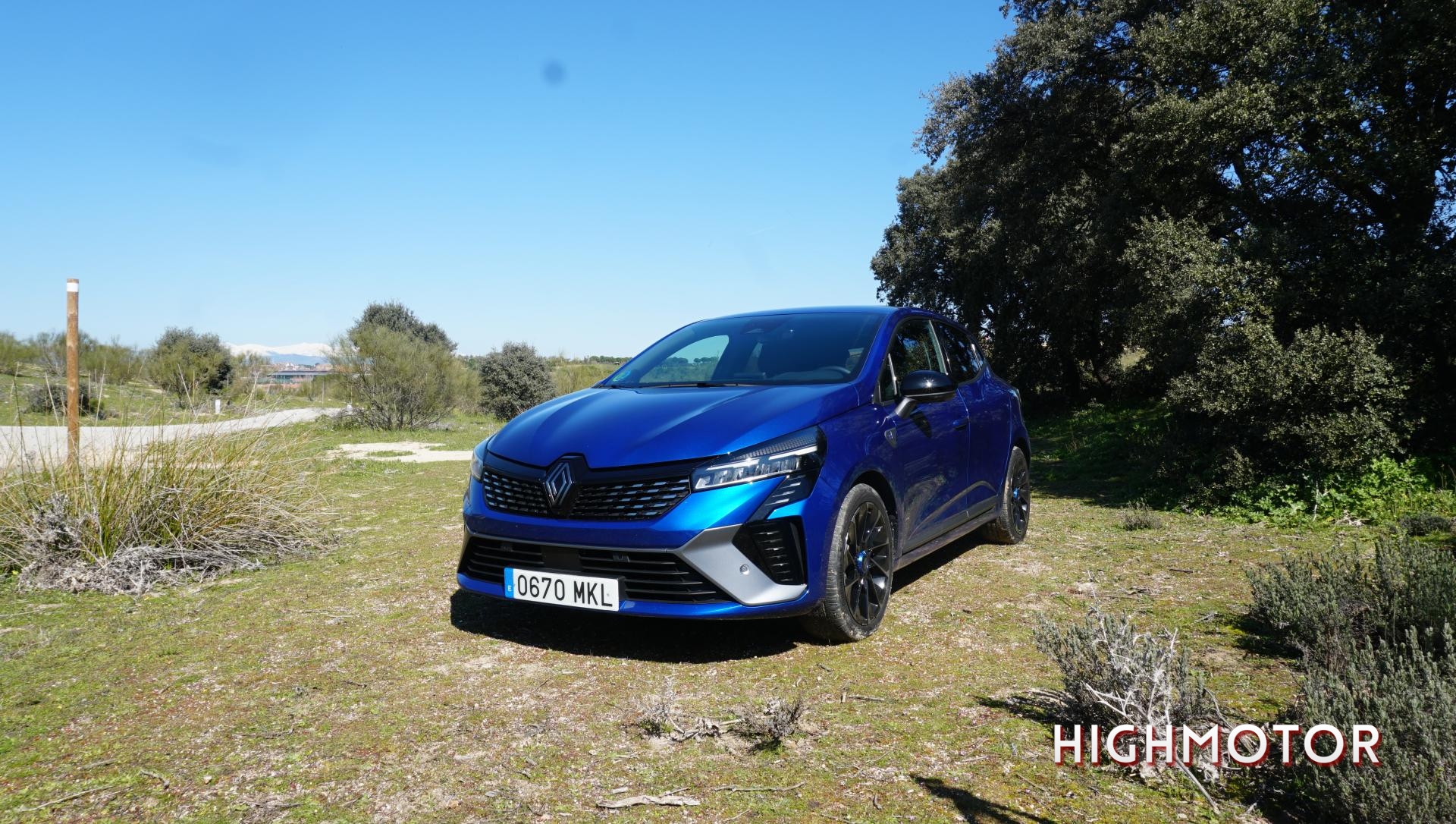
We have thoroughly tested the incredible update of the Renault Clio and here we show you the 5 most outstanding points that may make you consider buying a hybrid like this one
This week we had the opportunity to test one of the urban compacts with no more and no less than 33 years of history. Yes, it is the Renault Clio, one of the best-selling models of the brand behind the Captur both in Spain and in the rest of Europe. But this is not a normal Clio, it is the E-Tech hybrid version that now arrives with 143 CV. But is it worth opting for the hybrid version, when the range offers petrol, diesel or LPG engines to choose from?
This generation of the Clio reached the market in 2019, and received a major update at the end of 2023: grille, headlights, colour range, wheels, etc., and a simplified line-up of versions designed to compete with the acclaimed Toyota Yaris or the Honda Jazz thanks to its hybrid system. This model measures exactly 4.05 metres long, the same as its predecessor since the platform and chassis are exactly the same. The colour they let us test on this version is Iron Blue, the most attractive in my opinion, although it is also available in a new colour, Grey.
Distinctive and attractive design
Renault has decided to completely change the front end of the new Clio, it has nothing to do with the previous one. It now features a wider grille with a diamond finish that also has a gradient from dark to light towards the outer edge. The new Renault logo is also introduced with a chrome finish, we could say, and the headlight design has five modules instead of three with new LED lights, which now run vertically, leaving behind the previous teardrop shape.
In short, we could say that the front end has only received changes to make this model a somewhat sportier and, of course, more attractive version. But, without a doubt, the detail I liked most about its exterior are the 17-inch alloy wheels, which feature wheel nut covers with the Renault logo that simulate the single-nut wheels of F1, with a blue touch matching the bodywork.
Sporty option at an affordable price
In the Esprit Alpine version we find some details that show the sporty equipment of this sporty version. They have introduced these new sports seats with lateral support, upholstered in recycled fabric with some touches of synthetic leather. Adding to this sporty option is an increase in weight due to the installation of the battery just below the boot. This leads to greater driving confidence compared with the other diesel or petrol versions, as body roll is substantially reduced.
It also includes a drive mode selector which includes, for example, the Sport mode, which offers more responsive engine, gearbox and steering behaviour for an enhanced sensation and greater driving precision.
A true hybrid
This is a very efficient and economical engine, it comes with an automatic gearbox, improved performance and an incredible consumption that rarely exceeds 6 L. This engine is so special because it is a true hybrid, not a “mild hybrid” or “microhybrid”, also known as light hybrids. In the latter, the advantage is that they also carry the ECO label, but the system is more simplified and they do not achieve the efficiency in terms of consumption and performance that a full hybrid like the Clio’s provides. It also features the “B” or BrakePedal function, with which we do not even need to press the brake pedal in urban areas, as the electric motor retains and regenerates energy thanks to the combustion engine. Thanks to the combination of its two motors, it offers truly ridiculous consumption figures. No matter how hard you push or how much you rev the car, its consumption never goes above 6 litres per 100 kilometres. We can also force the car to cover a certain distance in fully electric mode, but in this case it will only manage a distance of 4.5 kilometres.
Complete engine range
Renault has simplified its engine range, offering petrol, LPG and diesel versions, a point in Renault’s favour, in addition to this E-Tech full hybrid now with 143 horsepower, 3 more than the previous Clio, and the ECO label from the DGT. Of course, if you are looking for the ECO label, in the current range the only alternative to the Clio E-TECH is the LPG version….
However, the petrol and hybrid options can be configured in the trims New, Evolution and Esprit. Clio TCe 100 LPG, with the three-cylinder turbo engine which can run alternatively on petrol or LPG with 100 CV in New, Evolution and Esprit trims. Two other possibilities are the TCe 90, with the 90 CV three-cylinder petrol engine paired with a six-speed manual gearbox; and the Blue dCi 100, the four-cylinder turbodiesel also with a six-speed manual gearbox.
More boot space than the Yaris
The boot has a small problem. What is that problem? Due to the installation of the hybrid system, which, as we have already mentioned, sits right below the boot, they had to sacrifice some space, leaving 300 L in this version, compared with 391 L for the petrol version and 366 L for the diesel. Even so, there is room for a spare wheel and a puncture repair kit. If we fold down the rear seat row, although the floor is not completely flat, we get a load capacity of up to 1069 L.
Its main rival, the Toyota Yaris Hybrid, is 15 centimetres shorter than the Clio, with its boot capacity at 289 litres. These two cars have very similar prices, with the Clio at €21,763 and the Yaris at €21,650.
Image gallery Renault Clio E-Tech Esprit Alpine
Technical specifications of this car


 Peugeot E-208 GTi: a battery-powered toy that revives the spirit of the 1980s sports cars
 New Lexus ES: luxury grows and goes electric
 First contact with the Dacia Sandero Hybrid 155: power and efficiency from €19,890
Deja un comentario