The Sant'Agata factory of Lamborghini turns 60
 Jaime Avilés
27 March 2023
3 min.
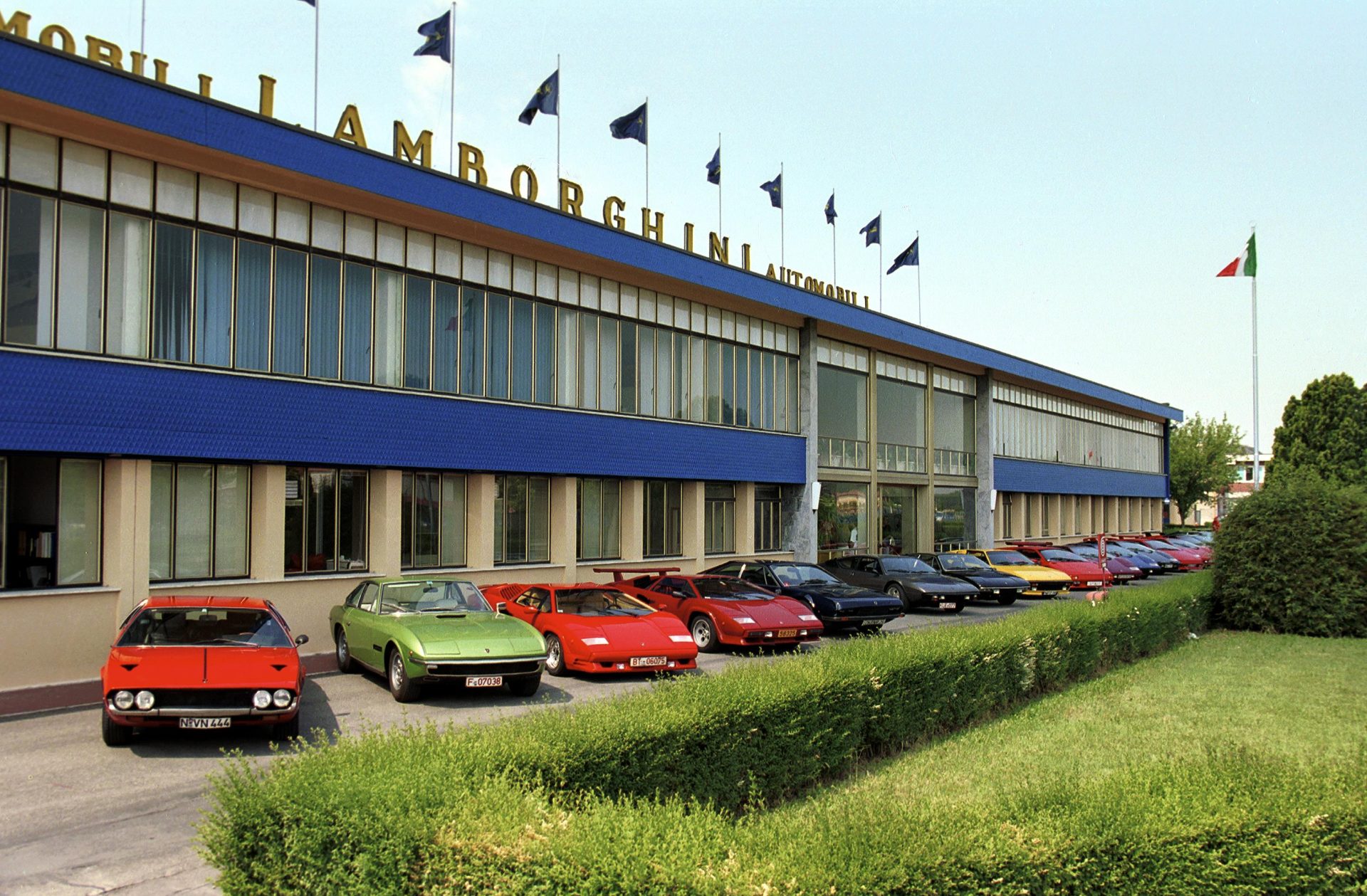
The iconic production plant of Lamborghini celebrates 60 years since its founding in 1963, evolving over the years while keeping its DNA intact
When Ferruccio Lamborghini decided to found his own sports car brand in 1963, he chose to establish what would then be his new factory in Sant’Agata Bolognese, a village about 23 kilometres from Cento, Ferruccio’s hometown. Since then, this legendary factory has become the birthplace of every single Lamborghini model, from the 350 GT to the Urus.
In the first images from the press presentation event of the 350 GTV prototype in 1963, the main structure of this factory could already be seen, now completed, which took only about eight months to build, making it one of the most modern production plants of its era.
It was not until 1966 that Lamborghini began to further centralise the production of its components such as the gearbox and the differential. By then, the production areas, offices, test rooms and the service workshop already occupied some 12,000 m2 of total floor space, focusing above all on combining the craftsmanship of its workers with the most advanced technology available.
Its first expansions
The next evolutionary step for the Sant’Agata factory took place specifically on 18 October 1968, when three new industrial buildings covering about 3,500 m2 were erected, created to reinforce the production facilities with a more modern and better equipped test centre.
However, despite the improvements to its infrastructure, the years ahead for the Italian brand were to be quite unstable, falling from producing 425 Lamborghinis in 1971 to just 55 vehicles in 1979 due to the economic crisis of the 1970s.
After some difficult years, the 1980s gave Lamborghini a fresh boost, using materials such as carbon fibre in its production, and even creating the first prototype with a carbon chassis, which was named Lamborghini Countach Evoluzione.
Exponential growth
The 1990s were marked by research, development and testing in the field of electronic systems and new composite materials, but above all by the union with Audi in 1998, which allowed it to grow exponentially, increasing production to 296 cars in 2001 with a workforce of 440.
Just two years later, the brand’s facilities already covered an area of 100,000 m2, and its annual production had risen to more than 1,300 cars, with a workforce of more than 624 employees. In 2006, growth over the previous year of 30.4% was recorded, and 2,087 cars were produced.
Another highly notable year for Lamborghini and its factory was 2011, the year the Aventador LP 700-4 was launched, equipped with a carbon fibre monocoque and developed entirely in Sant’Agata. At that point, Lamborghini launched in-house production of “CFK – Lamborghini Carbon Production”, consolidating the brand’s position in the supercar segment.
Evolution in every sense
In 2015 Automobili Lamborghini inaugurated its new trigeneration and district heating systems, two projects that were of vital importance in obtaining the CO2 neutrality certificate for the entire plant.
In 2018 the most successful model in the brand’s history to date, the Lamborghini Urus, arrived for the first time, a model that has allowed the brand to post its best sales results in its history for two consecutive years.
Now, as part of the “Direzione Cor Tauri” programme presented by Stephan Winkelmann, CEO of Lamborghini, in May 2021, the brand will electrify its entire product range between 2023 and 2024. In fact, this very Wednesday, 29 March, we will get to know the first electrified member of the Lamborghini range.


 The seven finalists for the 2027 European Car of the Year (COTY) are exclusively electric
 Peugeot E-208 GTi: a battery-powered toy that revives the spirit of the 1980s sports cars
 New Lexus ES: luxury grows and goes electric
Deja un comentario