BMW i7 Sedans Electric Cars ECO
This is the most expensive electric car from BMW, and its figures are even more impressive than its price
 Antonio Roncero @roncero_antonio
28 August 2023
3 min.
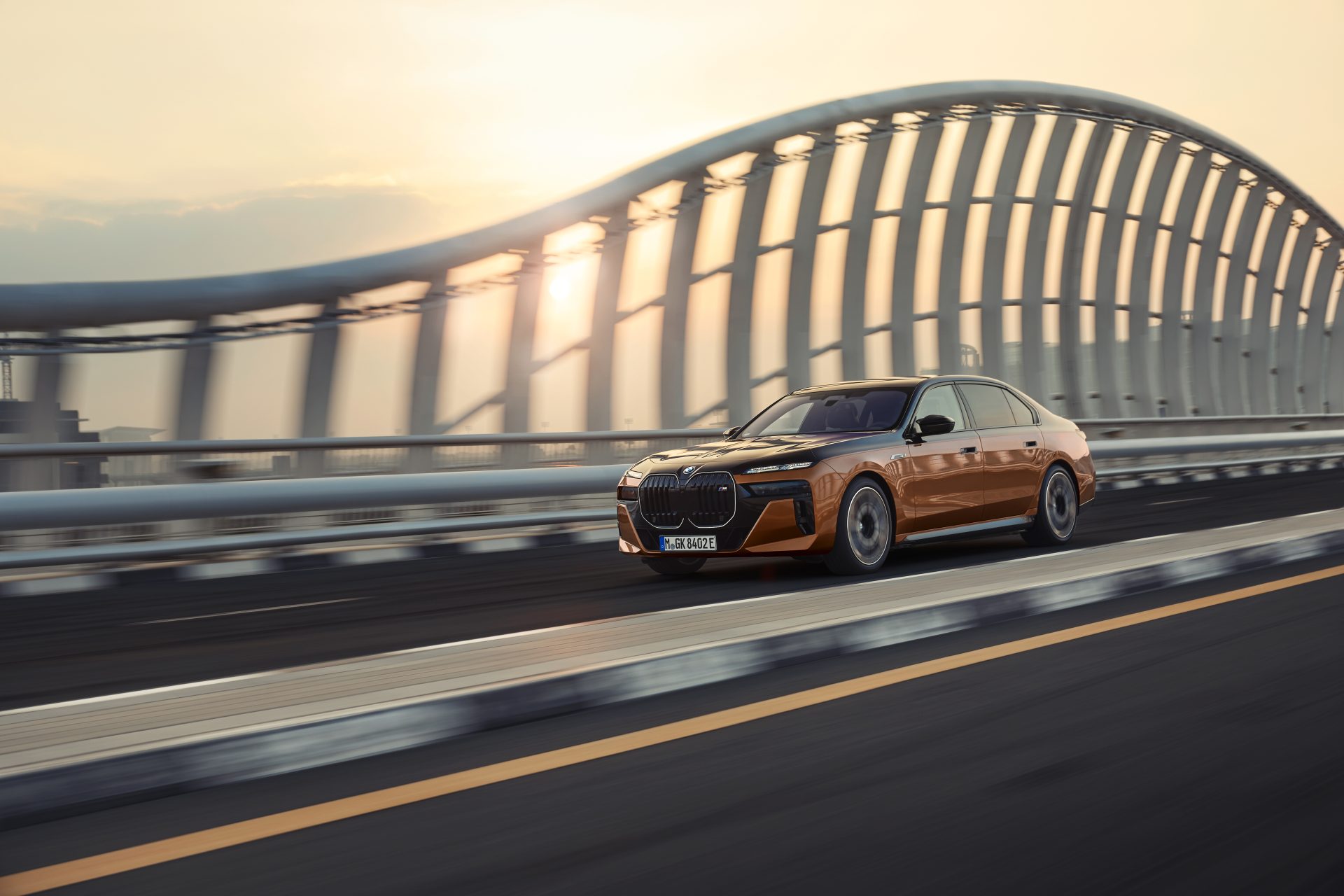
With a price of 186,450 euros, the BMW i7 M70 xDrive becomes the most expensive electric car from BMW, although it is not precisely its price that impresses the most.
BMW has already set the price for the new BMW i7 M70 xDrive, the most powerful and sporty version of the i7, its all-electric luxury saloon, which costs 186,450 euros in the Spanish market. A figure that makes the i7 M70 xDrive, by far, the most expensive battery-electric vehicle in the BMW range. The xDrive 60 version of the i7, for example, costs 139,350 euros. And in the BMW range, regardless of propulsion type, the only models more expensive than this i7 M70 xDrive are the BMW XM Label Red, a plug-in hybrid SUV with 748 CV, priced at 201,500 euros… and the Coupé, Gran Coupé and Cabrio versions of the BMW M8 Competition, with the 625 CV petrol V8 engine.
If we look at the ranking of the most expensive electric cars sold in Spain, the i7 M70 xDrive is only surpassed by the saloon, Sport Turismo and Cross Turismo versions of the Porsche Taycan Turbo S, with their 761 CV and a designation, “Turbo”, that can be confusing, because their propulsion is 100% electric. And compared with what is today its most direct rival, the Mercedes-AMG EQS 53 4MATIC+, the i7 M70 xDrive costs about 6,000 euros more. Other alternatives among high-performance electric saloons would be the Audi RS e-tron GT, which claims 646 CV and has a price of 151,830 euros; and the Tesla Model S Plaid, which offers the best balance between power and price, with its 1,020 CV and a price from 132,490 euros.
A luxury electric saloon with supercar performance
But price is not the only figure that impresses about the BMW i7 M70 xDrive, which at 5.4 metres is also the largest electric saloon currently on sale in our market. To quickly run through it, the saloon’s two electric motors deliver a maximum system power of 659 CV, with a peak torque of 1,015 Nm with M Sport Boost mode activated, allowing it to accelerate its no less than 2,770 kilograms from standstill to 100 km/h in 3.7 seconds using launch control, just half a second behind a full M8 Competition, and one tenth faster than its rival, the EQS 53 4MATIC+. The top speed is electronically limited to 250 km/h.
Its homologated consumption is low for the level of power and performance, and for the size and weight of the car: 20.8 kWh/100 km. With a 101 kWh battery, the homologated range reaches 559 km. The maximum charging power using direct current is 195 kW, which allows it to go from 0 to 80% in about 34 minutes.
What remains rather curious is that, by current standards, the standard wheels stay at a “mere” 21-inch diameter, and there is no possibility of fitting larger wheels, not even as an option. Among the wide catalogue of optional equipment, the Executive Lounge package stands out for its price: it adds ventilated massage seats, entertainment system in the rear seats, wood decorative trim and the rear console, and costs a staggering 14,650 euros. Although, when talking about prices, we should not overlook the Individual Merino leather upholstery together with the M Carbon Fibre inserts in the interior, which cost 9,500 euros.
Technical specifications of this car


 Peugeot E-208 GTi: a battery-powered toy that revives the spirit of the 1980s sports cars
 New Lexus ES: luxury grows and goes electric
 First contact with the Dacia Sandero Hybrid 155: power and efficiency from €19,890
Deja un comentario