We test the new Audi A5: the successor to the A4 with which Audi wants you to look beyond SUVs
 Antonio Roncero @roncero_antonio
17 December 2024
11 min.
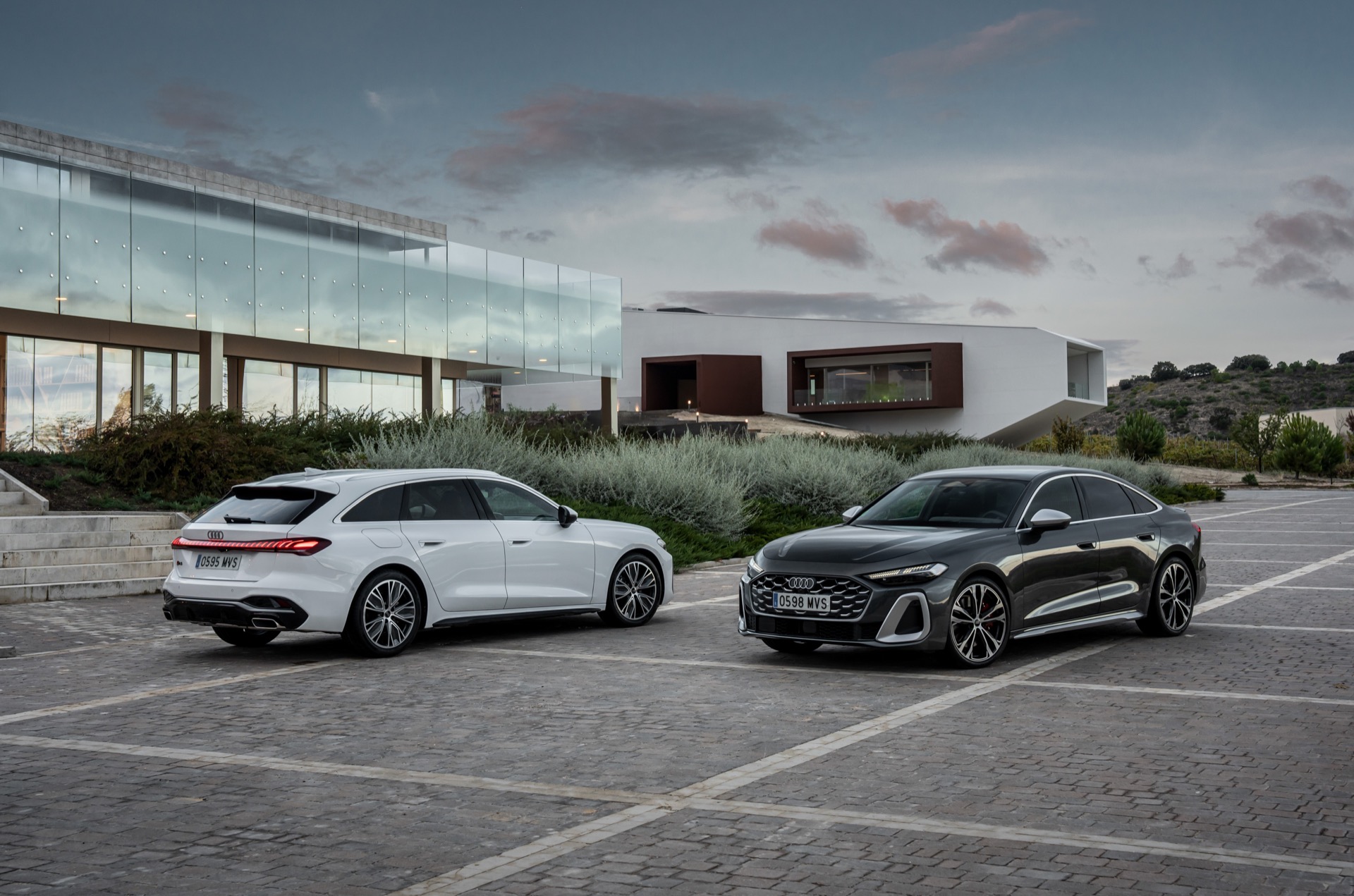
Audi is regaining ground at a frenetic pace: the brand with the four rings is undergoing the most important product offensive in its history, with a launch plan of up to 20 new models between 2024 and 2025. They may seem like a lot, and in reality they are, although the figure has a certain “trick”: the brand with the four rings considers different models not only the body variants of the same car, but also the S and RS versions. And the new Audi A5, which arrives in saloon and Avant versions, is a clear example.
We have found others in recent launches such as the Audi Q6 e-tron, now also announced in a Sportback version. Or in the Audi Q5 and the Q5 Sportback, and in the Audi A6 e-tron, available as Sportback and Avant. Two body versions that we will also see in the successor to the Audi A7, expected this year, alongside the new Audi Q3.
But today we are going to talk about the new Audi A5, which takes over from the A4 in the range of Audi models with combustion engines. As you know, from now on models with even numbers are reserved for electric cars, and odd numbers for combustion variants, which will still be making their presence felt. More than many had planned, even Audi itself…
Two bodies: five-door saloon and Avant
In the metamorphosis of the A4 into the A5, the traditional three-box body with a “classic” boot lid has been lost along the way. And, at least for now, the Coupé version too. Unlike the A4, the A5 saloon now has five doors, like the previous A5 Sportback, although in this case it does not carry that name. I think it is a good decision, as the rear hatch allows better access to the boot and does not detract a bit from the elegance of this body. As for the A5 Avant, which measures the same as the saloon in length and width but is about 2 centimetres taller, in my view it is one of the estates in its segment with a sportier design. The images speak for themselves.
The price difference between both bodies is 2,260 euros. As for boot capacity, the Avant has about 30 litres more, reaching 476 litres in the front-wheel-drive versions, since with quattro four-wheel drive the figure drops by almost 30 litres. The difference increases by 125 litres when the rear seats are folded down, which is when the Avant shows its family side. This is slightly less capacity than the A4 offered, despite the increase in size (almost 70 mm more in length). It is also somewhat less than its main rivals, the BMW 3 Series and the Mercedes-Benz C-Class. But thanks to its square and very usable shapes, and the generous access the hatch provides in both versions, with standard electric operation, it cannot be said that luggage space is a weak point of the new A5, far from it.
Choosing between the saloon and the Avant will be, above all, a matter of style, as the difference in luggage space is small, and the saloon’s hatch brings it very close to the estate in versatility. There are no differences in interior space either, except that rear passengers in the estate have almost five centimetres more headroom, as the roof does not drop as steeply as in the saloon, which could well have been called the A5 Sportback. Does Audi have a surprise in store for us? We shall see. In any case, broadly speaking, passengers in the new A5 would not travel with more room than in the A4. But comfort is noticeably better, for many other reasons.
Audi S5 Sportback – Image gallery
A very technological interior
And one of them is the technological load this new A5 brings, taking advantage of the so-called Premium Combustion Platform – also used in the new Q5 – and, especially when talking about connectivity or infotainment, thanks to the new electronic architecture. Some examples of the innovations coming to this A5 are the panoramic roof with adjustable transparency; a much larger head-up display projected onto the windscreen that allows control of various vehicle functions; or the Bang & Olufsen 3D sound system with 16 speakers (4 of them in the headrests).
All these elements are optional and, as you can imagine, not especially cheap. But what is standard on every A5 is what Audi calls “digital cockpit”, a configuration debuted on the Q6, which we have been seeing in the brand’s new models since the launch of the electric SUV. Now, Audi is betting on integrating all the screens into a single curved surface that practically occupies what we until now called the dashboard, with an 11.9-inch screen for the digital instrumentation and another 14.5-inch one next to it for the multimedia system. Lacking a longer test to “fiddle” more thoroughly, the operation seems impeccable to me, both in terms of screen definition and graphics speed or the smoothness with which menus are navigated.
I also found the Audi assistant very good, which recognises voice commands and in many cases spares you from having to go to the multimedia screen… or the new control panel on the driver’s door. For example, to lower a window fully or partially, darken the sunroof, make a phone call, adjust the temperature or search for a destination and set it in the navigation.
An optional 10.9-inch third screen can be fitted for the passenger, which allows playing multimedia content -it has a privacy mode that activates when the vehicle moves, so the driver cannot see anything- or helping with functions such as navigation. I don’t like how Audi has resolved this area in the versions that do not include the screen, because instead of the dashboard being left in view, which would be ideal, a smooth surface in a material that looks a bit dull is installed, and it almost looks like a “fake” addition.
Apart from this detail, and the overuse of “piano black” trim on many surfaces, a very elegant finish when clean of dust or fingerprints, which is almost never, the sense of very high quality that pervades the A5’s cabin is perceived both visually and by touch. In this regard Audi never fails, with impeccable presentation.
TFSI and TDI: diesel takes centre stage
Until the TFSIe versions with plug-in hybrid technology arrive later, which will exceed 100 km of electric range, the Audi A5 range has two petrol engines and one diesel.
The petrol engine is the 2.0 TFSI four-cylinder, which comes in two variants, with 150 hp or 204 hp, always with front-wheel drive, S tronic dual-clutch gearbox and DGT C environmental label. The price difference between the two engines is 2,200 euros, but I wouldn’t hesitate: the entry model is already very good, but the more powerful one is worth it, as it is clearly quicker and consumes the same or even less.
But watch out, because the turbodiesel version has a lot to say in this new A5 range. The 2.0 TDI offered from the outset also produces 204 hp, and costs barely 100 euros more than the TFSI with identical power… with the important added advantage of featuring the new MHEV plus mild-hybrid technology from Audi, which gives the TDI the increasingly attractive ECO label. With the TDI, quattro four-wheel drive is also an option, for an extra cost of about 2,600 euros.
Choosing between petrol and diesel in the new A5 therefore seems easier than ever to me: the TDI does not quite reach the refinement of the TFSI – technically it is impossible – but it is by no means a coarse engine. And with practically identical performance, in real driving it averages around 1.5 to 2 litres less fuel per 100 km. If we add that they cost the same, and that the TDI has the ECO label, unless you are “allergic” to the side effects of diesel – or of AdBlue – the sensible choice would be the diesel.
Furthermore, since launch the new Audi S5 is also offered, now with a 367 hp 3.0 TFSI V6 engine, also equipped with MHEV plus technology. Available with both saloon and Avant bodies, the S5s include small identifying details on the exterior, a specific chassis tuning, more powerful brakes and the sporty rear differential.
The PPC: a very well-suited platform
That the Audi A5 offers impeccable dynamic behaviour, typical of cars from a higher segment, is mainly due to the new Premium Combustion Platform. There are many contributions from this architecture, notably the new optimised progressive steering, more direct and with better feel; the torque vectoring system that vectors braking torque, acting on the brakes to improve agility in corners; or the new integrated iBS brake regulation system that decouples the pedal from the hydraulic mechanism for a more precise pedal feel.
Furthermore, Audi has applied greater differentiation between the driving modes of the Audi drive select – and you can feel it -, and the suspension has been optimised with stiffer new bearings, new anti-roll bars and more negative camber on the front axle. The result is a car that, at least with the standard sport suspension of the S line – slightly firmer damping and lowered ride height -, which is how I have driven it so far, feels much more agile than the previous Audi A4 (also taking an S line version as reference), yet at the same time offers superior pothole absorption.
During the first contact on the occasion of the national presentation I also briefly drove what would undoubtedly be “my car”, if I could choose one of those currently in the range and budget, both purchase and running costs, were not an issue: the Audi S5 Avant. The estate body, simply because I particularly find it more beautiful. As for the engine, once you try it it is hard not to surrender to the sensations conveyed by the smooth and powerful – depending on how you use the accelerator – 3-litre V6, which even thrills with a lovely sound, and the efficiency of a magnificent chassis.
Equipment and prices of the Audi A5
Before finishing, some considerations on the equipment and prices of the new Audi A5. Firstly, it is not a cheap car. It starts from 53,050 euros for the 150 hp 2.0 TFSI with Advanced trim, and the 204 hp TDI and TFSI versions rise to 56,000 euros, slightly above their main alternatives.
The equipment is very complete, but for 2,900 euros the step up to the S line versions is worth it, which add 19-inch wheels, the S line exterior package that gives the car more presence, the sport suspension, the ambient interior light plus and the S line interior package with sport seats and a lovely Kaskade fabric upholstery with contrast stitching.
And we should not lose sight of the two optional packages Audi offers, which allow significant savings compared with the price of their components if equipped separately. The first is the Comfort package, which for 3,000 euros adds a panoramic camera, the passenger MMI screen, Matrix LED headlights, comfort key and the safety package, with assistants such as lane change warning, exit warning when getting out of the vehicle and the Audi pre-sense front, side and rear. At that price, it seems to me an “obligatory” option.
Above it sits the Premium package, which costs 6,000 euros, and adds to the Comfort package the adaptive driver assistance plus – once you try it, you won’t want to travel without it -, the digital OLED rear lights, electronically controlled damping suspension, heated steering wheel with electric adjustment and heated rear seats.
Audi A5 Avant – Image gallery


 Kia offers an electric range of 10 models, 50 versions and 400 possible combinations
 The seven finalists for the 2027 European Car of the Year (COTY) are exclusively electric
 Peugeot E-208 GTi: a battery-powered toy that revives the spirit of the 1980s sports cars
Deja un comentario