We tested the Ford Kuga PHEV: a plug-in hybrid better than diesel!
 Antonio Roncero @roncero_antonio
3 July 2020
11 min.
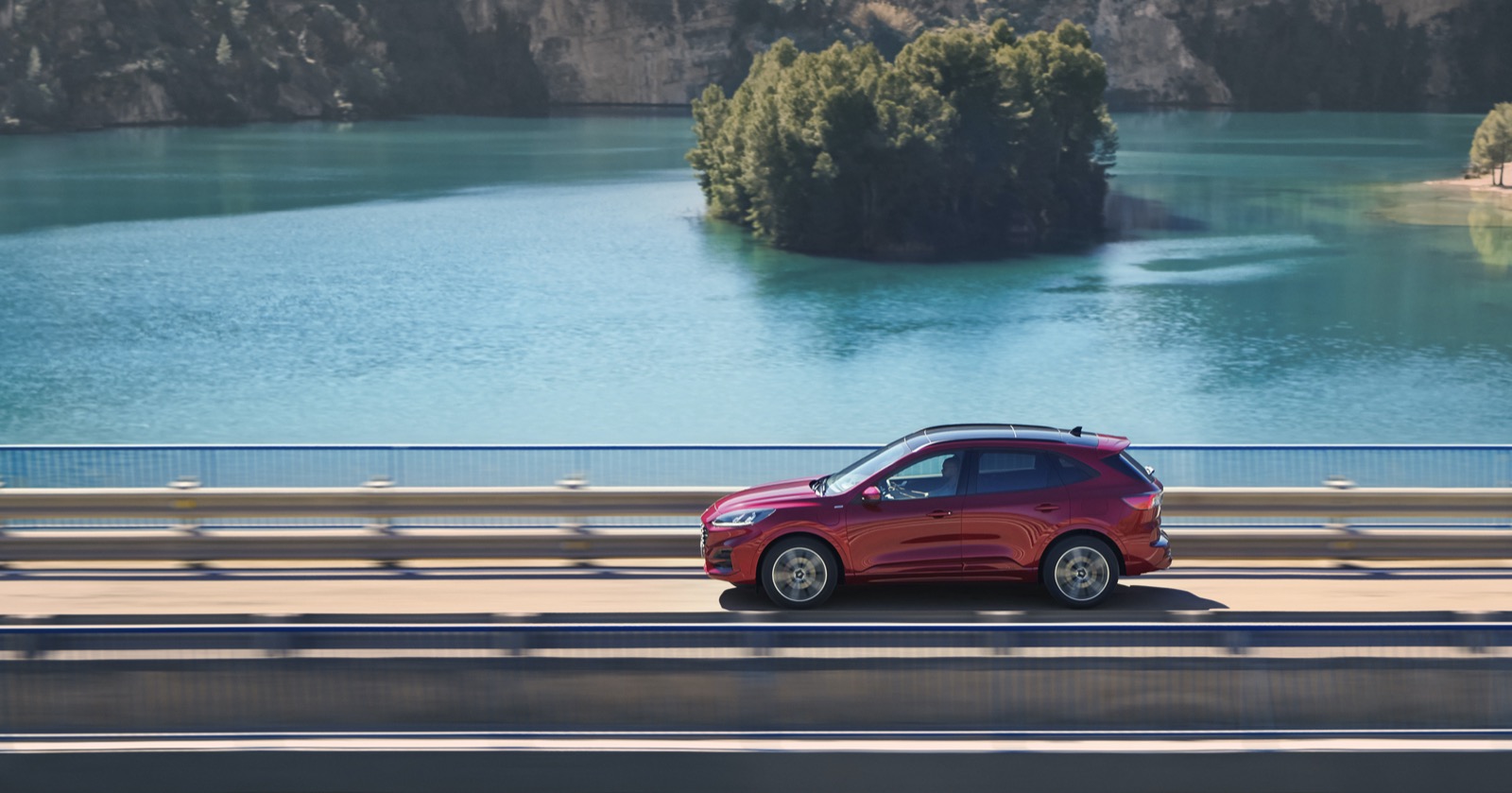
A few days living with the new Ford Kuga plug-in hybrid lead us to conclude that it can be a better alternative than diesel… even if you don’t have a plug.
What a calling card the most technologically advanced version of the new Ford Kuga, the PHEV plug-in hybrid, offers. So, before getting into the details, note these figures:
• System power of 225 CV
• Electric-mode range of 56 km (WLTP cycle)
• Average consumption from 1.4 l/100 km (WLTP cycle)
• Price from 34,260 euros, with discount and without financing or Plan Moves applied
• DGT ZERO emissions label
Right, you’re surely thinking… and what does it matter what it offers or how well the new Kuga PHEV performs, if I have nowhere to plug it in day to day? You might have a point if the price of this technology, which is gradually becoming established, were a drawback.
But as we’ll see, and this is also increasingly common, since the PHEV is exempt from paying the registration tax, we find that the Kuga PHEV has practically the same price as the 2.0 EcoBlue 190 CV. Neither of them will be the best-seller in the range; for that there are the 120 and 150 CV EcoBoost and EcoBlue engines, priced from 25,760 euros.
But today we’re talking about the Kuga PHEV. And even if a car of this type wasn’t in your plans at first, I recommend you keep reading.
The Kuga PHEV’s propulsion system
The plug-in hybrid version of the Ford Kuga uses a combustion engine that is not present in any other model in the range. It is a naturally aspirated 2.5-litre 4-cylinder from the Duratec family, which works on the Atkinson cycle. It is combined with an electric motor to deliver a combined power of 225 CV, sent to the front wheels. At the end of the year, Ford will offer a non-plug-in hybrid version, with this same engine, a self-charging 1.1 kWh battery and the option of front-wheel or all-wheel drive.
The Kuga PHEV’s high-voltage battery, of lithium-ion type, has a total (net) capacity of 14.4 kWh, of which nearly 11 kWh is usable (useful capacity). With the battery fully charged, the claimed electric-mode range is 56 km, with an average homologated consumption, again according to the WLTP cycle, from 1.4 l/100 km.
And the best part is that it meets both the range and the consumption figures quoted. Yes, but under certain conditions, as we’ll see later. The main one: the battery must have charge.
For that, you have to plug it in. This needs to be clear from the outset. A car like the Kuga PHEV only pays off if you make the most of its ability to run in electric mode for about 50 km on each battery charge… or of a very low consumption if, instead of forcing EV mode, you use hybrid mode and the battery has charge. We’ll go into consumption in depth later.
Four operating programmes
A push button on the console lets you switch between four operating modes: EV Auto, EV Now, EV Later and EV Charge. The first is the equivalent of “hybrid” mode, alternating between the combustion and electric engines. The second forces electric mode. The third lets you reserve battery charge for use later. In the fourth, the combustion engine, besides moving the vehicle, makes the electric motor work as a generator to recharge the battery on the move.
These programmes can be combined with those of the driving mode selector, which act on steering, throttle response, traction control or gearbox management. They are Normal, ECO and Sport modes, plus those designed to improve traction depending on the terrain (wet, slippery, tracks). Naturally, some combinations are not compatible, such as the Sport programme when you are driving in electric mode.
On a 230-volt domestic socket, recharging the battery using the vehicle’s 3.6 kW charger and the Schuko plug cable included as standard took just under 5 hours. In any case, it is an operation you can carry out overnight, and conveniently manage through the Ford Pass EV app.
On the road with the Kuga PHEV: let’s talk about consumption
We used the Kuga PHEV for several days in two ways: recharging the battery daily overnight on the one hand, and as if it were a “self-charging” hybrid, without taking advantage of the option to recharge from a plug.
With the battery fully charged it is easy to cover about 50 km in fully electric mode, with the only limitation being top speed: above 135 km/h the combustion engine kicks in. It also does so if you accelerate hard, but the engine’s power is enough to keep up with the rest of the traffic without needing more thrust than the electric motor provides in the vast majority of situations.
When hybrid mode is selected (which is always activated by default on start-up), the difference between the Kuga and other cars of this type is that even in the ECO programme, the system uses the electric motor whenever it gets the chance, either to propel the vehicle or to assist the combustion engine. In this way it is possible to achieve really very low consumption for a car of this size, power and weight.
And this is where the Kuga gains an advantage. On several occasions we measured an average consumption between 5.5 and 5.8 l/100 km in this type of use: motorway and dual carriageway, always starting with a charged battery and using hybrid mode, so as not to limit ourselves to the roughly 50 km you can cover in electric mode alone. As I said, a very low consumption, even better than that of a diesel.
The catch? Depending on the driving style and the journey, the battery will be exhausted after roughly 150 km. This means that, day to day, you can only run on electricity if you make journeys of less than 50 km, or achieve very low fuel consumption if your trips are around 150 km, always recharging the battery from a plug.
But… what happens on a long-distance journey? Well, for the first 150-180 km you will have very low consumption until the battery runs out. When this happens the electric range indicator reads “zero”, and from here on consumption is not so low. But don’t worry: surprisingly, if you drive smoothly, it stays around 7-7.5 l/100 km, a figure better than those of SUVs of equivalent size and power with petrol engines.
Bear in mind that at this point the Kuga PHEV is already working as a non-plug-in hybrid would, that is, the battery self-recharges on the move. The point is that here we have a battery with a capacity roughly 10 times greater than a non-plug-in hybrid would have, and you won’t be able to get it back to 100% without passing by a plug.
Regarding the operating mode we mentioned, which lets you force recharging on the move by making the combustion engine work, we managed to recover about 7 km of range starting from zero over a route of around 50 km. Surprisingly, consumption did not soar, never exceeding 8 l/100 km.
Ease of driving
Setting consumption aside, which as we have seen is an aspect where the Kuga PHEV scores very well, let’s move on to the other aspects related to driving.
What I liked least about this Kuga is that there are no paddles on the steering wheel, nor a gear lever. Instead, the transmission position is selected from a rotary knob on the console, with a central button to select “L”, maximum retention mode. Personally I find it more comfortable to have a lever, or paddles on the wheel.
Once you’re used to the controls, you get accustomed and entrust the driving to the automatic transmission and the accelerator pedal: in many situations you can use engine braking on lift-off to lose speed, without having to touch the brake.
Performance is very good; the Kuga responds as you would expect for its power, something that often does not happen with plug-in hybrids. And although consumption depends greatly on the battery’s state of charge, performance does not work that way. That is why there is such a difference between the useful capacity and the total capacity of the battery: part of it is reserved so that performance is maintained and the electric motor always has energy to draw on when you press the accelerator hard.
Moreover, it moves along very smoothly, with imperceptible transitions when the electric or combustion engine takes over.
The dynamic behaviour does deserve some nuances. In general terms it is a safe, stable and easy-to-drive car, though with some areas for improvement.
The brakes, for example, have that feel you need to get used to, as they offer a lot of deceleration with little pressure on the pedal. It’s not a problem once you adapt, but it requires concentration. As for the suspension, I have not been able to drive a version with standard settings. But I would dare to recommend it over that of the ST-Line Kuga we tested, which is too firm and “bouncy” as soon as the tarmac is not completely smooth, hurting comfort by not filtering potholes well.
Despite the power and the thrust from low revs, grip is not a problem, at least on dry roads, provided you don’t overdo the accelerator when the wheel is still turned. However, the specific programmes for driving on tracks or poor-quality roads do not make the Kuga PHEV a real alternative to all-wheel drive if you really need an SUV to go off the asphalt. At least with the on-road tyres on our test unit.
A technological and practical interior
Its hybrid nature does not reduce the practicality of the Kuga’s cabin, which differs from the rest of the range by the aforementioned rotary gear selector and by the standard digital instrument cluster, with display modes specific to monitoring the hybrid system’s operation.
Visibility is good, as is ergonomics. The seats in this ST Line version are very comfortable, and the rear seat space is very generous. Moreover, the sliding rear bench lets you adjust the space for passengers or luggage. Even in its most forward position, the rear seats can be used with reasonable comfort.
The boot does lose capacity compared with the rest of the Kuga versions, more so than other rivals that have been converted to plug-in hybrids. It just exceeds 400 litres, a small figure for a car of this size, but one that may be sufficient in many cases, thanks to the versatility already mentioned provided by the split rear seats and the sliding bench.
As for the range, the Kuga PHEV is offered in Titanium, ST Line and ST Line X trim levels, with very generous standard equipment and very competitive optional packs.
Within its own range, the Kuga PHEV benefits from its low emissions and is exempt from registration tax, which creates a curious situation: the price of the Kuga PHEV is identical to that of the 190 CV 2.0 EcoBlue diesel version, which always comes with automatic gearbox and all-wheel drive. Our choice is clear: the PHEV is better… even if you don’t have a plug! You’ve already seen in the consumption section that if you don’t recharge the battery it can work as a self-charging hybrid, and you also get the advantages of the ZERO label.
You could also wait until the end of the year for the non-plug-in hybrid version, or opt for the 150 CV diesel with mild hybridisation if you want at least the advantages of the ECO label. But the latter is only offered with a 6-speed manual gearbox.
As for its possible alternatives, the Kuga PHEV faces the real leader of the category, which until recently has been running unopposed, the Mitsubishi Outlander PHEV. Other plug-in hybrid options from non-premium brands are the new Citroën C5 Aircross Hybrid and its “cousin”, the Peugeot 3008 Hybrid.
Technical specifications of this car


 Kia offers an electric range of 10 models, 50 versions and 400 possible combinations
 The seven finalists for the 2027 European Car of the Year (COTY) are exclusively electric
 Peugeot E-208 GTi: a battery-powered toy that revives the spirit of the 1980s sports cars
Deja un comentario