Will motorcycles be able to join autonomous driving? BMW says yes
 Guillermo Lopez
13 September 2018
3 min.
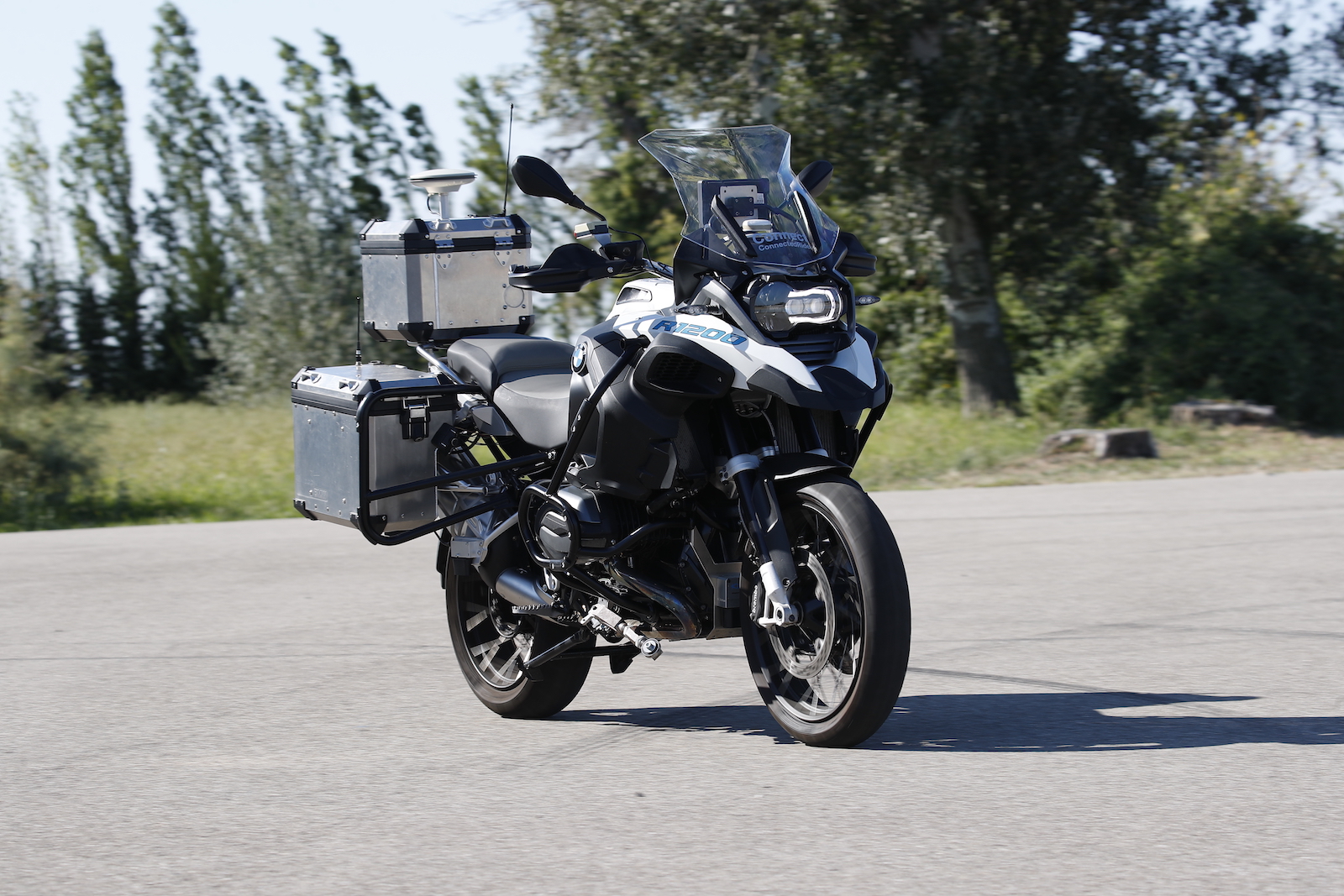
The Bavarian brand has answered one of the big questions of future autonomous mobility by making the BMW R 1200 GS ride without a rider.
Autonomous mobility appears, a priori, to have motorcycles as one of its main obstacles to full implementation. This claim has been repeated ad nauseam in many discussion forums and, until now, the industry had no answer to it. But now, BMW Motorrad, the motorcycle division of the German manufacturer BMW, has given its response, presenting to the media at the recent BMW Motorrad Techday a BMW R 1200 GS that, as if by magic, rode without a rider around the test track of BME Group in Miramas (southern France).
Developed by the technical team led by Stefan Hans at BMW Motorrad, the test unit built from a BMW 1200 GS is capable of riding completely independently, accelerating, and going around a winding track without a rider on board and slowing down until it stops completely without falling over.
The experimental prototype is a rolling test bench for many of the technologies that BMW Motorrad could install on its future motorcycle models, although the brand itself points out that this is only a vision of the future. “BMW Motorrad, as a driver of technical innovation in motorcycling, by no means aims for a fully autonomous motorcycle. On the contrary, the underlying technology should serve as a platform for developing future systems and functions that make motorcycling safer, more comfortable and more enjoyable.”
The goal of the prototype shown to the media is, from the outset, “to gather additional knowledge about riding dynamics in order to detect dangerous situations and support the rider with appropriate safety systems in difficult moments, such as when turning at intersections or braking hard,” say the managers at BMW Motorrad.
In developing the R 1200 GS that BMW Motorrad uses in its experiments, innovative components have been used for the chassis construction. A new frame, a new swingarm and larger-diameter wheels have been introduced, all of them built with advanced methods and materials (carbon fibre among them, drawing on the extensive experience with it of the cars division of the BMW Group).
During the technical session with the media, BMW Motorrad also showed the progress it is making in lighting, with new headlights equipped with laser lighting technologies or that improve visibility in corners, and a new motorcycle frame produced entirely using 3D printing technologies, which allow complete freedom in designing new shapes and components that until now could not be produced any other way.
https://youtu.be/emFX6tgyvtg
In addition, BMW Motorrad also showed part of the progress achieved in vehicle-to-vehicle communication (V2V), which improves the safety and comfort of riders by connecting their vehicle with all those that travel around it through digital networks.


 Peugeot E-208 GTi: a battery-powered toy that revives the spirit of the 1980s sports cars
 New Lexus ES: luxury grows and goes electric
 First contact with the Dacia Sandero Hybrid 155: power and efficiency from €19,890
Deja un comentario