At the wheel of the Denza Z9GT, the most innovative and technologically advanced model of the moment
 Rafa Guitart @GuitartRafa
15 April 2026
8 min.
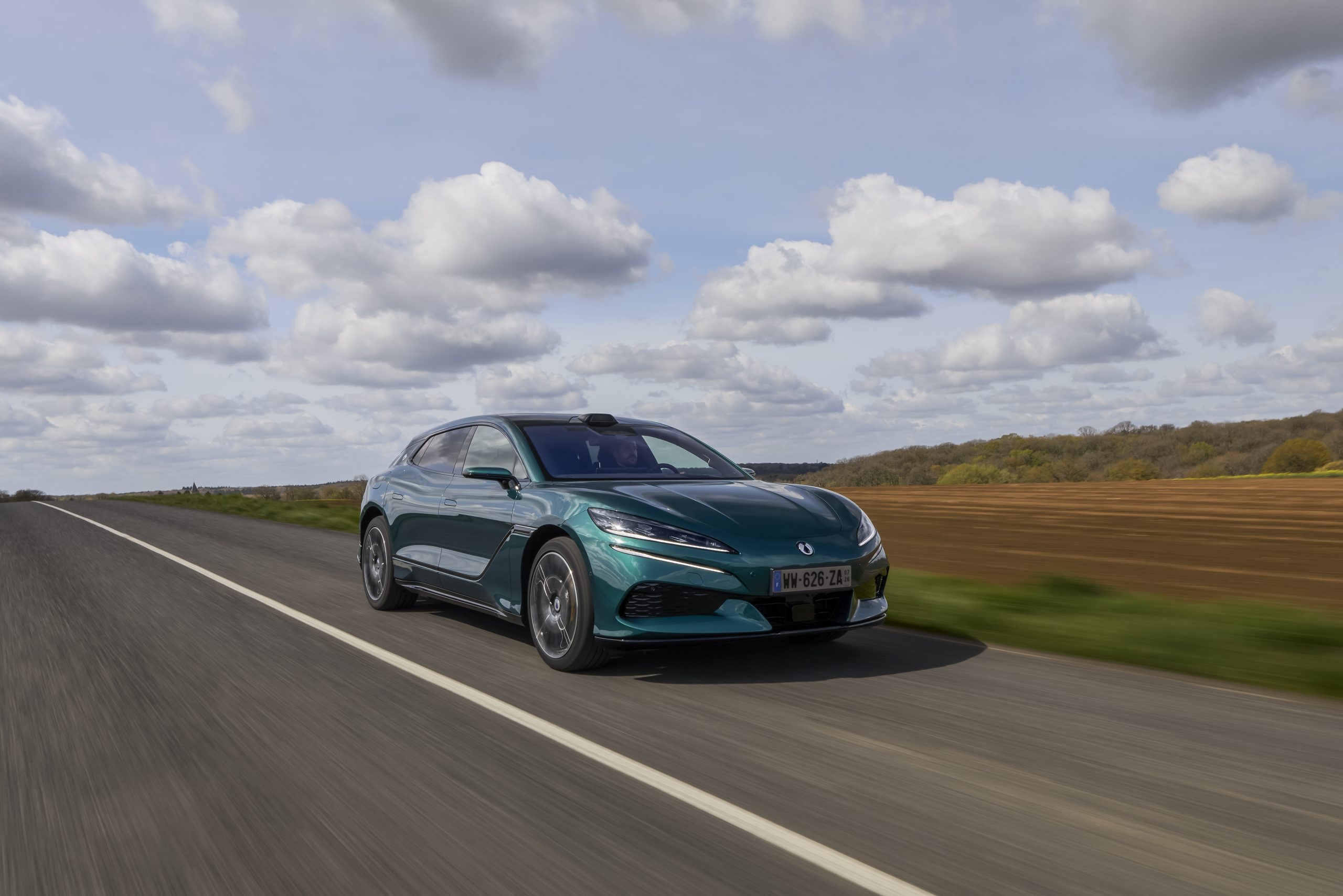
The luxury brand of the Chinese automotive group, BYD, is starting sales of its most powerful, exclusive and refined electrified model, a large-proportioned sports car with 1,156 CV of power, capable of recharging its 122 kWh battery in just 9 minutes.
The new brand, Denza, is starting out in Europe with two highly exclusive electrified models: on the one hand, the D9 DM-i, a huge PHEV MPV, and the Z9GT supercar, available with plug-in hybrid or fully electric variants, starting at 101,000 euros for the hybrid version and 115,000 for the pure electric one.
The Z9GT, which will be the first model Denza sells in Spain, is a 5.20-metre-long Gran Turismo, with very sleek lines and a luxurious interior, designed both for the enjoyment of driving and for the pleasure of travelling in any of its seats. It offers a boot capacity of 495 litres plus 53 additional litres in the frunk or front trunk, enough to hold the charging cables and a few extra items.
Untamed power
It delivers 1,156 CV of power, yes, you read that right, and 1,210 Nm of torque… thanks to the combination of a front motor and two rear motors, paired with a 122.5 kWh battery. The enormous amount of power and torque translates into stratospheric performance, with acceleration from 0 to 100 km/h in 2.7 seconds and a top speed electronically limited to 270 km/h.
It features a Blade Battery capable of delivering 600 km of range on the WLTP cycle, which represents an average consumption of 20.4 kWh per 100 kilometres. That is a good figure for a model weighing three tonnes, but what really stands out is the charging capacity promised by its Flash Charging technology, with peaks of up to 1,500 kW at DC superchargers, allowing it to go from 10% to 70% in just 5 minutes, and 9 minutes to reach from 10% to 97% (leaving a 3% safety margin so that regenerative braking is available after charging, as the model comes as standard with ceramic disc brakes). And this feat, which is not easy to reproduce as brands usually claim, we saw live in a real charge at the Mortefontaine circuit, near Paris.
The secret? It is simpler than it seems: it involves reinforcing the charge at fast-charging stations with two 490 kW battery modules, combined with an inverter and a charger with a recommended power of at least 200 kW, in order to deliver such an amount of energy to a single car (if two cars are connected at the same time, neither would receive more than 1,000 kW each). It is important that the power supply be high-capacity so that it can feed both the charger and the battery modules, since otherwise the battery would run out of energy for the next charges.
The brand announces the installation of 300 charging stations in Spain during this same year and some 3,000 across Europe, which will be open to supply electricity to other car models, although Denza plans to give its customers the energy for free during the first 18 months from the purchase of the model.
In the case of the hybrid version, with 775 CV of power and a 63.8 kWh battery, which promises a WLTP electric range of 203 kilometres, the charging capacity drops to “only” 550 kW, which would allow a recharge from 10 to 70% of total capacity in 5 minutes.
These charging capacities are already fully comparable to refuelling a traditional car in terms of time, although it will be necessary for charging locations to match users’ needs in terms of timing and convenience.
Eye-catching design
With a length of 5.18 metres and a Gran Turismo shooting brake silhouette, the Z9GT does not go unnoticed. It features a powerful, sporty front end with active air intakes that improve aerodynamic efficiency. Its width reaches almost two metres (1.99 m), while its height is just 1.49 m, creating very sleek proportions.
Inside, all surfaces are covered in striking finishes, such as leather and wood. The front seats offer 8-way electric adjustment, a massage function and ventilation/heating, along with active side bolsters on the driver’s seat.
It features a 17.3-inch central screen complemented by an additional 13.2-inch display, and a 50-inch augmented reality head-up display. With the DiLink system, it offers Google integration for connected navigation and voice assistant. It also stands out for high-fidelity sound, with a Devialet system featuring 20 speakers and 1,150 W.
The e3 Platform, high-level technology
In addition to Flash Charging technology, it incorporates several pioneering features, including a independent traction system with three electric motors, dual rear-wheel steering with a dual motor on the rear axle, the Vehicle Motion Control system, Cell to Body technology and the DiSus-A dual-chamber air suspension system.
The electric version of the Z9GT promises acceleration from 0 to 100 km/h in 2.7 seconds and a top speed of 270 km/h. Its front motor delivers 313 CV (230 kW), and each of the rear motors 422 CV (310 kW), for a total output of 1,156 CV.
Meanwhile, the Z9GT electric’s Blade Battery has a capacity of 122.49 kWh, enough to promise a combined range of over 600 km on the WLTP cycle. A rear-wheel-drive version, equipped with the same battery and offering a combined range of up to 800 km, is planned for late 2026.
Revolutionary in every way
Not only is the shape striking; the solutions developed for this model also go beyond the usual norm. It features sub-frames for the suspensions made of aluminium, with a deformable parallelogram at the front and a multi-link system at the rear. The DiSuS-A pneumatic system allows switching between two adjustable firmness levels.
The Vehicle Motion Control system acts as a control centre, allowing it to react to situations such as a tyre blowout at up to 180 km/h, responding in milliseconds to adjust the torque of the unaffected wheels and the dynamic distribution of power. This improves vehicle stability, while the assistance systems also intervene to identify the lane and reduce deviation from the vehicle’s trajectory.
The motors installed on the rear wheels are monitored by the VMC system to allow the rear right and left wheels to rotate independently of the front axle and of each other. This system provides greater manoeuvrability and better cornering stability when changing lanes and braking.
It is capable of truly eye-catching manoeuvres, such as turning in the same direction, with the rear wheels turning together in the same sense. When the steering reaches its limit, the rear wheels can move together, but in the opposite direction to the front wheels, creating a reverse angle that considerably reduces the turning radius. When necessary, the rear wheels can rotate to match the angle of the front wheels, enabling a diagonal driving function or “crab” movement.
The convergent rotation mode turns the rear wheels towards the centre of the vehicle to improve stability, especially when braking, activating this type of movement to resist lateral forces, while the divergent rotation mode turns the rear wheels away from the centre of the vehicle, allowing the car to pivot around the front axle. In this way, a turning radius of just 5.35 metres is achieved.
The vehicle is also capable of identifying a parking space and reversing into it automatically, either from the dashboard or through a smartphone app.
First-class behaviour
With more than 1,150 CV of power, smoothness seems hard to imagine. Yet nothing could be further from the truth. Everything depends on the force applied to the accelerator pedal: the Z9GT can deliver silky-smooth power if you use the throttle gently, or it can act like the devil if you are determined to do so.
In any case, you always feel in control of the situation, as the dynamic characteristics and driving aids are present at all times.
The chassis also contributes to first-rate handling, with very precise steering, effective suspensions that can be adjusted to provide extraordinary comfort or surprising grip, and ceramic brakes capable of stopping the car with astonishing ease.
But we have seen all these features before in high-performance sports models… What we had never seen in a car is the ability to move diagonally, to park with a compass-like movement, to brake creating a “wedge” effect, or to turn within such a small space in a car more than five metres long.
Image gallery
 Peugeot E-208 GTi: a battery-powered toy that revives the spirit of the 1980s sports cars
 New Lexus ES: luxury grows and goes electric
 First contact with the Dacia Sandero Hybrid 155: power and efficiency from €19,890
Deja un comentario