Audi Q7 4.2 V8 TDI 340 CV, road test (Engine and performance)
 Diego G. Moreira
30 August 2012
5 min.
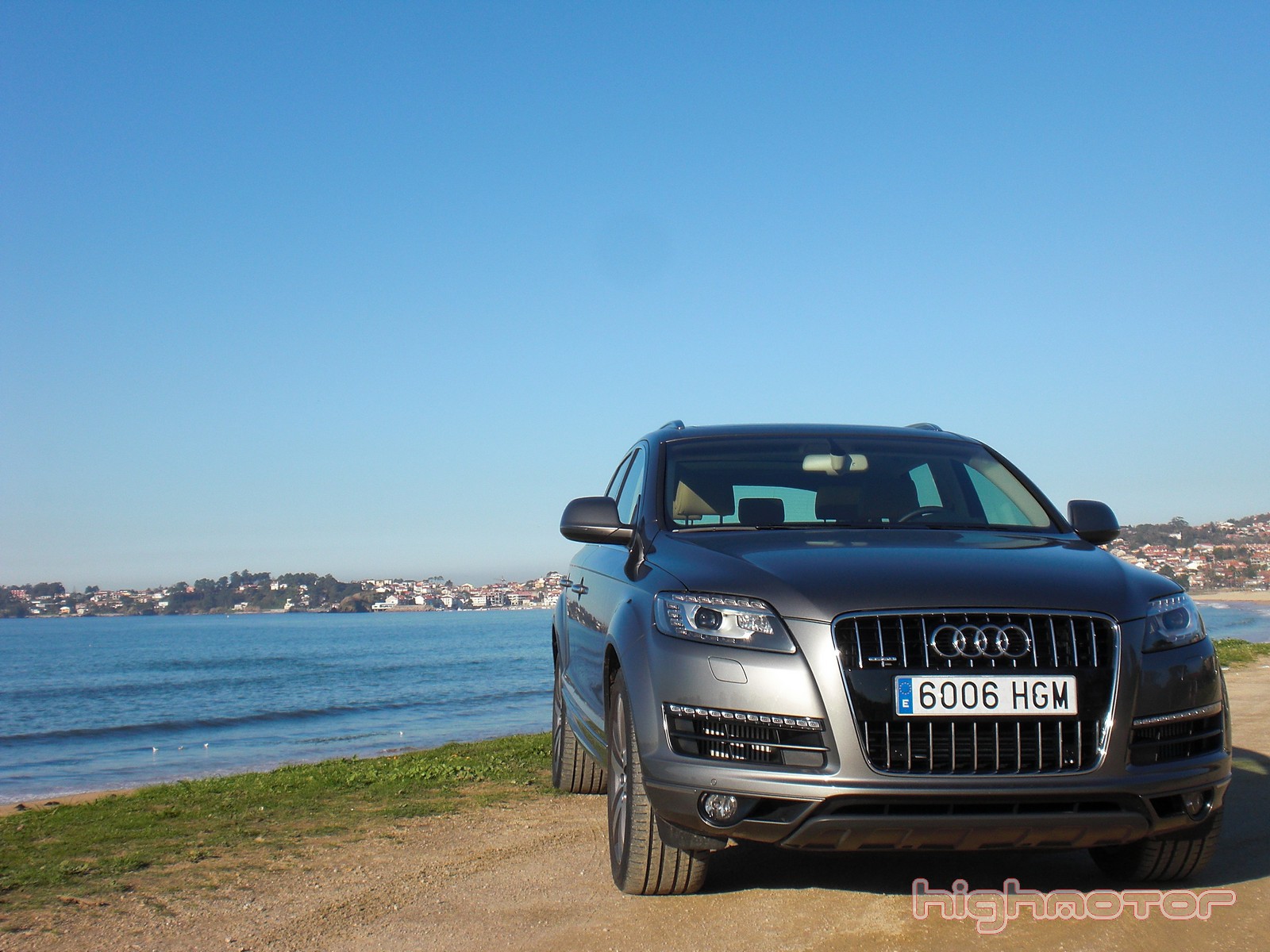
Behind the wheel of the Audi Q7 4.2 V8 TDI with 340 CV. In this section: engine, performance, handling and fuel consumption.
As we previewed in the teaser for the test, we get behind the wheel of something big. Whether because of its bodywork, since the Audi Q7 with seven seats can’t be considered a city car at 5 metres long, or because of its engine, the powerful 4.2-litre V8 TDI under the bonnet, capable of reaching 340 CV.
But it’s big in equipment too, since our test unit came almost fully loaded with extras, most notably the Bang & Olufsen sound system (7,735 euros). It’s also big in its final price, which came to around 118,000 euros (the price of a house in a car). Without further ado, let’s start with the mechanical and performance side of the Audi Q7.
Engine and performance
In the Q7 range you can choose from engines producing 204 CV up to 340 CV, curiously, the diesel engines open the range with the 204 CV TDI and close it with the 340 CV 4.2 V8 TDI. In between are the petrol engines of 272 CV and 333 CV, both 3.0 V6 TFSI. Every Audi Q7 comes with Quattro four-wheel drive as standard.
On diesel it starts with the 204 CV 3.0-litre V6 TDI, followed by a 245 CV variant, and finally the 340 CV 4.2-litre V8 TDI. The most sensible option for the Audi Q7 is undoubtedly the 245 CV 3.0 TDI, since it’s already a very capable diesel engine.
But although the 4.2 V8 isn’t the sensible choice, it simply captivates. It’s a very smooth engine, extremely smooth, which also makes just the right amount of noise without going to excess, and with good interior insulation. The torque figure gives us an idea of the pushing power of this powerful V8: no less than 800 Nm of torque.
Although the dimensions and weight of the Audi Q7 are noticeable, when we press the accelerator it pins us to the seat with great ease. At that moment, when we press the accelerator demanding more power, the engine’s smooth sound turns a little wilder and makes it clear we’re not dealing with a four-cylinder, far from it.
The engine’s response is available from 2,000 rpm almost up to the red zone (just over 4,000 rpm). That said, when we press the accelerator the response isn’t immediate, largely due to the eight-speed Tiptronic gearbox, which isn’t as quick as a dual-clutch transmission.
The gearbox normally keeps the car at 1,200 rpm unless we select Sport mode, which tries to keep it above 2,500 rpm so that the response when pressing the accelerator is more immediate.
Handling
Before going into detail on the equipment, it’s worth noting that our test unit had air suspension with adaptive damping, which is excellent for comfort and offers several selectable modes depending on how we’re driving.
In total there are five modes: Auto, Dynamic, Comfort, Lift and Off-Road (the last modes are for off-road routes, where it raises the suspension height). In Dynamic mode it firms up to make it more dynamic on bends or in sporty driving.
Without doubt, the most outstanding quality is comfort. Thanks to the suspension, any irregularity in the tarmac disappears, and on country roads or motorways the level of comfort is sublime.
On more winding roads with the suspension in Dynamic mode, the Q7 hides its size and weight and behaves more like a saloon than a five-metre-long SUV. That said, the handling of other models such as the BMW X5 is far more sporty and agile in this territory.
The route chosen to test the Q7’s dynamics was really demanding: a mountain road between Puebla de Sanabria and Bragança in Portugal. The road is narrow, full of very tight bends and devoid of straights. We were surprised that it kept the type without any problem.
The steering doesn’t change at any point; whichever mode we choose only affects the suspension, but even so the feel seemed correct. On the other hand, the braking system does its job without any great pretensions, but for such a powerful version it should have a set-up that “bites” harder under braking. That said, performance was correct and they always managed to stop the Q7 without problems.
Fuel consumption
In this section, the 340 CV, the weight and its dimensions take their toll. Even so, it remains within reasonable figures when we consider all of the above. On country roads, the lowest consumption we managed was around 8.5 litres per 100 km. On the motorway the figure rose to almost 10 litres per 100 km.
Town driving is the worst environment for a Q7, both because of its dimensions and its consumption, since our protagonist in town literally “drank” diesel, with consumption of around 15 to 18 litres per 100 km.
The country road and motorway figures don’t seem excessively high to me for an SUV that weighs over two tonnes and has a 340 CV V8.
Off-Road mode
Although it’s a model with Quattro four-wheel drive, its off-tarmac capabilities are more those of an SUV. The traction system is excellent, as we were able to confirm on several occasions, and the ground clearance, thanks to the air suspension, is quite generous.
But unlike a Land Rover Range Rover or an Mercedes ML, it doesn’t have specific off-road traction programmes, and as standard it comes with tyres that hate the countryside. Compared with other luxury SUVs, it sits somewhere between an BMW X5 and an Mercedes ML. But the car’s strong point is not its off-road ability.
In the next part of the test we’ll focus on exterior design, interior spaciousness and finish, as well as the boot.
Photos | Test team, Diego G. Moreira, and thanks to collaborators in the exterior photos taken in Portugal.


 Peugeot E-208 GTi: a battery-powered toy that revives the spirit of the 1980s sports cars
 New Lexus ES: luxury grows and goes electric
 First contact with the Dacia Sandero Hybrid 155: power and efficiency from €19,890
Deja un comentario