BMW iX Model X Tesla Análisis Electric Cars ECO SUV
BMW ix M60 vs Tesla Model X Plaid: a battle of giants with a winner you didn't expect
 Antonio Roncero @roncero_antonio
7 January 2022
7 min.
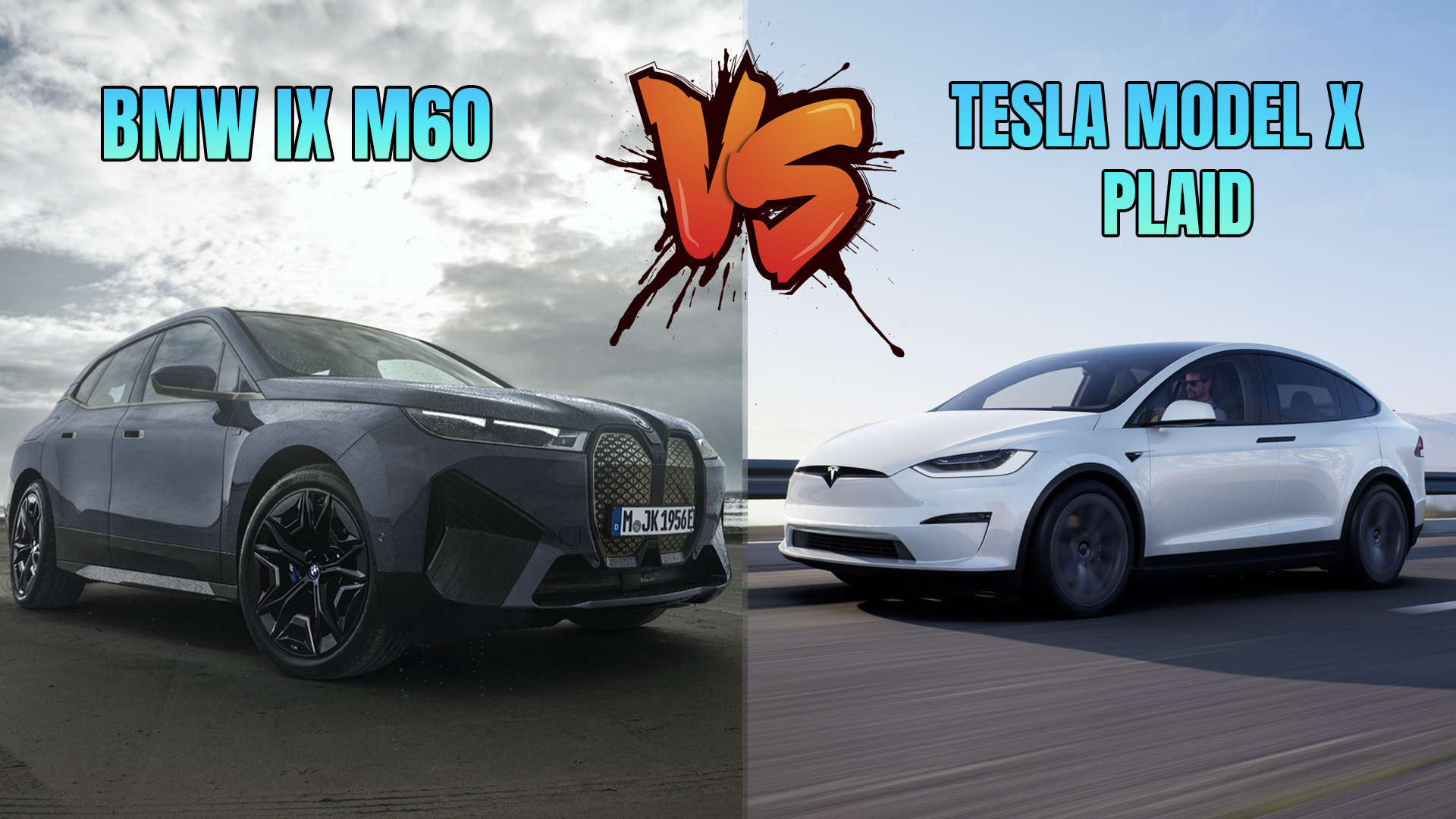
BMW challenges Tesla with the new BMW ix M60, although, at least on paper, the German electric SUV doesn’t come off well against the Model X Plaid in a direct comparison.
BMW has deployed its full arsenal with its new electric SUV, the BMW iX, even launching a very special version: the BMW ix M60, which will reach the market in summer and already has a price. And yes, on paper, the figures for this electric SUV built by the specialists at BMW Motorsport are truly surprising. Or perhaps not so much when we compare them with the Tesla Model X Plaid?
Let’s make it clear from the outset that this is nothing more than a comparison of the technical specifications and performance figures offered by BMW and Tesla, two of the fastest and most powerful electric SUVs on the market today, even though they are very different cars. Or perhaps not so much?
1.- Aerodynamic coefficient and weight: Tesla wins
To begin with, the two cars are very close in dimensions, although their body designs look very different. The BMW stands out above all for its controversial front grille, while the Tesla has its gull-wing doors as one of its distinctive features. Both are about 5 meters long.
But there are two data points in the technical specifications that are directly comparable, and in which the Model X comes out ahead. The first is the declared total weight. At 2,455 kg, the Tesla Model X Plaid falls below 2.5 tonnes, while the BMW iX M60 exceeds that comfortably, reaching almost 2,670 kg.
The surprise comes when comparing the aerodynamic coefficient. At least, a relative surprise. Because its sharp silhouette alone would make us bet on the Tesla, which claims a Cd of 0.25. However, with a Cd of 0.26, the iX M60 does not fall far behind. In fact, the other versions of the BMW iX also reach a Cd of 0.25, outperforming models such as the Audi e-tron.
By the way, for the most dedicated fans of the numbers: the standard wheels on the BMW are 21 inches, compared with the 20 inches fitted to the Model X. Both can be optionally fitted with 22-inch wheels.
2.- Cabin and boot capacity: Tesla wins
Another hallmark of the Tesla is the option of an interior configuration for the Model X with two rear rows of seats, each with two seats (the price is around 7,000 euros), which allows it to seat six passengers.
But if we compare the five-seat versions, the Tesla claims a boot volume double that of the BMW, with almost 1,000 litres expandable to 2,100 litres if the second row is folded down. The figures for the ix M60 are 500 litres with both rows of seats in place, and 1,750 litres with the rear seats folded.
Once again, when discussing the cabin, another curious detail emerges when comparing figures: the Model X’s multimedia screen is still on another level, with its 17-inch diagonal, versus the 14.9 inches of the BMW.
3.- Maximum power: Tesla wins
The 619 hp offered by the iX M60 is enough to take your breath away, even surpassing the 600 hp of the V8 in the BMW M5. Watch out for the Tesla, which already shook things up when it announced its new Model S and Model X Plaid. Specifically, the Model X Plaid goes up to… 1,020 hp!
It is true that in both cases, compared with combustion-engined cars, this maximum power is only available in the most sporty driving modes and for a short period of time, the so-called “boost” mode. For example, in the BMW, the 540 hp produced by the iX M60 rises to 619 hp only in Sport mode and for around 10 seconds. In this case the maximum torque also increases, reaching 1,100 Nm.
Tesla does not officially disclose the maximum torque of the Model X Plaid, which, unlike the iX M60, uses three motors instead of two, with one on the front axle and two on the rear. It is the same powertrain as the Model S Plaid, a configuration also used by Audi in its models e-tron S, and which makes the most of the advantages of torque vectoring.
4.- Performance: Tesla wins
Suffice it to say that the Model X Plaid leaves a Porsche Taycan Turbo S in the dust in the 0-100 km/h sprint, beating it by two tenths of a second with an incredible time of 2.6 s, so there’s not much more to add. Well, yes; in reality, the Model X’s acceleration figure carries an “asterisk” on the specification sheet that reads: “pending homologation”.
But there is the figure: 1.2 seconds faster than the BMW iX M60, which clocks 3.8 seconds. And from here on, shaving off each tenth is not just a matter of power; you have to manage very well how that power reaches the tarmac.
As for top speed, it is a mere formality. BMW electronically limits the iX M60 to 250 km/h, and Tesla sets its limit at 262 km/h. On the Model S Plaid, the saloon that shares its powertrain with the SUV, Tesla doesn’t hold back in the slightest, claiming a top speed of 320 km/h and 2.1 seconds from 0 to 100 km/h.
5.- Battery and range: BMW wins
Of the few figures we can compare where the BMW iX M60 beats the Tesla Model X Plaid, the German model’s battery has a usable capacity of 105 kWh, versus the 100 kWh of the Tesla. It’s a small difference that may prove decisive: despite less favourable aerodynamics, it also claims a slightly longer range, 566 km versus the Tesla’s 547 km… which are again pending homologation, so we’ll have to wait and see what the final figure is.
6.- Maximum fast-charging power: Tesla wins
None of its potential future owners should have problems in this respect: both electric SUVs accept high-power direct-current charging, up to 200 kW in the case of the BMW, and up to 250 kW in the Tesla.
In the case of the Model X, for example, using the Supercharger network of Tesla you can recover up to 280 km of range in about 15 minutes. Competition is also present here: the IONITY European fast-charging network, the joint venture to which BMW belongs (alongside other brands such as Ford, Mercedes, the Volkswagen Group, Hyundai and Kia), has already announced investments of 700 million euros to grow from the roughly 1,500 charging points it has today to 7,000 in 2025; for its part, Tesla currently has more than 6,000 ultra-fast charging points in Europe.
7.- Price: Tesla wins
Talking about price without matching equipment is not entirely fair. But at present it is impossible to configure the two models for that comparison, so the only available figure is the recommended retail price. And as standard, the Model X Plaid is almost 12,000 euros cheaper than the ix M60.
BMW ix M60 vs Tesla Model X Plaid: summary of figures and conclusion
While we wait to drive them and draw conclusions based on feel, not just figures, everything seems to point to the Model X having the upper hand when comparing their specification sheets. However, I’ll also tell you this: from what I know so far of the BMW and the Tesla I’ve been able to try, if I had to order one of the two models right now, before driving them… I would go for the BMW.
| BMW ix M60 | Tesla Model X Plaid | |
| Aerodynamic coefficient | 0.26 | 0.25 |
| Total weight | 2,569 kg | 2,455 kg |
| Maximum power | 619 hp | 1,020 hp |
| 0-100 km/h acceleration | 3.8 s | 2.6 s |
| Top speed | 250 km/h | 262 km/h |
| Battery | 105 kWh | 100 kWh |
| Range | 566 km | 547 km |
| Maximum charging power | 200 kW | 250 kW |
| Price | 131,700 euros | 120,000 euros |
Technical specifications of this car


 Kia offers an electric range of 10 models, 50 versions and 400 possible combinations
 The seven finalists for the 2027 European Car of the Year (COTY) are exclusively electric
 Peugeot E-208 GTi: a battery-powered toy that revives the spirit of the 1980s sports cars
Deja un comentario